Top 10 Cybersecurity Frameworks: A Complete Guide
Explore the top 10 cybersecurity frameworks, including NIST, ISO 27001, CIS Controls, and MITRE ATT&CK. Learn their types, benefits, and uses.
 Nashid Hussain CN
Cybersecurity is essential for businesses that use digital systems to store information, communicate with customers, and manage daily operations. Organizations face risks such as data breaches, ransomware, phishing, and unauthorized access. Without a clear security strategy, even a small vulnerability can lead to financial losses and damage customer trust.
This is why cybersecurity frameworks are important for businesses of all sizes. They provide structured guidance to identify risks, protect sensitive data, respond to security incidents, and improve security practices. According to IBM's Cost of a Data Breach Report 2026, the global average cost of a data breach reached $4.99 million, highlighting the financial impact of cyber security risks.
Here, we will discuss the top 10 cybersecurity frameworks, their purposes, key benefits, and how businesses can choose the right framework for their security needs.
What Are Cybersecurity Frameworks
What Are Cybersecurity Frameworks? Cybersecurity frameworks are structured sets of guidelines, policies, processes, and recommended security controls that help organizations manage cyber risks. They provide a systematic approach to protecting networks, applications, devices, and sensitive data from cyber threats.
Rather than treating every security issue separately, a framework helps an organization create a consistent security plan. It can guide teams in identifying valuable assets, assessing weaknesses, implementing protection measures, monitoring suspicious activities, and recovering from incidents.
For example, an e-commerce company may use a framework to protect customer information, secure online payments, manage employee access, and prepare for ransomware attacks. A healthcare organization may focus more on patient data protection and compliance requirements.
Different frameworks serve different purposes. Some focus on risk management, while others emphasize security controls, governance, compliance, or incident analysis. Selecting the right framework depends on the organization's industry, size, risks, and business requirements.
Refer to these articles:
- Cyber Security Risks in 5G-Connected Enterprise Networks
- How Organizations Can Implement Security Controls for Generative AI Systems
- What Is OWASP Top 10 in Cyber Security and How Does It Work
Importance of Cybersecurity Frameworks for Businesses
Businesses face increasing challenges as they adopt cloud services, digital payments, remote working, and connected applications. Frameworks in cyber security help organizations address these challenges through organized and repeatable security practices.
Here are the main reasons they matter.
- Better risk management: Frameworks help organizations identify critical assets, evaluate threats, and prioritize weaknesses that could cause serious damage.
- Improved data protection: They provide guidance on access control, encryption, monitoring, and secure data handling to protect confidential information.
- Regulatory and contractual support: Certain standards and frameworks help businesses address applicable legal, industry, and customer requirements. However, using a framework does not automatically guarantee compliance.
- Clear security responsibilities: A structured approach helps management, IT teams, employees, and security professionals understand their roles in protecting business systems.
- Stronger incident response: Organizations can establish procedures for detecting attacks, reporting incidents, containing threats, and restoring operations.
The financial impact of cyber incidents makes these measures particularly important. IBM's 2026 India breach report reported that the average cost of a data breach in India reached INR 25.5 crore in 2026, a 15.9% increase from 2025.
This figure does not mean that adopting a particular framework will prevent every breach. Instead, it demonstrates why organizations need a planned approach to reducing risk and managing security incidents.
Top 10 Cybersecurity Frameworks You Should Know
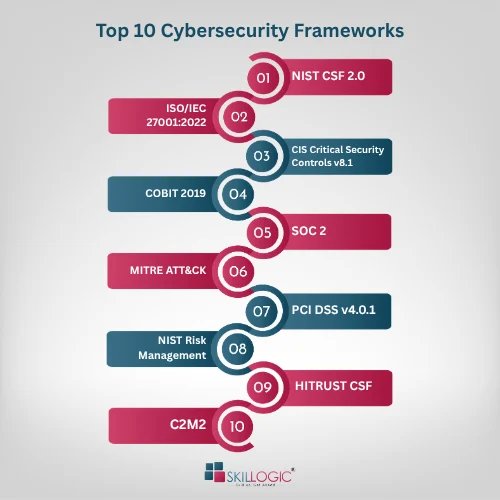
The following ten cybersecurity frameworks and standards include NIST CSF 2.0, ISO/IEC 27001, CIS Controls, COBIT, SOC 2, MITRE ATT&CK, PCI DSS, NIST RMF, HITRUST CSF, and C2M2. Each serves a different purpose, from managing cyber risks and protecting sensitive data to improving security controls and assessing cybersecurity maturity.
Top 10 Cybersecurity Frameworks
1. NIST Cybersecurity Framework (CSF)
The US National Institute of Standards and Technology develops the NIST Cybersecurity Framework. It helps organizations understand, assess, prioritize, and communicate cybersecurity risks.
NIST CSF 2.0 organizes its guidance into six core functions:
- Govern: Establish security strategy, responsibilities, and oversight.
- Identify: Understand assets, business needs, and cyber risks.
- Protect: Apply safeguards such as access controls and security awareness.
- Detect: Identify suspicious activities and potential incidents.
- Respond: Contain incidents and manage their impact.
- Recover: Restore affected systems and improve resilience.
The framework is suitable for businesses of different sizes and across multiple industries. NIST reported in February 2026 that CSF 2.0 had received more than three million views and downloads, demonstrating its wide reach.
For more details, readers can refer to the official NIST Cybersecurity Framework 2.0 documentation.
2. ISO/IEC 27001
ISO/IEC 27001 is an international standard for establishing, implementing, maintaining, and continually improving an Information Security Management System (ISMS).
It helps organizations manage information security through risk assessment, documented policies, security controls, and continuous improvement. Its approach covers people, processes, and technology rather than focusing only on cyber security technical tools.
Organizations can seek independent certification against ISO/IEC 27001 when they meet the applicable requirements. Certification can help demonstrate that an organization follows a structured information security management process.
It is particularly useful for technology companies, consulting firms, financial services providers, and businesses that handle sensitive customer information.
3. CIS Critical Security Controls
The CIS Critical Security Controls are a prioritized set of cybersecurity safeguards developed by the Center for Internet Security.
These controls focus on practical measures that organizations can implement to reduce common security risks. Examples include maintaining an inventory of hardware and software assets, managing vulnerabilities, securing accounts, protecting data, and monitoring systems.
CIS Controls are helpful for organizations that need clear, actionable steps to improve their security posture. They can also support teams that are beginning to establish formal security practices.
4. COBIT Framework
COBIT is a framework for enterprise IT governance and management developed by ISACA. It helps organizations align technology operations with business objectives, risk management, performance, and accountability.
COBIT is broader than a technical cybersecurity checklist. It helps management establish responsibilities, evaluate technology-related risks, measure performance, and ensure that IT investments support organizational goals.
Businesses can use COBIT alongside other security standards to strengthen governance and oversight.
5. SOC 2
SOC 2 is an assurance and reporting framework developed by the American Institute of Certified Public Accountants (AICPA). It evaluates how service organizations manage controls related to security, availability, processing integrity, confidentiality, and privacy.
SOC 2 is especially relevant to cloud service providers, SaaS businesses, and technology companies that process customer data.
A SOC 2 examination assesses controls against applicable Trust Services Criteria. A SOC 2 report is not the same as a general-purpose cybersecurity certification, and the scope of an assessment depends on the service organization's systems and commitments.
6. MITRE ATT&CK Framework
MITRE ATT&CK Framework is a knowledge base that documents real-world adversary tactics, techniques, and procedures. It helps security teams understand how attackers operate and how their activities may appear in an organization's systems.
Security professionals use ATT&CK to map observed attack behavior, improve threat detection, test defensive capabilities, and identify gaps in security monitoring.
For example, a security operations team may use ATT&CK to investigate suspicious account activity or identify techniques associated with lateral movement.
Unlike a governance standard, MITRE ATT&CK primarily supports threat-informed defense, detection engineering in cyber security, and security testing.
7. PCI DSS
The Payment Card Industry Data Security Standard (PCI DSS) establishes security requirements for organizations that store, process, or transmit payment card account data, depending on their role in the payment ecosystem.
Its requirements cover areas such as network security, access control, vulnerability management, monitoring, and information protection.
PCI DSS is particularly important for payment processors, online retailers, and other organizations handling cardholder data. Following the applicable requirements helps reduce payment-data risks, but it does not eliminate every possible cyber threat.
8. NIST Risk Management Framework (RMF)
The NIST Risk Management Framework provides a structured process for managing information security and privacy risks, particularly for information systems.
Its seven steps are:
- Prepare the organization for risk management.
- Categorize systems and the information they process.
- Select appropriate security and privacy controls.
- Implement the selected controls.
- Assess whether the controls work as intended.
- Authorize the system based on assessed risk.
- Monitor controls and system risks continuously.
NIST RMF is particularly useful for government agencies, contractors, and organizations that need a formal, risk-based system authorization process.
9. HITRUST CSF
The HITRUST Common Security Framework (CSF) provides a structured approach to managing information security and privacy risks. It brings together requirements and control practices from multiple standards, regulations, and authoritative sources.
It is widely associated with healthcare and organizations that handle sensitive health information, although its use is not limited to a single business type.
HITRUST helps organizations align security practices with relevant requirements and can support assessments and certification where applicable.
10. Cybersecurity Capability Maturity Model (C2M2)
The Cyber security Capability Maturity Model (C2M2) helps organizations evaluate and improve the maturity of their cyber security capabilities. Developed by the US Department of Energy, it has particular relevance to the energy sector and critical infrastructure.
C2M2 examines cybersecurity practices across areas such as asset management, threat and vulnerability management, access control, incident response, and situational awareness.
Organizations can use the model to understand their current capabilities, identify improvement areas, and create a roadmap for strengthening security over time.
Explore these articles:
- How to Become a Cyber Security Expert in India
- Cyber Security Scope in India
- Cyber Security in India: What You Need to Know
Key Components of a Cybersecurity Framework
Although individual frameworks differ, many share several important components.
- Risk assessment: Identifies valuable assets, possible threats, existing weaknesses, and the potential impact of security incidents.
- Security policies and governance: Defines security objectives, responsibilities, decision-making processes, and acceptable practices.
- Access control and data protection: Helps ensure that only authorized people can access sensitive information and systems.
- Monitoring and detection: Uses logs, alerts, and security tools to identify unusual activity and potential threats.
- Incident response and recovery: Establishes procedures for investigating incidents, containing damage, restoring services, and learning from failures.
- Continuous improvement: Reviews security performance, updates controls, and adapts practices as business needs and threats change.
These components are especially relevant because cyberattacks often exploit basic security weaknesses. Verizon's 2026 Data Breach Investigations Report found that exploitation of software vulnerabilities accounted for 31% of breaches. This reinforces the value of vulnerability management, timely patching, monitoring, and clear response procedures.
Different Types of Cybersecurity Frameworks
Understanding the types of cybersecurity frameworks makes it easier to identify which approach fits a particular organization.
Types of Cybersecurity Frameworks
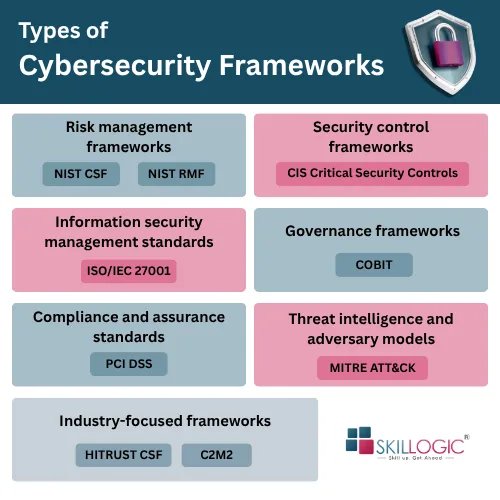
- Risk management frameworks: NIST CSF and NIST RMF help organizations identify, evaluate, prioritize, and monitor cyber risks.
- Security control frameworks: CIS Critical Security Controls provides practical safeguards that organizations can apply to improve their security posture.
- Information security management standards: ISO/IEC 27001 supports a formal management system for protecting information and continually improving security.
- Governance frameworks: COBIT helps align IT governance, risk management, and business objectives.
- Compliance and assurance standards: PCI DSS addresses payment card security requirements, while SOC 2 reports on relevant service-organization controls.
- Threat intelligence and adversary models: MITRE ATT&CK helps security teams understand and detect attacker behavior.
- Industry-focused frameworks: HITRUST CSF and C2M2 support security and capability assessment needs in specific contexts.
These categories can overlap, and organizations often combine multiple approaches instead of relying on a single framework.
How to Choose the Right Cybersecurity Framework: Benefits and Challenges
Choosing the right cybersecurity framework depends on your business risks, security goals, budget, and compliance requirements.
For example, payment companies may prioritize PCI DSS, while organizations seeking formal information security management certification may choose ISO/IEC 27001. Smaller businesses can start with NIST CSF or selected CIS Controls based on their needs.
Read these articles:
- The Future of Cyber Security in Chennai: Trends and Opportunities
- Top Cyber Security Hiring Industries in Chennai
- How to choose best institute for cyber security in coimbatore
- Cyber Security Course Fee in Coimbatore
Benefits and Challenges of Cybersecurity Frameworks
Cybersecurity frameworks help businesses protect sensitive data, manage risks, improve incident response, and build customer trust. However, implementation may require staff training, security tools, documentation, and regular assessments.
The World Economic Forum's Global Cybersecurity Outlook found that 54% of large organizations identified supply chain challenges as a major barrier to cyber resilience. This highlights the importance of assessing third-party risks alongside internal security.
Businesses should regularly review their framework and update security practices as threats and business needs change. The best framework is one that addresses actual risks and can be maintained effectively.
In short, Cybersecurity frameworks help businesses identify risks, protect sensitive information, manage security incidents, and improve their overall security practices. The top 10 frameworks discussed in this guide serve different purposes, from risk management and information security to compliance and threat detection. Organizations should choose frameworks based on their industry, security goals, and available resources.
Learning about these frameworks is also useful for individuals planning a career in cyber security. Enrolling in a best institute for cyber security courses in Chennai can help learners understand cyber security fundamentals, security controls, risk management, and commonly used frameworks. With the right knowledge and practical skills, learners can build a strong foundation for a cyber security career.
SKILLOGIC offers the Cyber Security Professional Plus Course for learners who want to develop practical cyber security skills and understand industry-relevant security frameworks. The course covers ethical hacking, vulnerability assessment, security operations, and incident response, along with hands-on labs and real-time projects. Learners can benefit from NASSCOM FutureSkills and IIFIS certifications, a SKILLOGIC course completion certificate, internship opportunities, and placement assistance.
SKILLOGIC provides cyber security training through centres in major Indian cities, including Bangalore, Chennai, Hyderabad, Pune, Mumbai, Ahmedabad, Delhi, Coimbatore, and Nagpur, along with online learning options. Learners looking for a SKILLOGIC cyber security institute in Coimbatore can explore the available training options to develop practical cyber security skills and build their career.