Qualifications for a Cyber Security Career: Skills, Degrees, and Certifications
Discover the qualifications for a cyber security career, including essential skills, educational degrees, and certifications needed to build a successful career in cyber security.
 Nashid Hussain CN
Cyber security is becoming important as businesses and people increasingly depend on digital technologies. From online banking to cloud platforms and AI tools, protecting information is essential. As cyber threats grow, organizations need skilled professionals to identify risks and secure digital systems.
If you want to build a career in this field, understanding the qualifications for cyber security is a good first step. A specific degree is not always necessary. Technical knowledge, practical skills, problem-solving abilities, and relevant certifications can help you enter this field. Students, freshers, and working professionals can all explore different career paths.
The demand for skilled professionals is also reflected in industry research. According to the Data Security Council of India (DSCI) and SANS Institute's Indian Cyber Security Skilling Landscape 2025–2026 report, 73% of enterprises and 68% of cyber security service providers reported limited availability of skilled candidates. These findings highlight the importance of developing industry-relevant skills and preparing for real-world security challenges.
Here, let’s explore the educational qualifications, essential skills, certifications, and career requirements needed to build a successful career in cyber security.
What Qualifications Are Required for a Cyber Security Career
The basic requirements for entering cyber security include technical knowledge, education, and practical learning. Candidates can develop these abilities through training, certifications, and independent practice.
Key Qualifications Required for a Cyber Security Career
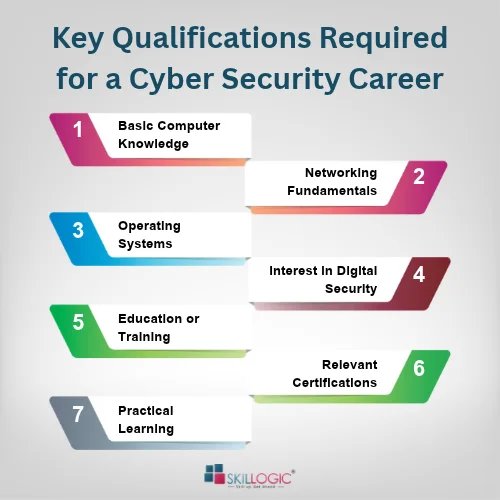
Some key requirements include:
- Basic Computer Knowledge: Understand computer systems and software.
- Networking Fundamentals: Learn IP addresses, DNS, and firewalls.
- Operating Systems: Understand Windows and Linux.
- Interest in Digital Security: Learn how to identify and prevent cyber threats.
- Education or Training: Study IT-related subjects or complete professional training.
- Relevant Certifications: Earn certifications to validate your skills.
- Practical Learning: Gain experience through labs and projects.
The qualifications for cyber security vary by role. SOC analysts need security monitoring tools and skills, while penetration testers require ethical hacking knowledge. Both IT and non-IT candidates can enter this field with the right skills and practical experience.
Explore these articles:
- Why Linux Skills are Important for Cyber Security Professionals
- Suspicious Activity Detection: Techniques to Identify Cyber Threats
- What Are the Different Types of Cyber Security and Their Uses
Educational Qualifications for Cyber Security
Education helps candidates understand how computers, networks, applications, and information systems work. Several undergraduate and postgraduate courses can support a career in this industry.
Bachelor's Degrees in Computer Science and IT
A bachelor's degree is a useful starting point for students interested in cyber security. Some relevant options include:
- BSc Computer Science: Introduces programming, computer systems, databases, and operating system concepts.
- BCA (Bachelor of Computer Applications): Covers application development, programming, networking, and database management.
- BTech or BE in Computer Science and IT: Provides technical knowledge of computer architecture, networks, software development, and information technology.
- Other relevant technical degrees: Electronics, information systems, and related engineering programmes can also provide useful foundations.
These courses help students understand the technical concepts used in cyber security job roles. They can further strengthen their knowledge through specialised security training and practical projects.
Postgraduate Degrees
Students who want to develop advanced knowledge can consider postgraduate programmes such as:
- MSc Cyber Security
- MCA (Master of Computer Applications)
- MTech in Cyber Security
- MTech in Information Technology
These programmes may cover advanced network security, digital forensics, cryptography, security management, and research-based cyber security topics. A postgraduate qualification can be useful for specialised technical or academic career paths, although it is not mandatory for every job.
Can Non-IT Students Build a Career in Cyber Security?
Yes. Students from commerce, arts, management, and other educational backgrounds can also enter cyber security. However, they should be prepared to learn technical subjects before moving into specialised roles.
Beginners should start with computer fundamentals, networking, Windows, Linux, and basic security concepts. Professional training programmes can help them understand these topics through structured lessons, practical exercises, and guided projects.
Therefore, educational background should not be the only factor when considering a cyber security career. Consistent learning and practical knowledge are equally important.
Essential Cyber Security Skills Required
Academic knowledge provides a foundation, but employers also expect candidates to demonstrate technical abilities. Understanding the following areas can help beginners prepare for different security positions.
Networking Fundamentals
Networking is one of the most important foundations of cyber security. Candidates should understand how computers and servers communicate with each other.
Important concepts include TCP/IP, DNS, HTTP, HTTPS, firewalls, IP addressing, and network protocols. This knowledge helps professionals identify suspicious network activities and understand how attackers may exploit network weaknesses.
Operating System Knowledge
Cyber security professionals regularly work with different operating systems. Basic knowledge of Windows and Linux is particularly useful.
Candidates should understand file permissions, user accounts, system processes, command-line operations, and system administration. Linux distributions such as Kali Linux and Parrot OS are also commonly used in ethical hacking and security testing environments.
Programming and Scripting
Programming is not compulsory for every cyber security position, but it can improve efficiency and problem-solving abilities.
Python is useful for automating repetitive tasks, analysing security data, and writing simple scripts. Bash scripting helps with Linux administration, while basic knowledge of JavaScript, SQL, and other programming languages can support application security testing.
Ethical Hacking and Security Fundamentals
Understanding how cyberattacks happen helps professionals identify and prevent security weaknesses. Important areas include:
- Vulnerability Assessment: Identifying weaknesses in systems, applications, and networks.
- Penetration Testing: Testing authorized systems to understand how security weaknesses could be exploited.
- Threat Detection and Prevention: Recognising suspicious activities and applying suitable security controls.
Learning tools such as Nmap, Wireshark, Metasploit, and vulnerability scanners can help candidates gain practical exposure in authorised lab environments.
Analytical and Problem-Solving Skills
Cyber security professionals must analyse information, investigate unusual activities, and make decisions under pressure. They should be able to identify security risks, examine system logs, investigate suspicious behaviour, and support incident response activities.
Communication and teamwork are also important because security professionals often work with IT teams, management, and other departments.
The importance of practical abilities is supported by the DSCI–SANS report. It found that 63% of enterprises and 59% of service providers reported limited hands-on practical skills among job candidates. This highlights why practical labs, technical exercises, and real-world projects should be part of cyber security learning.
Emerging Cyber Security Skills in Demand
Artificial intelligence is changing how organizations manage security risks. The same DSCI–SANS report found that 83% of organizations consider AI and Generative AI security skills a critical requirement, while 78% reported high demand for AI Security Engineers.
Learning about AI security, cloud security, application security, and emerging threats can help professionals prepare for changing industry requirements.
Refer to these articles:
- How to Become a Cyber Security Expert in India
- Cyber Security Scope in India
- Top Cyber Security Skills You Need to Master
Cyber Security Certifications That Can Strengthen Your Career
Apart from internationally recognized certifications, candidates can explore professional training programs to develop practical cyber security knowledge.
These programs are available at different learning levels.
Beginner Level: Entry-level certifications such as CompTIA Security+ and ISC2 Certified in Cyber security (CC) help learners understand basic security concepts, networking, and risk management. Some institutes also offer separate beginner-level courses, such as Cyber Security Associate programs.
Intermediate Level: Certifications such as those offered by IIFIS, along with CompTIA certifications, can help candidates develop skills in ethical hacking, vulnerability assessment, threat detection, and security analysis.
Advanced Level: Certifications such as CISSP and CSPP focus on security management, risk assessment, governance, and advanced security practices. Some institutes also offer separate advanced-level courses, such as Cyber Security Expert programs.
Candidates can also consider specialized training programs Such as the Cyber Security Professional Plus Course (CSPP), which combines Associate and Expert-level learning. Other options include ethical hacking courses and SOC Professional courses. Some programs may also include NASSCOM FutureSkills and IIFIS credentials, along with course completion certificates.
Choosing the right certification or training program based on experience and career goals can help candidates strengthen their technical knowledge and prepare for cyber security roles.
Cyber Security Course Eligibility: Who Can Apply?
The cyber security course eligibility requirements depend on the training provider, course level, and certification programme. However, many beginner-level training programmes are open to students and graduates from different educational backgrounds.
Here are some common entry pathways:
- After 12th grade: Students can begin with computer fundamentals, networking, and introductory cyber security courses. Specific eligibility depends on the institute.
- IT graduates: BCA, BSc IT, BTech, BE, and computer science graduates can build on their existing technical knowledge.
- Non-IT graduates: Commerce, arts, and management graduates can start with basic IT and networking concepts before moving to specialised security topics.
- Working professionals: IT support engineers, network administrators, software developers, and system administrators can develop cyber security skills to explore new career opportunities.
Before enrolling, candidates should check the course syllabus, training requirements, practical lab access, certification options, and learning support. A good training programme should combine theoretical concepts with hands-on exercises and projects.
Cyber Security Job Requirements for Different Career Roles
The cyber security job requirements differ according to responsibilities and specialisation. Some common career options include:
Security Operations Centre (SOC) Analyst
SOC analysts monitor networks, review security alerts, investigate suspicious activities, and support incident response. Networking knowledge, log analysis, SIEM tools, and basic security certifications can help candidates prepare for this role.
Ethical Hacker
Ethical hackers test authorised systems to identify security weaknesses. They need knowledge of networking, Linux, web applications, vulnerability assessment, and penetration testing. CEH can be a relevant certification for this career path.
Cyber Security Analyst
Cyber security analysts identify security risks, monitor systems, review incidents, and recommend protective measures. Knowledge of security tools, operating systems, risk assessment, and threat analysis is useful.
Penetration Tester
Penetration testers perform authorised security assessments on applications, networks, and systems. They require practical knowledge of vulnerability testing, scripting, web security, and ethical hacking tools.
Cyber Security Engineer
Cyber security engineers design, implement, and maintain security solutions. They should understand network architecture, cloud environments, firewalls, identity management, and security monitoring.
How to Prepare for a Career in Cyber Security
Building a career in this field requires continuous learning and practical experience.
Steps to a Successful Cyber Security Career
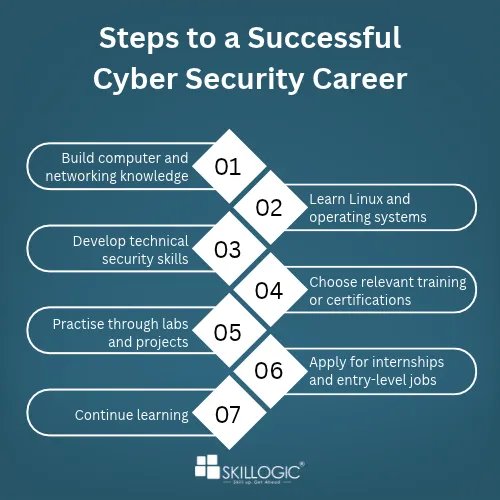
Beginners can follow these steps:
- Build computer and networking knowledge: Understand computer and networking fundamentals, IP addressing, network protocols, and basic troubleshooting.
- Learn Linux and operating systems: Practise using Windows and Linux environments and understand system administration.
- Develop technical security skills: Study ethical hacking, vulnerability assessment, threat detection, and security fundamentals.
- Choose relevant training or certifications: Select a programme based on your current knowledge and preferred career role.
- Practise through labs and projects: Work with authorised lab environments, analyse security logs, and complete practical exercises.
- Apply for internships and entry-level jobs: Look for opportunities such as SOC trainee, junior security analyst, and IT security support roles.
- Continue learning: Follow emerging cyber threats and develop knowledge of cloud security, AI security, and new technologies.
Maintaining a portfolio of practical projects can also help candidates demonstrate their abilities during interviews.
Read these related articles:
- Launching Your Cyber Security Career in Pune
- Cyber Security Course Fees in Pune
- Guide to Becoming a Cyber Security Engineer in Mumbai
- First Cyber Security Interview Tips for Mumbai Candidates
In short, A career in cyber security requires a combination of education, technical knowledge, practical experience, and continuous skill development. A degree in computer science or IT can provide a strong foundation, but candidates from non-IT backgrounds can also explore this field by learning the necessary technical concepts.
Understanding the qualifications for cyber security helps students, freshers, and working professionals choose suitable educational pathways, certifications, and training programmes. Those looking for the best institute for Cyber Security courses in Pune should also consider practical training, hands-on labs, projects, and internship opportunities.
SKILLOGIC’s AI-Powered Cyber Security Professional Plus Course offers a 4-month training programme covering ethical hacking, network security, SOC operations, and other essential cyber security areas. The course includes hands-on labs, real-time projects, and certifications from NASSCOM FutureSkills, IIFIS, and SKILLOGIC, helping learners develop practical industry-relevant skills.
With 13+ years of experience, 1,00,000+ learners trained, 20+ accreditations, and 25+ offline centres across India, SKILLOGIC offers flexible online and classroom learning options. Learners interested in the SKILLOGIC Institute for cyber security training in Mumbai can also explore training opportunities in Bangalore, Chennai, Pune, Ahmedabad, Delhi, Coimbatore, Nagpur, and other cities across India.