What Are the Different Types of Cyber Security and Their Uses
Explore the different types of cyber security, their uses, and how they protect networks, applications, cloud systems, and sensitive data from cyber threats.
 Nashid Hussain CN
The internet has become an important part of our daily lives. People use digital platforms for online shopping, banking, education, communication, and business activities. While technology makes these activities easier, it also creates security risks. Cybercriminals use different methods, such as phishing, malware, ransomware, and data theft, to target individuals and organisations. As a result, protecting digital information and systems has become increasingly important.
Cyber security helps protect computers, networks, applications, and sensitive information from unauthorized access and cyberattacks. Understanding the types of cyber security is important because every digital environment faces different risks. For example, a business needs network and cloud security to protect its infrastructure, while an individual may need mobile and endpoint security to protect personal devices.
Here, we will discuss the different types of cyber security, their uses, and how they help protect digital systems and information.
What Is Cyber Security?
Cyber security refers to the practices, technologies, and processes used to protect computers, networks, applications, devices, and digital information from cyber threats. Its main purpose is to prevent unauthorised access, data theft, system damage, and other malicious activities.
For example, when someone uses a banking application, security technologies help protect login credentials, financial information, and online transactions. Similarly, businesses use firewalls, antivirus software, encryption, and monitoring systems to secure their digital infrastructure.
Cyber security is not limited to installing antivirus software. It includes several security practices that work together to identify threats, prevent attacks, protect information, and respond to security incidents.
Explore these articles:
- What Is OWASP Top 10 in Cyber Security and How Does It Work
- Top 10 Cybersecurity Frameworks: A Complete Guide to Types, Benefits, and Uses.
- Why Linux Skills are Important for Cyber Security Professionals
Different Types of Cyber Security
There are several categories of cyber security, and each focuses on protecting a particular part of a digital environment. Understanding what the types of cyber security are helps individuals and businesses choose suitable protection methods based on their security requirements.
Types of Cyber Security and Their Uses
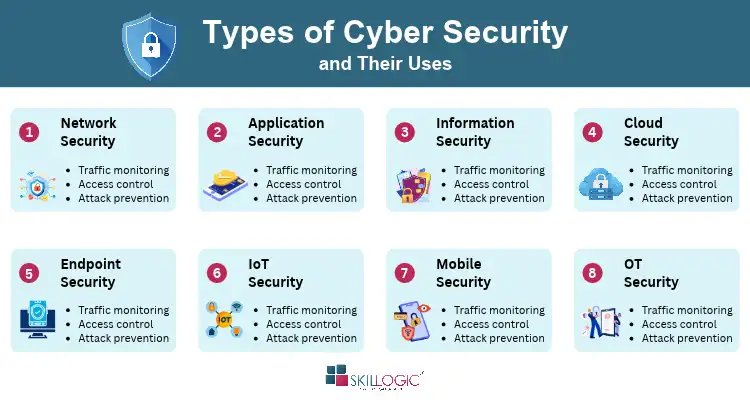
The following are eight important categories and their practical uses.
Network Security
Network security focuses on protecting computer networks and connected systems from unauthorized access, suspicious activities, and cyberattacks. It helps organisations maintain secure communication between computers, servers, and other network devices.
Common network security tools include firewalls, Intrusion Detection Systems (IDS), Intrusion Prevention Systems (IPS), and Virtual Private Networks (VPNs).
Uses of network security:
- Preventing unauthorised access to business networks.
- Monitoring suspicious network traffic.
- Blocking malicious connections and network attacks.
- Protecting information transferred between connected systems.
For example, a company can use a firewall to monitor incoming and outgoing network traffic and block connections that do not meet its security rules.
Application Security
Application security involves protecting websites, software, and mobile applications from vulnerabilities that attackers could exploit. It focuses on identifying security weaknesses during application development, testing, and maintenance.
Common techniques include secure coding, vulnerability assessment, penetration testing, security updates, and Web Application Firewalls (WAFs).
Uses of application security:
- Protecting websites from SQL injection attacks.
- Preventing Cross-Site Scripting (XSS).
- Securing application login and authentication systems.
- Protecting sensitive information stored in applications.
For instance, an e-commerce website uses application security practices to protect customer accounts, payment information, and personal details.
Information Security
Information security focuses on protecting sensitive information from unauthorised access, modification, disclosure, or destruction. It applies to both digital and physical information.
It follows three important principles known as the CIA Triad:
- Confidentiality: Ensures that only authorised people can access information.
- Integrity: Maintains the accuracy and reliability of information.
- Availability: Ensures that information remains accessible when required.
Uses of information security:
- Protecting customer and employee records.
- Preventing confidential data leaks.
- Maintaining the accuracy of business information.
- Securing financial and personal records.
For example, a bank uses encryption and access controls to protect customer account details and financial transactions.
Cloud Security
Cloud security refers to the technologies and practices used to protect cloud-based infrastructure, applications, platforms, and stored data. As businesses increasingly use cloud services for storage and operations, protecting these environments has become essential.
Common cloud security practices include data encryption, identity and access management, multi-factor authentication, security monitoring, and regular configuration checks.
Uses of cloud security:
- Protecting information stored in cloud platforms.
- Preventing unauthorised access to cloud accounts.
- Securing cloud-based business applications.
- Identifying misconfigurations and suspicious activities.
For example, an organisation using cloud storage can implement encryption and access restrictions to prevent unauthorised users from viewing confidential files.
Endpoint Security
Endpoint security protects devices connected to a business network, such as laptops, desktops, smartphones, and servers. These devices can become entry points for malware, ransomware, and other cyber threats.
Common endpoint security solutions include antivirus software, Endpoint Detection and Response (EDR), endpoint protection platforms, and device management tools.
Uses of endpoint security:
- Detecting and blocking malware infections.
- Identifying ransomware activities.
- Monitoring suspicious device behaviour.
- Protecting business devices from unauthorised access.
For example, endpoint detection software can identify suspicious file activity on an employee's laptop and alert the security team before an attack spreads.
Internet of Things (IoT) Security
IoT security focuses on protecting internet-connected devices such as smart cameras, sensors, smart appliances, and industrial monitoring equipment. These devices collect and exchange information, making them potential targets for cybercriminals.
Common security practices include firmware updates, strong authentication, device encryption, and network segmentation.
Uses of IoT security:
- Preventing unauthorised access to connected devices.
- Protecting information collected by smart devices.
- Securing communication between IoT devices.
- Reducing risks associated with vulnerable connected systems.
For example, a smart home security system uses authentication and secure network connections to prevent outsiders from accessing connected cameras.
Mobile Security
Mobile security involves protecting smartphones, tablets, mobile applications, and the information stored on them. Since people use mobile devices for banking, shopping, communication, and business activities, these devices require proper security measures.
Common mobile security practices include biometric authentication, encryption, multi-factor authentication, secure application permissions, and regular software updates.
Uses of mobile security:
- Protecting personal information stored on smartphones.
- Securing mobile banking and payment applications.
- Preventing unauthorised access to mobile devices.
- Reducing risks from malicious mobile applications.
For example, biometric authentication and multi-factor authentication help protect mobile banking accounts from unauthorised access.
Operational Technology (OT) Security
Operational Technology (OT) security focuses on protecting industrial systems, machines, and equipment used in sectors such as manufacturing, energy, transportation, and utilities.
Unlike traditional IT environments, OT systems often control physical processes. A security incident can therefore affect not only information but also industrial operations and safety.
Common OT security practices include network segmentation, continuous monitoring, access restrictions, and regular security assessments.
Uses of OT security:
- Protecting industrial control systems.
- Preventing unauthorised changes to machine operations.
- Securing manufacturing and energy infrastructure.
- Reducing disruptions to critical industrial processes.
For example, a manufacturing plant uses OT security controls to protect automated production equipment from unauthorised access and malicious commands.
Refer to these articles:
- How to Become a Cyber Security Expert in India
- Cyber Security Scope in India
- Cyber Security in India: What You Need to Know
What Are the Uses of Cyber Security?
Cyber security plays an important role in protecting individuals, businesses, and government organisations. Different security methods address different risks, but they work towards the common goal of keeping digital environments safe.
Uses of Cyber Security
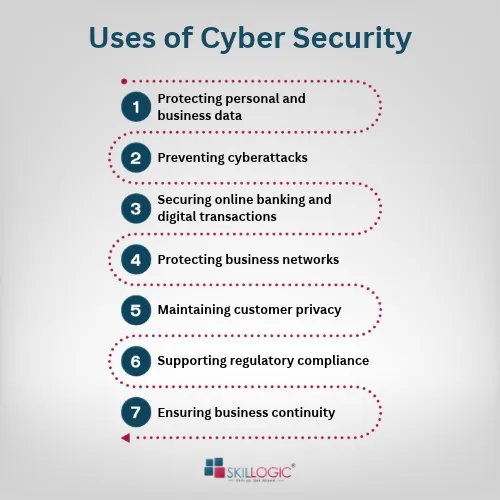
Some important uses of cyber security include:
- Protecting personal and business data: Security measures such as encryption and access controls help prevent confidential information from being exposed or stolen.
- Preventing cyberattacks: Firewalls, antivirus software, and threat detection tools help identify and block malicious activities.
- Securing online banking and digital transactions: Authentication and encryption help protect financial information during online transactions.
- Protecting business networks: Network monitoring and security controls help organisations maintain secure communication and operations.
- Maintaining customer privacy: Data protection practices help businesses handle customer information responsibly.
- Supporting regulatory compliance: Security policies and controls help organisations meet applicable data protection and industry requirements.
- Ensuring business continuity: Backup systems, disaster recovery planning, and incident response help organisations recover from security incidents and reduce downtime.
These applications explain why cyber security is necessary for both personal and professional digital activities.
Why Are Different Types of Cyber Security Important
Different digital environments face different security risks. A firewall may protect a company's network, but it cannot independently address every application vulnerability or protect all information stored in cloud platforms. This is why organisations need multiple layers of security.
The importance of different cyber security categories can be understood through their individual roles. Network security protects communication systems, application security addresses software vulnerabilities, cloud security protects online infrastructure, and endpoint security helps secure connected devices. Together, these measures create a stronger security environment.
The financial impact of cyberattacks also highlights the need for proper protection. According to IBM's 2026 Cost of a Data Breach Report, the average cost of a data breach in India reached approximately ₹25.5 crore, representing a 15.9% increase from 2025. The report also found that an average of 39,500 records were compromised per breach.
Source: IBM's 2026 Cost of a Data Breach Report
This research shows why businesses need effective information security, access controls, encryption, threat monitoring, and incident response strategies. A single security weakness can expose sensitive information and create financial and operational problems.
Therefore, understanding cyber security and its types helps organisations select suitable protection methods, reduce risks, and maintain trust with customers and employees.
Real-World Examples of Cyber Security in Action
Cyber security plays an important role in protecting businesses, financial institutions, and digital platforms from cyber threats. The following examples show how different security methods help prevent attacks and protect sensitive information.
- Firewall and Network Security: Businesses use firewalls and network monitoring tools to detect suspicious traffic and block unauthorised access to internal systems.
- Multi-Factor Authentication (MFA): Online platforms and financial institutions use MFA to add extra account protection, even if a password is stolen.
- Endpoint and Ransomware Protection: Organisations use endpoint detection tools to identify suspicious activity and alert security teams about potential ransomware attacks.
These examples demonstrate how different security methods work together to protect digital systems, prevent unauthorised access, and reduce cyber security risks.
How to Choose the Right Type of Cyber Security?
Choosing suitable security measures depends on the systems, information, and potential threats an individual or organisation needs to address.
Here are some important factors to consider:
- Identify what needs protection: Understand which devices, applications, networks, and information require security.
- Evaluate potential risks: Identify possible threats such as phishing, malware, ransomware, and unauthorised access.
- Understand security requirements: Consider the size of the organisation, its industry, and the sensitivity of its information.
- Select appropriate tools: Choose suitable technologies such as firewalls, antivirus software, encryption, EDR, and access management solutions.
- Conduct regular security assessments: Review systems, identify vulnerabilities, install updates, and test security controls regularly.
- Train employees: Help employees recognise phishing attempts, suspicious links, and other common cyber threats.
A well-planned security strategy should combine preventive measures, continuous monitoring, and incident response rather than depending on a single security solution.
Read these related articles:
- How to Choose the Best Institute for Cyber Security in Bangalore
- How much is the Cyber Security Course Fees in Bangalore
- Your Path to Becoming a Cyber Security Engineer in Hyderabad
- Cyber Security Salary in Hyderabad: Fresher to Experienced
In short, Cyber security plays an important role in protecting digital information, devices, networks, and business operations. The different types of cyber security address specific threats and help individuals and organisations protect sensitive data, maintain privacy, and use technology safely. Understanding their uses and following strong security practices can help reduce cyber risks and build a safer digital environment.
To learn more about the different types of cyber security and their practical applications, consider enrolling in a top institute for cyber security courses in Bangalore or other cities across India. Practical training, hands-on labs, and real-time projects can help you develop the skills needed to understand and apply cyber security techniques.
SKILLOGIC’s AI-Powered Cyber Security Professional Plus Course offers 4 months of practical training in ethical hacking, network security, SOC operations, and other key cyber security areas. The programme includes hands-on labs, real-time projects, and certifications from NASSCOM FutureSkills, IIFIS, and SKILLOGIC.
SKILLOGIC is a leading training institute with 13+ years of experience, 1,00,000+ learners trained, 20+ accreditations, and 25+ offline centres across India. Learners can explore SKILLOGIC Institute for cyber security training in Hyderabad and other cities, including Bangalore, Chennai, Pune, Mumbai, Ahmedabad, Delhi, Coimbatore, and Nagpur, with flexible learning options.