What Is OWASP Top 10 in Cyber Security and How Does It Work?
Learn what OWASP Top 10 means in cyber security, understand real-world examples, and discover ways to improve web application security.
 Nashid Hussain CN

Web applications have become an important part of everyday life. People use websites and online platforms for banking, shopping, education, healthcare, communication, and business operations. While these applications make daily tasks easier, they can also become targets for cybercriminals when security weaknesses are present.
The OWASP Top 10 in cybersecurity helps developers and organizations understand some of the most critical risks affecting web applications. These risks include unauthorized access, insecure configurations, injection attacks, and weaknesses in software components. Understanding these threats helps businesses build safer applications and protect sensitive information.
Application security is becoming more important as cyber security threats continue to evolve. According to the 2026 Web Application Security Report by Cybersecurity Insiders and Fortinet, a survey of 871 cybersecurity and IT professionals found that 53% of organizations had experienced a web application or API-related breach during the previous 12 months. The findings highlight why identifying weaknesses and improving application security should be priorities for businesses.
Here, we will discuss the OWASP Top 10 list, its major vulnerabilities, how it works, and the best practices organizations can follow to improve web application security.
What Is OWASP Top 10 and Why Is It Important?
OWASP stands for the Open Worldwide Application Security Project. It is a nonprofit organization that promotes software security through educational resources, open-source tools, and community research.
The OWASP Top 10 is a guide that highlights major cyber security risks affecting web applications. It helps developers, security testers, IT teams, and organizations understand common weaknesses and take steps to protect applications and sensitive information.
Why Is the OWASP Top 10 Important?
The OWASP Top 10 helps organizations identify security risks and make better decisions about protecting their applications. It also encourages development teams to consider security throughout the software development process rather than addressing it only after a problem occurs.
Here are some key reasons why it matters:
- Identifies common risks: Helps teams understand important web application security weaknesses.
- Improves security testing: Provides a useful reference for developers and security professionals.
- Protects sensitive information: Helps organizations recognize risks that could expose user or business data.
- Supports secure development: Encourages teams to consider security during application design, development, and testing.
What Do Recent Application Security Statistics Tell Us?
The 2026 Web Application Security Report found that only 29% of surveyed professionals were confident in their overall application security, dropping to 15% for AI-integrated applications.
These findings highlight the need for regular security testing and stronger controls, with the OWASP Top 10 providing a useful starting point for identifying and reducing application security risks.
Read Related Articles:
- Cyber Security Across Different Industries: Why Every Sector Needs Protection
- UPI Frauds and Payment Gateway Scams: How to Stay Safe
- Cyber Security Risks in 5G-Connected Enterprise Networks
- How Organizations Can Implement Security Controls for Generative AI Systems
How Does the OWASP Top 10 Work?
The OWASP Top 10 works as a practical reference throughout the software development lifecycle. It does not automatically scan an application or fix security problems. Instead, it helps development and security teams understand what to look for when designing, building, testing, and maintaining software.
How Does the OWASP Top 10 Work
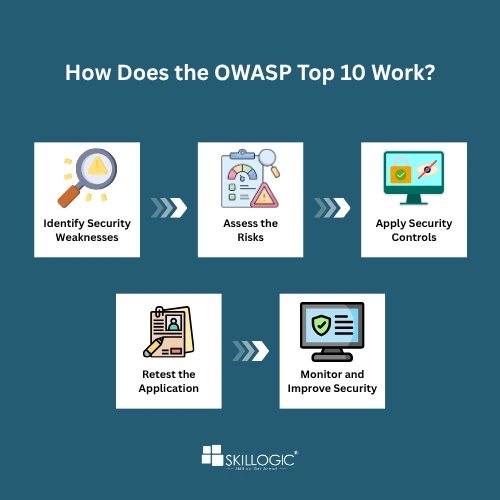
Here is how organizations can use it.
- Identify Security Weaknesses: Developers and security professionals examine applications using code reviews, security tools, and manual testing to find issues such as weak authentication and incorrect access permissions.
- Assess the Risks: Teams evaluate each weakness based on its potential impact. For example, unauthorized access to customers' financial records requires urgent attention.
- Apply Security Controls: Organizations reduce risks by strengthening authentication, validating user input, encrypting sensitive data, and correcting insecure configurations.
- Retest the Application: Security teams test the application after applying fixes to confirm that the weaknesses have been addressed and no new issues have been introduced.
- Monitor and Improve Security: Teams regularly update software, review new vulnerabilities, monitor suspicious activity, and repeat cyber security assessments as applications change.
For example, an online shopping website lets customers check their orders after logging in. If the website does not verify who owns each order, a user could change the order number in the URL and access another customer's details. The OWASP Top 10 helps developers recognize this as an access control issue and fix it by ensuring users can only view their own orders.
OWASP Top 10 List: The Major Web Application Security Risks
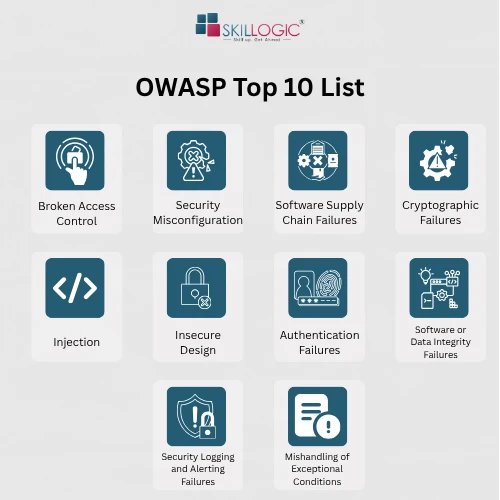
The latest general release is the OWASP Top 10:2025, which contains ten categories of web application security risks. The list helps organizations understand common weaknesses and prioritize security improvements.
The following OWASP Top 10 list uses the official category names.
1. Broken Access Control
Broken access control occurs when users can perform actions or access information beyond their permissions. For example, a customer might access another customer's account by changing an ID in a website URL. Applications should verify authorization for every sensitive action.
OWASP ranks this as A01:2025, the first category in its latest list. Its guidance highlights unauthorized data access, privilege escalation, and missing server-side authorization checks as key concerns.
2. Security Misconfiguration
Security misconfiguration happens when applications, servers, databases, or cloud services are configured incorrectly. Examples include default passwords, unnecessary services, excessive permissions, and exposed administrative interfaces. Secure configurations and regular reviews help reduce these risks.
OWASP ranks this risk as A02:2025, highlighting the importance of secure configurations across the application environment. Its guidance recommends removing unnecessary features, reviewing permissions, and regularly checking security settings
3. Software Supply Chain Failures
Modern applications depend on third-party libraries, frameworks, development tools, and external services. If these components or the systems used to build and distribute them are compromised, the application may become vulnerable. Organizations should maintain dependency inventories, verify software sources, and apply security updates.
OWASP introduced the expanded category A03:2025 to cover risks across software dependencies, build systems, and distribution processes. This broader scope recognizes that vulnerabilities can originate beyond an application's own source code.
4. Cryptographic Failures
Cryptographic failures occur when sensitive information is not properly protected. Weak encryption, poor key management, or storing passwords insecurely can expose personal and financial data. Businesses should use appropriate encryption methods and established password-protection techniques.
OWASP identifies this as A04:2025, focusing on weaknesses that compromise the confidentiality or protection of sensitive information. Using suitable cryptographic standards and managing encryption keys securely are important preventive measures.
5. Injection
Injection attacks happen when untrusted input is interpreted as a command or query. SQL injection prevention is a common example in which an attacker manipulates database queries through application input. Developers can reduce this risk by using parameterized queries, validating inputs, and avoiding unsafe command construction.
OWASP lists injection as A05:2025, covering risks that arise when applications handle untrusted input unsafely. Parameterized queries and context-appropriate input handling help prevent attackers from changing the intended meaning of commands.
6. Insecure Design
Insecure design means an application lacks appropriate security controls because risks were not adequately considered during planning and development. For example, a payment system without transaction limits or abuse prevention may be vulnerable even if its code contains no obvious programming error. Threat modelling and security requirements can help prevent these weaknesses.
OWASP ranks this category as A06:2025, emphasizing security weaknesses rooted in design and architecture. Its guidance encourages threat modelling and secure design patterns before implementation begins.
7. Authentication Failures
Authentication failures involve weaknesses in verifying a user's identity. Examples include weak password policies, poorly protected sessions, and inadequate protection against automated login attempts. Strong authentication, multi-factor authentication, and secure session management can improve protection.
OWASP identifies this risk as A07:2025, covering weaknesses that can allow attackers to impersonate legitimate users. Strong authentication controls and secure session handling help reduce the risk of unauthorized account access.
8. Software or Data Integrity Failures
These failures occur when software or data cannot be trusted because integrity has not been properly verified. For instance, an application that accepts an unverified software update may install malicious code. Digital signatures, trusted update mechanisms, and integrity checks can help reduce this risk.
OWASP lists this category as A08:2025, focusing on failures to verify the integrity of software, code, and data. It distinguishes these integrity issues from broader supply chain failures by focusing on whether software or data can be trusted.
9. Security Logging and Alerting Failures
Applications need useful logs to help security teams detect suspicious activity and investigate incidents. If important events are not recorded or alerts are not generated, an attack may continue unnoticed. Organizations should monitor relevant security events and ensure alerts reach the people responsible for responding.
OWASP names this category A09:2025, emphasizing that logging alone is not enough without effective alerting. Timely alerts help security teams investigate suspicious events and respond to potential incidents.
10. Mishandling of Exceptional Conditions
Applications sometimes encounter unexpected errors, invalid states, or unusual operating conditions. If these situations are handled incorrectly, the application may expose information, continue unsafe operations, or grant access when it should deny it. Developers should design safe error-handling processes and test unusual conditions.OWASP introduced this category as A10:2025 to bring attention to weaknesses involving improper error handling, logical errors, and unsafe behavior during abnormal conditions. Developers should ensure applications fail safely and test how systems behave when unexpected situations occur.
OWASP Top 10 List
According to the Open Worldwide Application Security Project (OWASP), improving software security through open-source projects, educational resources, and community-driven initiatives helps developers and organizations build more secure applications.
Explore Related Articles:
- How to Become a Cyber Security Expert in India
- Cyber Security Scope in India
- Cyber Security in India: What You Need to Know
OWASP Top 10 Vulnerabilities: Common Examples and Their Impact
Understanding OWASP Top 10 vulnerabilities becomes easier when they are connected to real application scenarios.
Consider a banking application that does not properly verify account ownership. A logged-in user might be able to access another person's transaction details. This could result in privacy violations, financial risks, and loss of customer trust.
Another example is SQL injection. If a website inserts user input directly into a database query without proper safeguards, an attacker may manipulate that query. Depending on the weakness and database permissions, the result could include unauthorized data access or modification.
A third example involves security misconfiguration. A business might accidentally expose a database management interface to the public internet or leave unnecessary services enabled. Attackers could attempt to exploit the exposed system.
The impact depends on the type of vulnerability, the application's exposure, and the data or services involved. Possible consequences include:
- Exposure of personal, financial, or business information.
- Unauthorized access to user accounts and administrative functions.
- Data theft, modification, or deletion.
- Service disruption and recovery costs.
- Legal, regulatory, and reputational consequences.
The 2026 Web Application Security Report found that API abuse was reported as a breach entry point by 49% of respondents, while web application exploits were reported by 43%. These are survey findings about reported breach entry points, not the percentage of all cyberattacks or the prevalence of individual OWASP weaknesses.
These examples show why application security requires more than simply knowing the names of vulnerabilities. Security teams must understand how weaknesses occur, test whether applications are exposed, and implement suitable protections.
How to Prevent OWASP Top 10 Vulnerabilities
Organizations can reduce application security risks by making security part of everyday development and maintenance. The following practices provide a useful starting point.
- Follow secure coding practices. Validate inputs, use parameterized queries, and handle errors safely.
- Implement proper access controls. Verify user identities and permissions on the server side.
- Protect sensitive information. Use encryption, secure password hashing, and proper key management.
- Secure software dependencies. Scan third-party components and apply security updates regularly.
- Perform regular security testing. Use code reviews, security scans, and authorized penetration testing.
- Improve monitoring and incident response. Log security events, set alerts, and prepare response plans.
- Review security continuously. Reassess applications after major changes and as new threats emerge.
Following the OWASP Top 10 is a helpful starting point, but organizations should also consider their own business risks, regulatory requirements, architecture, and threat environment.
Refer to these articles:
- Your Path to Becoming a Cyber Security Engineer in Hyderabad
- Top Cyber Security Hiring Industries in Hyderabad
- Cyber Security Salary in Hyderabad: Fresher to Experienced
Benefits of Understanding the OWASP Top 10 for Cyber Security Professionals
Understanding the OWASP Top 10 in cyber security helps professionals recognize common web application risks and learn how to reduce them. It also gives teams a common way to discuss vulnerabilities and their potential impact.
For developers, it encourages secure coding and helps prevent security issues. Penetration testers can use it as a reference when checking applications, while security analysts can use it to understand vulnerabilities and support investigations.
Students and aspiring ethical hackers can use the OWASP Top 10 to build their application security knowledge. Practising in authorized labs helps them understand how vulnerabilities occur and how to fix them.
Combining theory with hands-on practice makes learning more effective. However, the OWASP Top 10 is a starting point, not a complete security checklist. Professionals should also focus on secure design, regular testing, monitoring, and continuous improvement.
In short, the OWASP Top 10 helps organizations identify common web application security risks and understand how to prevent them. Developers and security teams should use it to review applications, fix vulnerabilities, apply secure coding practices, and conduct regular security testing to protect sensitive data.
To put this knowledge into practice, start by learning the OWASP Top 10 vulnerabilities, practise identifying them in authorized labs, and understand how to apply suitable fixes. Aspiring cyber security professionals can strengthen their skills through hands-on projects, vulnerability assessments and penetration testing, helping them prepare for real-world application security challenges.
A professional cyber security course can help learners develop practical skills in vulnerability assessment, ethical hacking, and application security. Choosing a Top Institute for cyber security courses in Hyderabad or exploring training options in other cities can help students and aspiring professionals build the skills needed to pursue a career in cyber security.
Recommended Articles:
- How Bangalore's IT Growth Fuels Cyber Security Demand
- How to Choose the Best Institute for Cyber Security in Bangalore
- How much is the Cyber Security Course Fees in Bangalore
SKILLOGIC offers a Cyber Security Professional Plus Course, a 4-month program covering ethical hacking, SIEM, SOC operations, cloud security, fraud detection, and incident response. The course includes hands-on labs, real-time projects, and internship opportunities, along with certifications from NASSCOM FutureSkills and IIFIS and a SKILLOGIC Course Completion Certificate.
Learners looking for cyber security classes in Bangalore can explore practical training options, while learners in cities such as Chennai, Hyderabad, Pune, Mumbai, Ahmedabad, Delhi, Bangalore, Coimbatore, and Nagpur can also explore SKILLOGIC's training options to build their cyber security skills and prepare for industry challenges.