UPI Frauds and Payment Gateway Scams: How to Stay Safe
Learn how to prevent UPI fraud and payment gateway scams with practical tips for online payment security, fraud detection, and safe digital transactions.
 Nashid Hussain CN
Digital payments have changed the way people shop, transfer money, pay bills, and run businesses. UPI has made payments faster and more convenient, while payment gateways have become an important part of online shopping and business transactions. However, the rapid growth of digital payments has also created more opportunities for cybercriminals to target users, merchants, and payment infrastructure.
The scale of this ecosystem explains why digital payment fraud has become an important cybersecurity concern. According to the National Payments Corporation of India (NPCI), UPI processed around 24.51 billion transactions worth approximately ₹29.82 lakh crore in August 2026. The UPI ecosystem also had 752 banks live on the platform during the month. These figures highlight the massive scale of digital payments in India and the growing importance of strong security measures. As UPI adoption continues to expand, users, merchants, banks, and payment service providers need to remain alert to emerging payment fraud risks.
Understanding how scams work is essential because fraud often starts with fake messages, calls, malicious links, or payment requests. Strong security requires user awareness, technical controls, transaction monitoring, and quick response.
Here, we will deeply explore common UPI frauds and payment gateway scams, how cybercriminals carry out these attacks, the warning signs users and businesses should watch for, and practical ways to protect digital payments from financial and cyber security risks.
Understanding UPI Fraud and Online Payment Fraud
Digital payments have made everyday transactions faster and easier, but they have also created new opportunities for cybercriminals to target users and businesses.
What Is Digital Payment Fraud?
Digital payment fraud involves attempts to steal money, payment details, or account access through digital payment channels. Attackers may target users, merchants, apps, or payment systems. Fraudsters often impersonate banks, customer support, delivery agents, sellers, or known contacts to create urgency and trick victims into sharing information or approving transactions.
The scale of the problem extends beyond individual UPI transactions. According to the Global eCommerce Payments & Fraud Report, real-time payment fraud was reported by 45% of merchants globally, making it one of the most widespread payment fraud attacks identified in the report. The study surveyed more than 1,000 eCommerce merchants across 38 countries, highlighting that payment fraud is a global challenge rather than an issue limited to a single country or payment system.
RBI Research on Digital Payment Fraud
According to Business Standard, citing the Reserve Bank of India’s Annual Report 2025–26, banks and financial institutions reported 10,114 fraud cases involving ₹48,021 crore in FY2025–26, compared with 23,722 cases involving ₹32,803 crore in FY2024–25. However, this overall figure covers different types of banking fraud. Fraud involving cards, internet banking, and digital payments fell to 293 cases involving ₹29 crore in FY2025–26. The figures highlight the importance of strong authentication, transaction monitoring, fraud detection, and customer awareness in protecting digital payment systems.
Refer these articles:
- Understanding Synthetic Identity Fraud and Its Impact
- Best Cyber Security Techniques for Modern Threats
- What is Voice Phishing and How to Prevent Vishing Scams
Common UPI Fraud Techniques
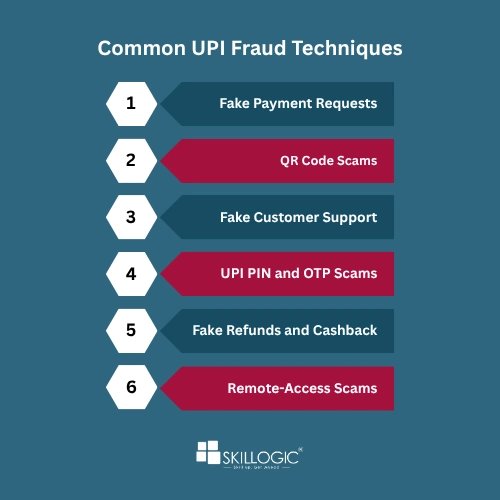
UPI scams often rely on social engineering and user manipulation rather than directly attacking the payment system. Some of the most common techniques include:
- Fake Payment Requests: Fraudsters may send payment requests claiming to offer refunds, cashback, prizes, or other benefits. Approving the request can transfer money to the attacker.
- QR Code Scams: Attackers may share fake QR codes and claim they are needed to receive money. Scanning and approving the transaction can result in an unauthorised payment.
- Fake Customer Support: Criminals may impersonate banks or payment apps through fake websites, phone numbers, or social media accounts to steal information or install malicious applications.
- UPI PIN and OTP Scams: Attackers may use urgency or fake verification messages to trick users into revealing sensitive authentication details.
- Fake Refunds and Cashback: Fraudsters may promise refunds or rewards and then redirect victims to malicious links or payment requests.
- Remote-Access Scams: Attackers may convince victims to install remote-access applications, allowing them to view sensitive information or control the device.
Common UPI Fraud Techniques
Common Online Payment Fraud Methods
Online payment fraud can occur through:
- Phishing Pages: Fake payment pages that steal card or login details.
- Fake Websites: Fraudulent shopping or payment websites designed to collect user information.
- Stolen Card Details: Misuse of stolen card numbers, CVV, or authentication details.
- Malicious Links: Fake payment links shared through SMS, email, or messaging apps.
- Payment Redirects: Users are redirected from legitimate websites to fraudulent payment pages.
- Fake Checkout Pages: Lookalike checkout screens used to capture sensitive information.
How Payment Gateway Scams Work
Payment gateways connect merchants and customers with the financial institutions and payment systems involved in processing online transactions. Because they sit within an important part of the payment process, weaknesses in authentication, configuration, application logic, APIs, or merchant accounts can create security risks.
Fake Payment Gateway Pages
A fake payment gateway page is designed to look like a genuine payment interface. Attackers may copy branding, page layouts, payment options, and familiar security messages to make the page appear trustworthy.
The objective may be to collect card numbers, CVVs, passwords, OTPs, or other information. Some fraudulent pages may also attempt to deliver malware or redirect the user to additional malicious websites.
A simple security habit is to verify the payment domain before entering sensitive information. Users should also avoid making payments through links received unexpectedly through SMS, email, social media, or messaging applications.
Malicious Payment Links and Redirects
Fraudsters can distribute payment links through several channels. A message may claim that a pending invoice needs immediate payment or that a refund is waiting for confirmation. The link may lead to a fake checkout page.
Businesses can reduce this risk by using trusted payment providers, securing their websites, and monitoring unusual changes in payment URLs or checkout behaviour.
Merchant and Payment Account Attacks
Attackers may also target merchants rather than customers. A compromised merchant account could provide access to transaction information, payment configurations, customer data, or connected services.
Weak authentication is one possible entry point. Reused passwords, missing multi-factor authentication, excessive user permissions, and poorly protected administrator accounts can increase exposure.
Insecure APIs can create additional risks. Payment applications often exchange information between websites, mobile applications, payment processors, banks, and other services. APIs should therefore be authenticated, authorised, monitored, and tested regularly.
The goal of payment gateway security should be to protect the complete transaction lifecycle, including customer authentication, payment processing, data transmission, merchant systems, APIs, and post-transaction monitoring.
Refer these articles:
- What is SQL Injection and How to Prevent Attacks
- What is a Malware Attack and How Can You Prevent It
- Best Cyber Security Techniques for Modern Threats
Payment Gateway Security: Key Protection Measures
Strong payment security requires multiple layers rather than a single security product. Businesses should treat payment infrastructure as a critical part of their overall cybersecurity environment.
Authentication and Access Control
Strong authentication helps prevent unauthorized access to merchant dashboards, administrative systems, and payment-related applications. Multi-factor authentication can add another layer of protection when passwords are compromised.
Businesses should also apply the principle of least privilege. Employees should receive only the access required for their responsibilities. An employee who only needs to view transactions should not automatically receive administrative permissions.
Administrator accounts should receive additional protection because compromise of these accounts can affect payment configurations and other sensitive systems.
Data and Transaction Protection
Encryption protects information while it is being transmitted between systems. Tokenization can also reduce the exposure of sensitive payment information by replacing valuable payment data with tokens that have limited usefulness outside the intended transaction environment.
Secure API design is equally important. Businesses should validate inputs, authenticate requests, restrict access, protect credentials, maintain logs, and monitor unusual API activity.
Transaction monitoring can help identify unusual behaviour. Examples include sudden changes in transaction volume, repeated failed payments, unusual login locations, rapid account changes, or transactions that differ significantly from normal customer behaviour.
Fraud Detection and Security Testing
Fraud detection systems can combine transaction patterns, device information, account behaviour, and other signals to identify suspicious activity.
Security testing should also be part of the payment-security lifecycle. Vulnerability assessments and penetration testing can help organisations identify weaknesses before attackers exploit them.
For businesses handling online payments, security monitoring should continue after deployment. New vulnerabilities, compromised credentials, malicious campaigns, and changes in attacker behaviour can create risks even when an application was secure when it was first launched.
How to Prevent UPI Scams and Improve Online Payment Security
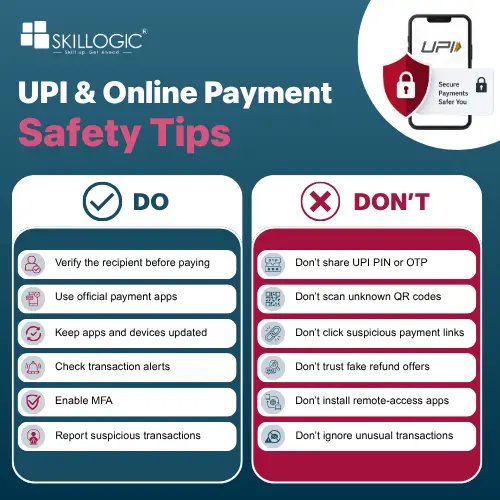
Preventing digital payment fraud requires a combination of user awareness, secure payment practices, and proper technical controls. The following Do and Don't guidelines can help individuals and businesses reduce their exposure to upi fraud and improve online payment security.
For Individuals: Stay Safe from UPI Scams
Do:
- Verify the recipient's name and payment details before approving a transaction.
- Use official banking and payment applications.
- Keep payment apps and devices updated.
- Check transaction alerts and bank statements regularly.
- Contact your bank through its official support channels when you notice suspicious activity.
Don't:
- Don't share your UPI PIN, OTP, CVV, password, or banking credentials.
- Don't scan unknown QR codes to receive money.
- Don't click unfamiliar payment links.
- Don't trust unexpected refunds, cashbacks, or prize offers.
- Don't install remote-access applications at the request of unknown callers.
These basic precautions can reduce the risk of upi scam attempts that rely on social engineering and user manipulation.
For Businesses: Improve Payment Security
Do:
- Enable multi-factor authentication for payment and administrator accounts.
- Protect payment gateways, APIs, merchant dashboards, and databases.
- Monitor unusual transactions and account activity.
- Conduct regular vulnerability assessments and security testing.
- Train employees to identify phishing and social engineering attempts.
- Maintain an incident-response process for suspected payment fraud.
Don't:
- Don't provide unnecessary access to payment systems.
- Don't ignore unusual transactions or suspicious login activity.
- Don't rely on a single security control.
- Don't leave payment APIs or software unprotected or outdated.
- Don't delay investigating suspected online payment fraud.
Strong payment gateway security helps businesses protect payment infrastructure while improving their ability to detect and respond to suspicious activity.
Warning Signs of a Payment Scam
Be cautious when you notice:
- Unexpected payment requests
- Urgent or threatening messages
- Fake refund or cashback claims
- Suspicious payment URLs or QR codes
- Unverified customer-support contacts
- Requests for OTPs, UPI PINs, or passwords
- Requests to install remote-access applications
- Payment details that do not match the expected transaction
If a payment request seems suspicious, stop the transaction and independently verify it through the bank, merchant, or payment provider's official channel.
UPI Fraud and Online Payment Security: Do’s and Don’ts
Refer these articles:
- Cyber Security Scope in Bangalore
- Cyber Security Career in Bangalore: Skills, Salaries, and Success Tips
- Cyber Security in India: What You Need to Know
What to Do After a UPI or Payment Fraud
Even with strong precautions, fraud can still occur. A fast and organised response can help reduce further exposure.
Immediate Actions After Payment Fraud
If a fraudulent transaction has occurred, contact the bank or payment provider through an official channel as quickly as possible. Report the transaction and provide the relevant transaction details.
Users should also secure potentially compromised accounts. This may include changing passwords, disabling compromised access, removing unknown devices, and contacting the bank about suspicious activity.
In India, financial cyber fraud can also be reported through the 1930 cybercrime helpline and the official cybercrime reporting system. The Government of India has developed mechanisms that connect financial institutions and law-enforcement agencies to support faster intervention.
Preserve Evidence of the Fraud
Victims should preserve useful evidence rather than deleting suspicious messages immediately. Important information can include:
- Transaction ID
- Date and time of the transaction
- Screenshots
- SMS and email messages
- Phone numbers
- Sender details
- Payment links
- Website addresses
- Relevant application information
- Bank communication
This information can help banks, payment providers, and law-enforcement authorities investigate the incident.
Why Quick Fraud Reporting Matters
Speed is particularly important in financial cybercrime because fraudulent funds may move through multiple accounts or services. The role of cyber security in financial services is therefore important in detecting suspicious activity, protecting financial systems, and supporting faster response. India's financial cyber-fraud response system is designed to support rapid reporting and intervention.
According to the Ministry of Home Affairs, the Citizen Financial Cyber Fraud Reporting and Management System had helped save more than ₹7,130 crore across over 23.02 lakh complaints by October 2025, according to government data. This demonstrates why victims should report suspicious financial transactions as quickly as possible rather than waiting to see what happens.
Refer these articles:
- How Much Is The Cyber Security Course Fee in Hyderabad
- Cyber security in Hyderabad: Market Growth and Industry Insight
- How to Become a Cyber Security Expert in India
In short, As digital payments continue to grow, digital payment fraud and upi scams remain important security concerns for individuals and businesses. Staying safe requires a combination of user awareness and strong online payment security, including secure authentication, protected payment systems, transaction monitoring, regular security testing, and quick fraud reporting.
For those interested in understanding payment scams, phishing, social engineering, and other cyber threats, cyber security courses in Bangalore and other major cities in India can provide practical knowledge and help build the skills needed to identify and respond to evolving security risks.
SKILLOGIC’s Cyber Security Professional Plus Course is a 4-month program covering practical areas such as ethical hacking, fraud detection, SIEM, SOC operations, cloud security, and incident response. The course includes hands-on labs, real-time projects, and internship opportunities to help learners understand practical cybersecurity applications. Learners also receive certifications from NASSCOM FutureSkills and IIFIS, along with a SKILLOGIC Course Completion Certificate. For those looking for a structured cyber security training institute in Hyderabad, this type of practical training can help develop the technical knowledge and skills needed to understand and respond to evolving cyber threats.