Difference Between IDS and IPS in Cyber Security: A Complete Guide
Learn the difference between ids and ips in cyber security, how intrusion detection system and intrusion prevention system work, their key differences, benefits, limitations, and role in network security solutions
 Nashid Hussain CN
Modern organizations face a growing number of cyber threats every day. From malware attacks and ransomware campaigns to phishing attempts and advanced persistent threats (APTs), businesses must constantly protect their networks and sensitive data. As cybercriminals become more sophisticated, relying only on traditional firewalls is no longer enough.
To strengthen security, organizations use advanced monitoring and protection technologies such as the intrusion detection system and intrusion prevention system. These technologies play a critical role in identifying and responding to suspicious activities before they cause serious damage.
Understanding the difference between ids and ips is essential for security teams, network administrators, and organizations looking to build a strong defense strategy. While both technologies help protect networks, they function differently and serve unique purposes within a security architecture.
In this guide, we will explore how IDS and IPS work, their advantages and limitations, and why they remain essential components of modern network security solutions.
What is an Intrusion Detection System (IDS)?
An intrusion detection system is a security tool designed to monitor network traffic and system activities for signs of malicious behavior, policy violations, or unauthorized access attempts.
Many beginners often ask, what is IDS in cyber security? Simply put, IDS acts like a security alarm system. It continuously watches network activity and alerts administrators whenever suspicious behavior is detected.
How Intrusion Detection System Works
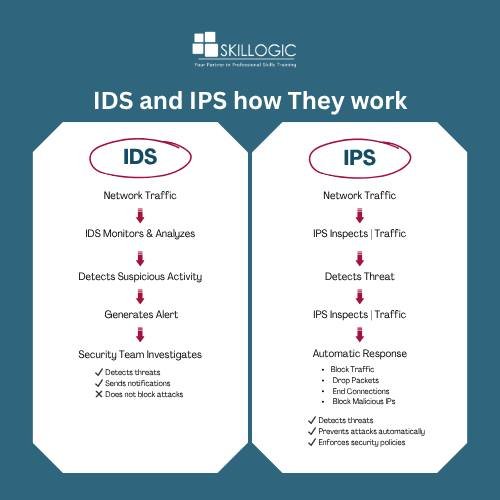
An IDS analyzes incoming and outgoing traffic by comparing network activities against known attack signatures or unusual behavioral patterns. When suspicious activity is identified, the system generates alerts for security teams to investigate.
Unlike prevention systems, IDS does not block attacks automatically. Its primary role is detection and notification.
Types of IDS
- Network-Based IDS (NIDS): This type monitors traffic flowing across an entire network. It is commonly deployed at strategic points such as gateways and network segments to identify malicious activities.
- Host-Based IDS (HIDS): Host-based IDS operates on individual devices such as servers, laptops, or workstations. It monitors file changes, system logs, user activities, and operating system events.
Benefits of IDS
Continuous monitoring of network traffic
- Early detection of cyber security threats
- Improved visibility into network activities
- Supports incident response investigations
- Helps organizations meet compliance requirements
A well-implemented network intrusion detection solution helps security teams identify threats before they escalate into major incidents.
IDS and IPS how They work
What is an Intrusion Prevention System (IPS)?
An intrusion prevention system is an advanced security technology that not only detects threats but also actively blocks them before they can affect systems or networks.
If you are wondering what is ips in cyber security, think of IPS as a security guard that immediately stops intruders instead of simply sounding an alarm.
How Intrusion Prevention System Works
IPS sits directly in the path of network traffic and examines packets in real time. When it detects suspicious activity or known attack patterns, it automatically takes preventive action.
These actions may include:
- Blocking malicious traffic
- Dropping suspicious packets
- Terminating connections
- Preventing access from malicious IP addresses
- Enforcing security policies automatically
Types of IPS
- Network-Based IPS (NIPS): Monitors and protects entire networks against threats.
- Host-Based IPS (HIPS): Installed on endpoints to prevent attacks targeting individual devices.
- Wireless IPS (WIPS): Protects wireless networks against rogue access points and wireless attacks.
- Network Behavior Analysis IPS: Identifies unusual traffic patterns that may indicate attacks such as DDoS attempts.
Benefits of IPS
- Real-time threat prevention
- Automatic response capabilities
- Reduced attack surface
- Stronger protection against malware
- Enhanced compliance and security posture
Organizations seeking proactive network security solutions often deploy IPS to reduce risks and improve overall protection. Understanding IPS is also an important part of network security fundamentals for modern cyber security professionals.
Refer these articles:
- How to Start a Career in Cyber Security
- Best Cyber Security Techniques for Modern Threats
- Information Security vs Cybersecurity
IDS vs IPS: Key Differences Explained
The discussion around ids vs ips often creates confusion because both technologies monitor network traffic. However, their functions differ significantly.
Detection vs Prevention
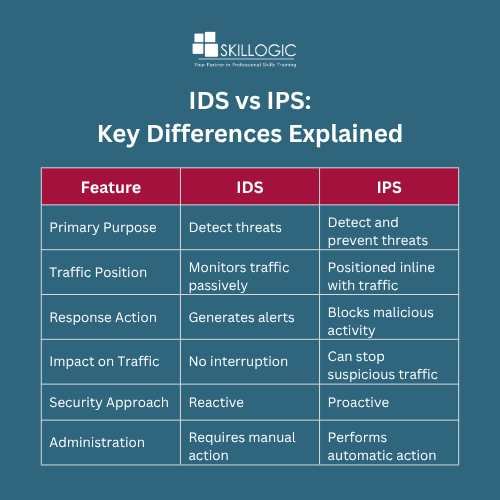
The biggest difference between ids and ips lies in how they respond to threats.
- An IDS identifies suspicious activity and sends alerts to administrators. The security team must then investigate and take action.
- An IPS goes a step further by automatically blocking threats before they reach target systems.
Deployment Location
- IDS is typically deployed outside the main traffic path, allowing it to observe traffic without affecting network performance.
- IPS is deployed inline, meaning all traffic passes through it for inspection and filtering.
Threat Handling
- IDS informs administrators about potential threats.
- IPS immediately enforces protective measures against detected attacks.
This distinction makes ids and ips in cyber security complementary technologies rather than competing solutions.
Growing Market Demand for IDS and IPS
The importance of IDS and IPS technologies continues to grow as cyberattacks become more frequent and sophisticated.
According to a market report from Global Market Insights, the global IDS/IPS market was valued at approximately USD 5.7 billion in 2025 and is expected to reach USD 11.4 billion by 2034, growing at a CAGR of 7.3% between 2025 and 2034. The growth is driven by increasing cyber threats, cloud adoption, hybrid infrastructures, and the expansion of IoT environments.
The report also highlights that network-based IDS/IPS solutions accounted for approximately 55% of the market share in 2025 due to their effectiveness in protecting enterprise networks against unauthorized access, DDoS attacks, and data breaches.
These numbers clearly demonstrate why organizations are investing heavily in advanced threat detection and prevention technologies.
How IDS and IPS Work Together for Stronger Security
In today's threat landscape, many organizations use both IDS and IPS rather than relying on a single security solution. While IDS helps identify and alert security teams about suspicious activities, IPS actively blocks malicious traffic before it can cause damage. Together, they provide a stronger and more comprehensive approach to network security, improving both threat detection and prevention capabilities.
Complementary Roles
- IDS provides visibility and detailed threat intelligence by monitoring network activities and generating alerts.
- IPS delivers active defense by stopping threats before they reach critical systems.
When used together, they create a layered security architecture that improves overall resilience.
Benefits of Combining IDS and IPS
- Improved threat detection accuracy
- Faster incident response
- Better network visibility
- Enhanced protection against advanced attacks
- Reduced risk of successful breaches
Real-World Example
Consider a financial institution handling thousands of transactions every minute.
An IDS detects unusual login attempts from multiple locations and alerts the security team.
At the same time, the IPS automatically blocks suspicious traffic and prevents attackers from gaining access.
This coordinated defense significantly reduces the likelihood of a successful attacks in cyber security.
As organizations continue adopting cloud computing and hybrid environments, integrated network security solutions combining IDS and IPS are becoming increasingly common.
Advantages and Limitations of IDS and IPS
IDS and IPS play a vital role in protecting networks from cyber threats. While they offer valuable security benefits, they also have certain limitations that organizations should consider when implementing them.
Advantages of IDS
- Enhanced Visibility: Provides deep insight into network activities and user behavior.
- Threat Intelligence: Helps security teams understand attack patterns and trends.
- Compliance Support: Supports regulatory requirements by maintaining detailed logs and monitoring activities.
- Minimal Performance Impact: Since IDS operates passively, it generally has little impact on network performance.
Limitations of IDS
- No Automatic Protection: IDS can only alert administrators; it cannot stop attacks directly.
- Alert Fatigue: Large organizations may receive thousands of alerts daily, making threat prioritization challenging.
- Dependence on Human Response: Security teams must investigate and respond to alerts promptly.
Advantages of IPS
- Real-Time Protection: Automatically blocks malicious activities before damage occurs.
- Reduced Incident Response Time: Immediate action minimizes attack impact.
- Stronger Security Posture: Provides proactive defense against known threats.
- Policy Enforcement: Helps organizations enforce security rules consistently.
Limitations of IPS
- False Positives: Legitimate traffic may occasionally be blocked if incorrectly identified as malicious.
- Performance Overhead: Because IPS inspects all traffic inline, it can introduce some network latency.
- Ongoing Management: Requires continuous tuning and updates to maintain effectiveness.
Balancing detection accuracy and prevention capabilities is essential for successful deployment of both systems.
Refer these articles:
- What Is Hashing in Cyber Security
- What is SQL Injection and How to Prevent Attacks
- What is Voice Phishing and How to Prevent Vishing Scams
Why Learning IDS and IPS is Important for Cyber Security Professionals
As organizations increasingly prioritize cyber defense, professionals with expertise in IDS and IPS technologies are becoming highly valuable.
Importance in Ethical Hacking
Ethical hackers must understand how security systems detect attacks to perform effective vulnerability assessments and penetration testing. Knowledge of IDS and IPS helps them identify how organizations monitor threats and allows them to test security defenses more accurately while recommending improvements.
Role in SOC Operations
Security Operations Centers (SOCs) rely heavily on IDS and IPS platforms to monitor network traffic, detect suspicious activities, and investigate security incidents. These tools provide real-time alerts that help SOC analysts respond quickly to potential threats and minimize the impact of cyberattacks.
Relevance in Network Security
Professionals working with enterprise networks frequently manage IDS and IPS deployments to protect critical infrastructure and sensitive data. Understanding these technologies helps network security teams strengthen defenses, improve threat visibility, and maintain a secure and reliable network environment.
Growing Cybersecurity Career Opportunities
Knowledge of ids and ips in cyber security is highly relevant for cyber security job roles such as:
- SOC Analyst
- Cyber Security Analyst
- Security Engineer
- Incident Response Specialist
- Threat Hunter
- Penetration Tester
- Network Security Engineer
As cyber threats continue to evolve, employers increasingly seek professionals with hands-on experience in threat detection and prevention technologies.
Importance of Training and Certifications
Practical training helps professionals understand real-world attack scenarios, security monitoring techniques, and threat response procedures. Through hands-on labs and simulated environments, learners gain valuable experience in detecting, analyzing, and mitigating cyber threats effectively.
Industry-recognized certifications and hands-on training provide practical knowledge in configuring, managing, and optimizing IDS and IPS solutions. Enrolling in cyber security classes in Pune or other major cities can help aspiring professionals build job-ready skills, gain exposure to real-world security tools, and prepare for roles in SOC operations, network security, and cyber defense.
In short, understanding the difference between ids and ips is essential for building a strong cyber security strategy. While an intrusion detection system focuses on identifying and alerting security teams about suspicious activities, an intrusion prevention system actively blocks threats before they can impact the network. Rather than choosing one over the other, organizations achieve better protection when both technologies work together as part of a layered security approach.
Refer these articles:
- How to Become a Cyber Security Analyst in 2026
- What is Phishing? Types of Phishing Attacks
- What is Cyber security? A Beginner’s Guide to Protecting Your Data
As cyber threats continue to evolve, businesses increasingly depend on advanced network security solutions that combine threat detection and prevention capabilities. IDS and IPS play a crucial role in protecting enterprise networks, cloud environments, and critical infrastructure. For aspiring cyber security professionals, gaining knowledge of these technologies can create opportunities in network security, ethical hacking, SOC operations, and incident response, making them valuable skills in today's security landscape.
Those interested in building a career in IDS, IPS, SOC operations, or network security should choose a cyber security course that includes hands-on training in threat detection, network monitoring, and cyber security tools. Practical lab experience, industry-recognized certifications, and real-world security scenarios can help learners develop the skills needed to succeed in today's growing cyber security job market.
SKILLOGIC is a top institute for cyber security training, offering its industry-recognized Cyber Security Professional Plus Course, a 4-month program accredited by IIFIS and NASSCOM FutureSkills. The course includes hands-on labs, real-time projects, internship opportunities, and certifications to help learners build practical cyber security skills. With 25+ training centers across India, including cyber security courses in Hyderabad, Bengaluru, Chennai, Pune, Mumbai, and Delhi, SKILLOGIC provides accessible, career-focused cyber security training for aspiring professionals.