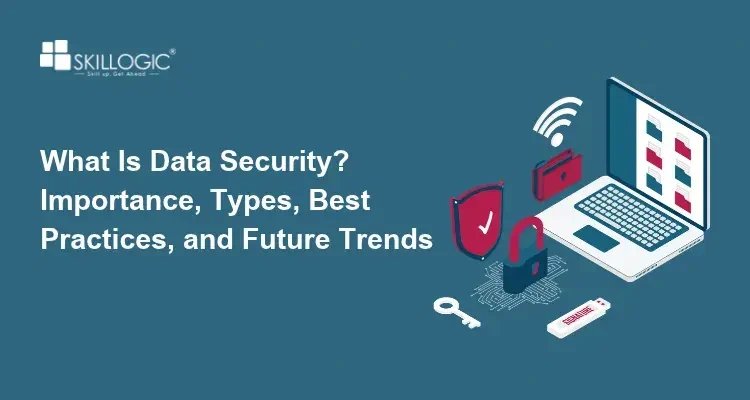
What Is Data Security? Importance, Types, Best Practices, and Future Trends
Learn what data security is, why it matters, its key types, best practices, and future trends to protect sensitive information from cyber threats.
 Nashid Hussain CN
Digital information has become one of the most valuable assets for individuals and businesses. From personal details and financial records to customer information and business documents, large amounts of data are stored and shared through digital platforms every day. However, as technology continues to advance, the risks of data theft, cyberattacks, and unauthorized access are also increasing. This makes protecting sensitive information an important part of modern cyber security.
What Is Data Security, and why is it important in today's digital world? Data security refers to the methods, technologies, and practices used to protect digital information from unauthorized access, modification, loss, or theft. It helps businesses maintain the confidentiality, integrity, and availability of important information while reducing the risk of financial losses and data breaches.
Here, we will discuss the importance of data security, its different types, common security threats, best practices for protecting sensitive information, and emerging trends shaping the future of data security.
What Is Data Security
Data security is the process of protecting digital and physical information against unauthorized access, misuse, alteration, disclosure, and destruction. It involves using security technologies, policies, and procedures to ensure that sensitive information remains protected throughout its lifecycle.
For example, when someone uses a banking application, their account details, passwords, and transaction information must remain protected. Encryption, Multi-factor authentication, and access controls help prevent unauthorized people from accessing this information.
An effective data protection strategy is based on three important principles, commonly known as the CIA Triad:
CIA Triad: Three Important Principles of Data Security
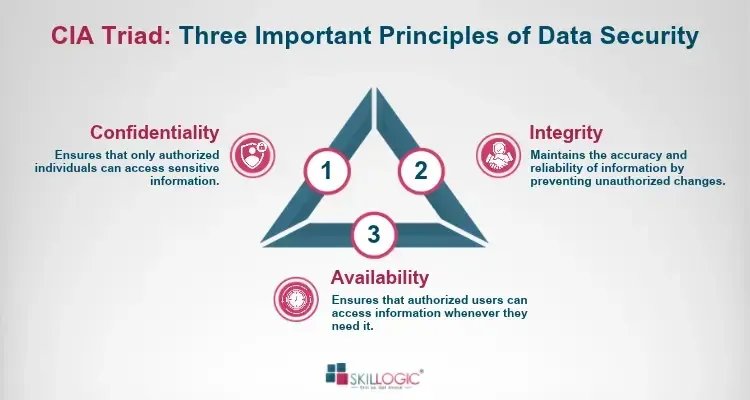
- Confidentiality: Ensures that only authorized individuals can access sensitive information.
- Integrity: Maintains the accuracy and reliability of information by preventing unauthorized changes.
- Availability: Ensures that authorized users can access information whenever they need it.
These three principles form the foundation of information protection. Organizations use them to develop security policies and choose appropriate technologies for protecting their digital assets.
Explore these articles:
- Why Linux Skills are Important for Cyber Security Professionals
- Suspicious Activity Detection: Techniques to Identify Cyber Threats
- What Are the Different Types of Cyber Security and Their Uses
Importance of Data Security in the Digital World
The importance of data security has increased as businesses depend more on digital platforms, cloud services, online transactions, and connected systems. A single security incident can expose confidential information, interrupt business operations, and damage an organization's reputation.
Here are five major reasons why protecting information is essential.
Protects Sensitive Information
Businesses collect personal details, financial records, employee information, and customer data. Security measures help prevent unauthorized individuals from accessing or stealing this information.
Prevents Data Breaches and Financial Losses
A data breach can result in financial damage, legal expenses, and business interruptions. According to IBM's Cost of a Data Breach Report, the average cost of a data breach in India reached approximately ₹22 crore, highlighting the need for effective security measures.
Builds Customer Trust and Business Reputation
Customers expect businesses to handle their personal information responsibly. Strong data protection practices help maintain customer confidence and build long-term business relationships.
Supports Regulatory Compliance
Businesses must follow applicable data protection and privacy regulations. Security policies, encryption, access restrictions, and proper record management help meet these requirements.
Ensures Business Continuity and Prevents Cybercrime
Cyberattacks, ransomware, and accidental data loss can interrupt business operations. Regular backups, recovery plans, and security monitoring help protect important information and reduce the risks of identity theft and financial fraud.
What Are the Different Types of Data Security?
Understanding the types of data security helps organizations choose suitable protection methods according to their requirements. Different techniques work together to protect information stored on computers, servers, cloud platforms, and other digital systems.
Different Types of Data Security
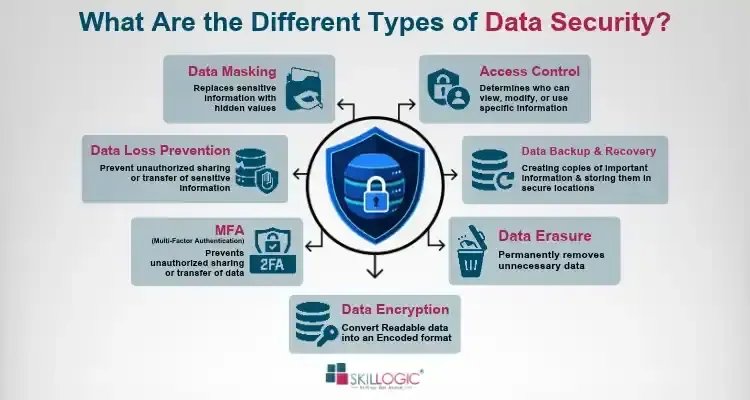
Data Encryption
Encryption converts readable information into an encoded format that cannot be easily understood without the correct decryption key. It protects information during storage and transmission.
For example, online banking platforms use encryption to protect sensitive financial information exchanged between users and servers.
Access Control
Access control determines who can view, modify, or use specific information. Organizations assign permissions according to employees' roles and responsibilities.
For example, an HR employee may access employee records, while other departments may not have permission to view the same information.
Data Masking
Data masking replaces sensitive information with modified or hidden values. It allows developers and testing teams to work with realistic datasets without exposing actual customer details.
For example, a bank may display only the last four digits of a customer's card number.
Data Backup and Recovery
Data backup involves creating additional copies of important information and storing them in secure locations. Recovery procedures help restore lost or damaged data after accidental deletion, hardware failure, or ransomware attacks.
Regular backups are especially important for organizations that handle large amounts of business information.
Data Loss Prevention (DLP)
Data Loss Prevention technologies help identify, monitor, and prevent unauthorized sharing or transfer of sensitive information.
For example, a DLP system can detect when an employee attempts to send confidential company documents to an unauthorized external email address.
Data Erasure
Data erasure involves permanently removing information from storage devices when it is no longer required. Secure erasure methods help prevent unauthorized recovery of deleted information.
Multi-Factor Authentication (MFA)
Multi-Factor Authentication adds additional verification steps beyond a password. Users may need to provide an OTP, authentication app approval, or biometric verification before accessing an account.
This makes it harder for attackers to gain access using stolen passwords alone.
Refer to these articles:
- How to Become a Cyber Security Expert in India
- Cyber Security Scope in India
- Cyber Security in India: What You Need to Know
Common Data Security Threats Businesses Face
Even organizations with security systems can face cyber threats if their protection measures are outdated or poorly managed. Some common threats include:
- Phishing attacks: Attackers send fraudulent emails or messages to steal passwords, financial information, and other sensitive details.
- Ransomware attacks: Malicious software encrypts or locks important files and demands payment for restoring access.
- Insider threats: Employees or other trusted individuals may accidentally or intentionally expose confidential information.
- Malware and spyware: Malicious programs can steal information, monitor user activities, or damage computer systems.
- SQL injection: Attackers exploit vulnerable application inputs to access or manipulate database information.
- Cloud data breaches: Misconfigured cloud storage, weak permissions, or compromised accounts can expose sensitive information.
- Unauthorized access: Attackers may use stolen credentials or security weaknesses to enter systems without permission.
The growing number of cyber incidents highlights the need for stronger protection. According to India's Ministry of Home Affairs, information reported to and tracked by CERT-In recorded 29,44,248 cyber security incidents in 2025, compared with 20,41,360 in 2024.
These figures demonstrate why organizations must continuously review their security systems and identify potential weaknesses.
Data Security Best Practices to Protect Sensitive Information
Following effective data security best practices helps individuals and businesses reduce risks and protect important digital assets. Organizations should treat security as an ongoing responsibility rather than a one-time activity.
Here are some practical measures to follow:
- Use Strong Passwords and MFA: Create unique and complex passwords for different accounts. Enable multi-factor authentication wherever possible to add another layer of protection.
- Encrypt Sensitive Information: Use reliable encryption methods to protect confidential files, databases, and information exchanged through networks.
- Regularly Update Software and Security Systems: Install security updates and patches to fix known vulnerabilities. Outdated applications and operating systems can provide attackers with opportunities to enter systems.
- Implement Role-Based Access Control: Provide employees with access only to the information required for their work. Review permissions regularly and remove unnecessary access when responsibilities change.
- Maintain Regular Data Backups: Create backups of important files and store them securely. Test recovery procedures to ensure that information can be restored when required.
- Conduct Security Audits and Vulnerability Assessments: Regularly review security policies, identify system weaknesses, and perform vulnerability assessments. Penetration testing can also help organizations understand how attackers might exploit security gaps.
- Train Employees to Identify Cyber Threats: Employees should understand phishing emails, suspicious links, social engineering, and safe data-handling practices. Regular awareness sessions can help reduce human-related security risks.
- Monitor Systems for Suspicious Activities: Use security monitoring tools to identify unusual login attempts, unauthorized file transfers, and unexpected system activities. Early detection can help security teams respond before an incident causes greater damage.
Future of Data Security: Emerging Trends and Technologies
The future of data security will be influenced by artificial intelligence, cloud computing, automation, and advanced encryption technologies. As organizations generate and store more digital information, they will need stronger methods to identify threats and protect sensitive data.
Some important developments include:
- AI-Powered Security: Detects unusual activities and potential threats.
- Zero Trust Security: Verifies every user and device before granting access.
- Cloud Data Protection: Secures information stored on cloud platforms.
- Automated Threat Detection: Identifies and responds to threats faster.
- Quantum-Resistant Encryption: Protects data against future quantum computing threats.
Read these related articles:
- The Future of Cyber Security in Chennai: Trends and Opportunities
- How to Build a Cyber Security Engineering Career in Chennai
- Cyber Security Salary in Coimbatore: Fresher to Experienced
- How much is the Cyber Security Course Fee in Coimbatore
Global Data Security Market Growth
The growing demand for information protection is also influencing the global data security industry.
According to Mordor Intelligence's Data Security Market Report, the global data security market was valued at approximately USD 14.70 billion in 2025. The report estimates that it will reach USD 17.21 billion in 2026 and grow to USD 37.93 billion by 2031, at a compound annual growth rate (CAGR) of 17.12% during 2026 to 2031.
This growth reflects increasing investment in data protection technologies, cloud security, encryption, and advanced threat detection solutions. The Asia-Pacific region is also identified as the fastest-growing market, supported by digital transformation and evolving data protection requirements.
These developments indicate that organizations will continue investing in advanced security technologies to protect their information and maintain digital trust.
In short, Data security is essential for protecting sensitive information and preventing cyber threats. By using encryption, access controls, regular backups, and effective security practices, businesses can reduce data breaches and maintain customer trust. As technology advances, adopting stronger data protection methods will become increasingly important.
Learning cyber security through a professional cyber security course can help individuals understand data protection, encryption, threat detection, and security monitoring. Choosing the best institute for cyber security courses in Chennai and other cities can also help beginners gain practical knowledge and develop skills for careers in cyber security and information security.
SKILLOGIC is a professional training institute with 13+ years of experience, 1,00,000+ learners, 20+ accreditations, and 25+ offline centres. Its 4-month AI-Powered Cyber Security Professional Plus Course offers 200+ learning hours, hands-on labs, real-time projects, NASSCOM FutureSkills and IIFIS certifications, internship opportunities, and placement assistance.
Learners can explore SKILLOGIC cyber security courses in Coimbatore through available training options, along with online and classroom learning at centres in Bangalore, Chennai, Hyderabad, Pune, Mumbai, Ahmedabad, Delhi, and Nagpur, helping them develop practical cyber security skills and explore career opportunities.