
Suspicious Activity Detection: Techniques to Identify Cyber Threats
Learn how suspicious activity detection helps identify cyber threats using monitoring techniques, security tools, and real-time analysis to protect digital systems.
 Nashid Hussain CN
Cyber security has become an important concern for businesses, government organizations, and individuals as more activities move online. From digital payments and cloud applications to business databases and communication platforms, organizations increasingly depend on connected systems to manage their daily operations. However, this growing digital environment also creates opportunities for cybercriminals to access sensitive information, disrupt services, and steal valuable data.
This is where suspicious activity detection plays an important role in cyber security. It involves monitoring networks, computer systems, user accounts, and applications to identify unusual behaviour that could indicate potential security threats. By using effective monitoring techniques and security tools, organizations can recognize warning signs, investigate unusual activities, and respond to possible cyberattacks before significant damage occurs.
Here, we will discuss the importance of suspicious activity detection, common warning signs, effective detection techniques, popular monitoring tools, and best practices to identify and prevent potential cyber threats.
What Is Suspicious Activity Detection in Cyber Security?
Suspicious activity detection refers to the process of identifying unusual or unexpected behaviour within a computer system, network, or digital environment. These activities may indicate unauthorized access, malware infections, data theft attempts, or other security risks. Security professionals analyse system logs, network traffic, login records, and user behaviour to understand whether an activity is normal or potentially harmful.
For example, if an employee usually accesses a company system during office hours but suddenly attempts to log in several times from an unfamiliar location at midnight, the activity may require investigation. Similarly, unexpected data transfers, unknown software installations, and repeated failed login attempts can indicate possible security problems.
Modern security teams use automated monitoring systems to identify these activities. These systems compare current behaviour with established patterns and generate alerts when unusual events occur. This process helps organizations improve their cyber security threat detection capabilities and maintain better control over their digital infrastructure.
Explore these articles:
- Cyber Security Across Different Industries: Why Every Sector Needs Protection
- How to Become a Network Security Engineer as a Fresher
- UPI Frauds and Payment Gateway Scams: How to Stay Safe
Why Is Suspicious Activity Detection Important?
Identifying unusual activities at an early stage helps organizations reduce the risk of data breaches, financial losses, and operational disruptions. Cybercriminals often try to gain access to systems through stolen credentials, phishing emails, malicious software, or software vulnerabilities. If these activities remain unnoticed, attackers may gain access to confidential information and move further into the organization's network.
The importance of suspicious activity detection can also be understood through recent cyber security statistics from India.
According to the Government of India's Indian Computer Emergency Response Team (CERT-In), India reported 29.44 lakh cyber security incidents in 2025. During the same year, CERT-In issued 1,530 security alerts, 390 vulnerability notes, and 65 advisories to address emerging security risks. These figures highlight the growing need for organizations to strengthen their security monitoring and incident response practices.
Source: CERT-In statistics, Government of India, January 2026.
Continuous monitoring helps businesses identify unauthorized access, unusual network traffic, suspicious login attempts, and unexpected system changes. When security teams recognize these warning signs early, they can investigate the activity, block unauthorized access, and take appropriate action to protect important information.
Common Signs of Suspicious Activities in a Network
Suspicious activities can appear in different forms depending on the type of system and the attack method. Understanding common warning signs helps security professionals identify possible threats more effectively.
Unusual Login Attempts
Repeated failed login attempts, logins from unfamiliar locations, and access requests at unusual times may indicate attempts to compromise user accounts. Attackers sometimes use automated cyber security tools to test multiple passwords until they find valid credentials.
Unexpected Network Traffic
A sudden increase in network traffic or unusual communication with unknown external servers may indicate malware activity or unauthorized data transfers. Security teams should investigate unexpected connections and unusual bandwidth usage.
Unauthorized Access
Access to restricted files, confidential databases, or administrative accounts without proper permission can indicate a security violation. Organizations should regularly review user permissions and monitor sensitive system access.
Unusual File Modifications
Unexpected changes to important documents, system configurations, or application files may indicate malicious activity. Ransomware attacks, for example, can modify or encrypt multiple files within a short period.
Suspicious System Processes
Unknown applications, unusual background processes, and unexpected system resource usage can sometimes indicate malware infections. Security professionals should investigate unfamiliar processes before allowing them to operate further.
Effective Techniques to Detect Suspicious Activities
Organizations use different techniques to identify unusual behaviour and improve their overall security posture. Combining multiple detection methods provides better visibility across networks, devices, and applications.
Network Traffic Analysis
Network traffic analysis involves monitoring data moving between connected devices, servers, and external networks. Security professionals examine communication patterns, connection requests, bandwidth usage, and unusual data transfers. Tools such as Wireshark help analysts inspect network packets and investigate unexpected connections.
Log Monitoring and Analysis
System logs record important events such as user logins, file access, application activities, and system changes. Regular log analysis helps security teams identify repeated login failures, unexpected administrative actions, and other unusual events. Centralized log management also makes it easier to investigate security incidents.
User Behaviour Analytics (UBA)
User Behaviour Analytics focuses on understanding normal user activities and identifying unusual changes. For example, accessing sensitive information outside normal working hours or downloading an unusually large amount of data may generate a security alert. This technique is particularly useful for identifying compromised accounts and potential insider threats.
Anomaly Detection
Anomaly detection identifies activities that differ from established system or network behaviour. Machine learning and statistical analysis can help security platforms recognize unusual patterns that traditional detection methods may overlook. These cyber security techniques are useful for identifying new or previously unknown threats.
Endpoint Monitoring
Endpoint monitoring focuses on devices such as laptops, desktops, and servers connected to an organization's network. Security teams monitor running processes, software installations, file changes, and suspicious connections. Endpoint Detection and Response (EDR) solutions help identify potential threats and support investigation and response.
Read these articles:
- How to Become a Cyber Security Expert in India
- Cyber Security Scope in India
- Cyber Security in India: What You Need to Know
Role of Cyber Security Monitoring Tools
Effective cyber security monitoring helps organizations maintain visibility across their digital infrastructure. Instead of checking individual systems manually, security teams can use monitoring platforms to collect information from multiple sources and identify possible threats from a centralized location.
Security Information and Event Management (SIEM) solutions are commonly used for this purpose. They collect and analyse security logs from servers, applications, firewalls, and network devices. When unusual patterns are identified, the platform generates alerts that security professionals can investigate.
According to the Data Security Council of India and Seqrite's India Cyber Threat Report, researchers recorded 369.01 million malware detections across 8.44 million endpoints. The report also identified 53.73 million behaviour-based detections, representing 14.56% of the total detections. The findings demonstrate the importance of combining traditional detection methods with behaviour-based analysis.
Continuous monitoring also helps organizations improve their incident response processes. When alerts are investigated quickly, security teams can isolate affected devices, disable compromised accounts, and prevent threats from spreading across the network.
Popular Tools for Suspicious Activity Detection
Security professionals use different tools to monitor networks, analyse system behaviour, and investigate potential cyber threats. Some commonly used tools include:
Top Cyber Security Tools for Suspicious Activity Detection
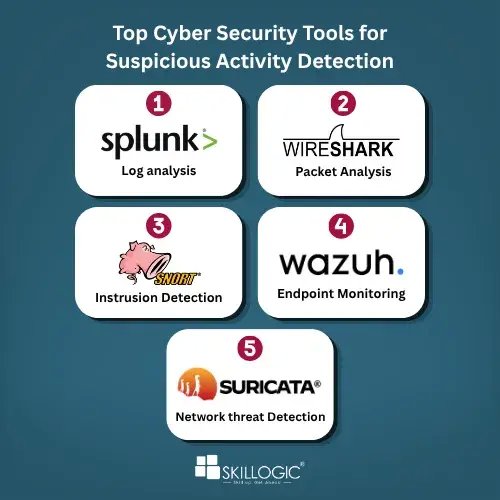
- Splunk: Splunk is a data analysis and security monitoring platform that helps organizations collect, search, and analyse machine data. Its security capabilities support log analysis, threat investigation, and centralized monitoring.
- Wireshark: Wireshark is a network protocol analyzer used to capture and inspect network traffic. It helps security professionals investigate unusual connections, communication patterns, and suspicious packets.
- Snort: Snort is an open-source network intrusion detection and prevention system. It analyses network traffic and uses predefined rules to identify potentially malicious activity.
- Wazuh: Wazuh is an open-source security monitoring platform that provides capabilities such as log analysis, file integrity monitoring, vulnerability detection, and endpoint security monitoring.
- Suricata: Suricata is an open-source network threat detection engine that supports intrusion detection, intrusion prevention, and network security monitoring. It helps identify suspicious network communication and potential attack patterns.
These tools help security professionals investigate alerts, understand potential threats, and strengthen an organization's overall security monitoring capabilities.
Best Practices to Improve Suspicious Activity Detection
Organizations should follow consistent security practices to identify potential threats and reduce the possibility of unauthorized access.
Best Practices to Improve Suspicious Activity Detection
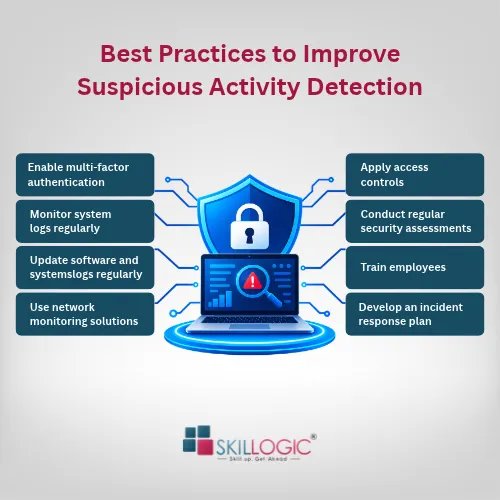
- Enable multi-factor authentication: Use additional authentication methods to protect user accounts, even if passwords are compromised.
- Monitor system logs regularly: Review login records, application activities, and system events to identify unusual behaviour.
- Update software and systems: Install security patches regularly to address known vulnerabilities.
- Use network monitoring solutions: Monitor network connections and data transfers to identify unexpected communication.
- Apply access controls: Give employees access only to the systems and information required for their responsibilities.
- Conduct regular security assessments: Perform vulnerability assessments and security audits to identify weaknesses.
- Train employees: Educate staff about phishing emails, suspicious links, social engineering, and safe online practices.
Develop an incident response plan: Establish clear procedures for investigating alerts, containing threats, and recovering affected systems.
Following these practices helps organizations build a stronger security environment and improve their ability to identify potential attacks.
Read these related articles:
- Your Guide to a Cyber Security Career in Ahmedabad
- Leading Industries Offering Cyber Security Jobs in Ahmedabad
- Cyber Security Job Interview Tips for Freshers in Delhi
- How Much Is The Cyber Security Course Fee In Delhi
Cyber threats continue to evolve, making early identification and continuous monitoring important for every organization. Understanding unusual login attempts, unexpected network traffic, unauthorized access, and suspicious system changes can help security teams recognize potential risks before they become serious incidents.
Suspicious activity detection is not limited to using security software. It also involves analysing user behaviour, monitoring network traffic, reviewing system logs, and responding to security alerts effectively. By combining suitable tools, trained professionals, and consistent security practices, organizations can protect their digital assets and build a more secure IT environment.
Learners interested in building a career in cyber security can explore professional courses covering ethical hacking, threat detection, network security, and practical security skills. Enrolling in cyber security courses in Ahmedabad can help develop industry-relevant knowledge and prepare for emerging opportunities in the cyber security field.
SKILLOGIC offers an AI-powered Cyber Security Professional Plus Course designed to help learners develop practical skills in ethical hacking, threat detection, network security, and incident response. The program includes hands-on lab sessions, real-time projects, and internship opportunities, along with certifications from NASSCOM FutureSkills, IIFIS, and SKILLOGIC. With 13+ years of experience, 25+ offline training centres, and a strong focus on practical learning, SKILLOGIC provides training across cities including Bangalore, Chennai, Hyderabad, Pune, Mumbai, Ahmedabad, Delhi, and Kolkata.
Those looking for a top Institute in Delhi for cyber security courses can explore this program to build industry-relevant knowledge and technical skills.