How AI Security Is Creating New Cyber Security Career Opportunities
Discover how AI security is creating new cybersecurity career opportunities, emerging roles, essential skills, and career paths for aspiring professionals.
 Nashid Hussain CN
Artificial intelligence is changing how organizations work, analyze information, automate tasks, and protect digital systems. AI-powered applications are now used for customer support, fraud detection, security monitoring, threat analysis, and many other business activities. As AI adoption grows, organizations also need to protect AI models, applications, data, APIs, and the infrastructure supporting them. This is creating new AI security jobs while also changing the responsibilities of existing cybersecurity professionals.
For cybersecurity professionals and people entering the field, this shift is creating new cyber security career opportunities. Professionals are increasingly expected to understand AI-related risks such as prompt injection, data poisoning, model theft, sensitive data exposure, and misuse of AI systems. NIST's AI Risk Management Framework highlights security and resilience as important characteristics of trustworthy AI and provides guidance for managing AI-related risks.
Here, we discuss how AI security is creating new career opportunities, the emerging job roles, essential skills, and how cybersecurity professionals can prepare for this growing field.
Why AI Is Creating New Cyber Security Career Opportunities
AI adoption is creating a new layer of cyber security responsibilities. Organizations must secure not only traditional networks, endpoints, applications, and cloud environments but also AI models, training data, APIs, prompts, and AI integrations.
According to the ISC2 2025 Cybersecurity Workforce Study, based on a record 16,029 cybersecurity practitioners and decision-makers, AI was the most pressing skills need reported by respondents at 41%, ahead of cloud security at 36%. The study also found that 73% believe AI will create more specialized cybersecurity skills, while 72% expect AI to create a need for more strategic cybersecurity mindsets.
Source: ISC2 Cybersecurity Workforce Study
This research is important because it shows that AI is influencing cybersecurity careers at the skills level, not simply adding another technology to the existing workplace. ISC2 also found that 69% of respondents were already on a path toward regular AI security tool use, including organizations that had integrated, tested, or were evaluating these tools.
Security concerns are another reason for this shift. IBM's Cost of a Data Breach research found that 13% of organizations studied reported breaches involving AI models or applications. Among those organizations, 97% reported that they did not have proper AI access controls. IBM also found that 63% of the breached organizations either had no AI governance policy or were still developing one.
These gaps require people who understand both technology and security. As a result, AI security careers can develop across engineering, security operations, risk management, governance, threat intelligence, and security testing.
Refer these articles:
- Cyber Security Across Different Industries: Why Every Sector Needs Protection
- Difference Between IDS and IPS in Cyber Security: A Complete Guide
- Top Ethical Hacking Tools Every Beginner Must Learn
What Are AI Security Jobs and What Do Professionals Do?
The term AI security jobs covers several responsibilities rather than one single position. Depending on the organization, professionals may work directly with AI models or focus on protecting the infrastructure and applications connected to them.
AI Security Engineer
An ai security engineer focuses on protecting AI systems throughout their development and deployment lifecycle. Responsibilities can include reviewing AI architecture, protecting sensitive data, implementing access controls, testing AI applications, and identifying weaknesses in AI integrations.
The role may also involve working with security teams, developers, cloud engineers, and data scientists. A strong foundation in networking, application security, cloud security, scripting, and vulnerability assessment can be useful for this career path.
AI Security Analyst
An AI security analyst may monitor AI-related activity, investigate suspicious behavior, assess security alerts, and help identify threats affecting AI applications. This role can overlap with traditional SOC activities while adding AI-specific investigation requirements.
For example, an analyst might investigate unusual API activity, suspicious prompts, unauthorized access to an AI service, or possible leakage of sensitive information through an AI application
AI Risk and Governance Specialist
Not every AI security position is deeply technical. Organizations also need professionals who can identify AI risks, create security policies, assess controls, and support compliance activities.
NIST's AI Risk Management Framework provides a structured approach around functions such as Govern, Map, Measure, and Manage. This creates opportunities for professionals who understand cybersecurity alongside risk management and organizational governance.
Machine Learning Security Specialist
Machine learning security specialists focus on protecting models, training data, and machine learning environments. Their work may include assessing threats such as data poisoning, model theft, adversarial manipulation, and unauthorized access.
NIST identifies risks including adversarial examples, data poisoning, and potential exfiltration of models or training data, showing why specialized security knowledge is relevant to machine learning environments.
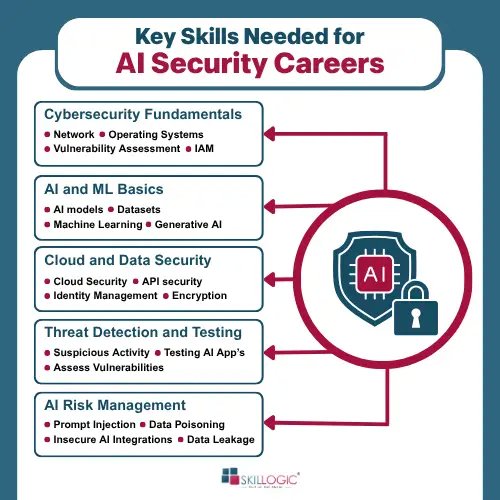
Key Skills Needed for AI Security Careers
Building successful AI security careers requires more than simply learning how to use an AI chatbot. Professionals need a combination of cyber security fundamentals and AI-related knowledge.
- Cybersecurity Fundamentals: Knowledge of networking, operating systems, IAM, vulnerability assessment, monitoring, and incident response.
- AI and ML Basics: Understanding AI models, datasets, machine learning, generative AI, and large language models.
- Cloud and Data Security: Skills in cloud security, encryption, API security, identity management, and data protection. ISC2's 2025 study identified AI at 41% and cloud security at 36% as leading cybersecurity skill needs.
- Threat Detection and Testing: Ability to identify suspicious activity, assess vulnerabilities, and test AI applications.
- AI Risk Management: Understanding risks such as prompt injection, data poisoning, data leakage, and insecure AI integrations, as highlighted by NIST.
Building these cyber security skills can help professionals adapt to changing security needs and prepare for emerging AI security careers.
Key Skills for AI Security Careers
How AI Cybersecurity Jobs Are Evolving
The growth of AI cyber security jobs does not mean that traditional cybersecurity positions will simply disappear. Instead, AI is changing the tools, responsibilities, and skills associated with many existing roles.
Security Operations and AI-Powered Threat Detection
SOC teams handle large volumes of alerts, logs, and network activity. AI tools can help security teams identify patterns, prioritize alerts, and automate repetitive tasks.
The ISC2 study found that 42% of respondents considered using AI for threat detection and response an important AI-specific skill, making it the highest-rated AI competency in that section of the research.
AI Model and Application Security
AI applications introduce security considerations that traditional applications may not have. Professionals may need to examine prompts, model access, training data, APIs, plugins, and connections to external systems.
This creates opportunities for cyber security professionals who can combine application security knowledge with an understanding of AI architectures.
Incident Response for AI Systems
Incident response is also evolving. A security team may need to investigate whether sensitive information was exposed through an AI application, whether an account was misused, or whether an AI model or dataset was manipulated.
These investigations require traditional incident response skills combined with knowledge of how AI systems store, process, and generate information.
Security Automation and Threat Intelligence
AI can assist with repetitive security activities and help professionals analyze large amounts of information. At the same time, attackers can use AI to improve phishing, social engineering, and other attack techniques.
ISC2 reported that 40% of surveyed professionals had experienced AI-optimized social engineering attacks during the previous year, while 25% reported data leakage and 23% reported suspected AI-powered cyberattacks.
This changing threat landscape is one reason ai cyber security jobs are becoming more closely connected with threat intelligence, detection engineering, security automation, and incident response.
AI Security Career Paths: Emerging Roles and Opportunities
One advantage of the AI security field is that professionals do not necessarily have to begin their careers in a completely new role. Existing cybersecurity experience can provide a pathway into emerging positions.
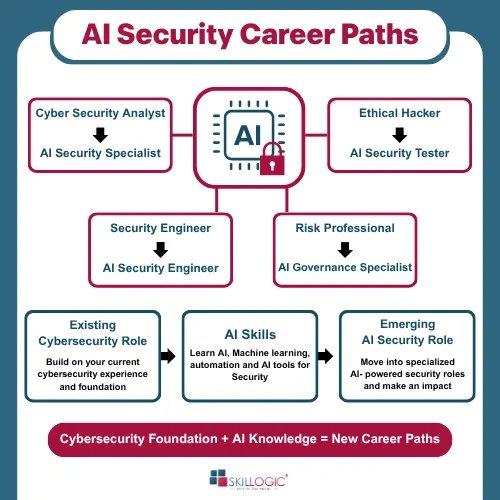
- Cyber Security Analyst to AI Security Specialist: Security analysts with experience in SIEM platforms, network traffic, endpoint security, and incident investigation can build AI security knowledge and take on responsibilities related to protecting AI-enabled systems.
- Ethical Hacker to AI Security Tester: Ethical hackers can expand their expertise by learning how to assess AI applications, APIs, model integrations, and AI-specific attack surfaces. This can help them identify vulnerabilities before they are exploited.
- Security Engineer to AI Security Engineer: Security engineers with experience in cloud infrastructure, identity management, application security, and secure architecture can add AI security skills and move toward the ai security engineer role. Securing an AI environment often requires protecting both the AI model and the infrastructure supporting it.
- Risk Professional to AI Governance Specialist: Professionals working in risk and compliance can develop knowledge of AI security, privacy, governance, and regulatory requirements. This can open pathways toward AI risk assessment and governance responsibilities.
These pathways demonstrate that ai security careers can develop from multiple cybersecurity backgrounds. The key is to build AI knowledge on top of a strong security foundation rather than treating AI security as an isolated subject.
AI Security career paths
Refer these articles:
- First Cyber Security Interview Tips for Pune Candidates
- Top Cyber Security Job Opportunities in Pune
- Cyber Security in Pune: Market Growth and Industry Insights
How to Prepare for a Career in AI Security
People interested in AI security jobs should approach preparation as a gradual combination of technical learning, practical experience, and continuous research.
Build Strong Cyber Security Foundations
Start with networking, Linux, operating systems, security fundamentals, authentication, Penetration testing and vulnerability assessment, cloud security, and incident response.
A professional who understands these areas will have a stronger foundation for securing AI systems and applications.
Learn AI Security Concepts and Common Threats
Learn how AI models and applications work and study cyber security risks such as prompt injection, data poisoning, model theft, data leakage, adversarial attacks, and insecure AI integrations.
NIST's AI RMF and its Generative AI Profile are useful reference points for understanding AI risk management and security considerations.
Gain Hands-On Experience Through Labs and Projects
Practical experience can make technical knowledge easier to demonstrate. Learners can create projects around secure AI APIs, access controls, AI application testing, threat detection, security monitoring, or AI risk assessments.
For example, a project could involve building a small AI application and documenting its attack surface, data flow, authentication controls, and potential security weaknesses.
Future Scope of AI Security Careers
The future of AI security will depend heavily on how quickly organizations adopt AI and how effectively they address the associated risks. AI is increasingly becoming part of applications, business workflows, security operations, and data environments. That means security responsibilities will extend across the complete AI lifecycle.
Increasing Adoption of AI Across Industries
AI is being introduced into sectors such as finance, healthcare, retail, manufacturing, education, technology, and professional services. Each implementation creates different security and privacy considerations.
As more organizations integrate AI into their operations, professionals may be needed to assess how these systems interact with existing applications, users, data, and infrastructure.
Growing Focus on Responsible and Secure AI
Security is becoming part of the broader conversation around trustworthy AI. NIST's AI RMF emphasizes characteristics such as security, resilience, privacy, accountability, transparency, and reliability.
This means future professionals may work across cyber security, privacy, governance, compliance, data protection, and AI risk management rather than within a single technical area.
Demand for Professionals With Combined AI and Security Skills
The most important development may be the convergence of two skill areas. Cybersecurity professionals who understand AI can contribute to securing AI systems, while AI professionals who understand cybersecurity can design safer systems.
ISC2's 2025 research supports this direction: 73% of respondents said AI would create more specialized cybersecurity skills, and 66% said AI would create a need for broader skill sets across the field.
This combination can expand cyber security career opportunities across engineering, security operations, governance, testing, risk management, and threat intelligence.
Refer these articles:
- How Freshers Can Start a Cyber Security Career in Chennai
- How Much is The Cyber Security Course Fee in Chennai
- Cyber Security Salary in Chennai: Fresher to Experienced
In short, AI is creating new responsibilities across cybersecurity, from protecting AI applications and data to testing models, managing risks, and responding to emerging threats. Professionals who combine cybersecurity fundamentals with AI, cloud, data protection, and risk management skills can prepare for changing roles in this field. Developing practical AI security knowledge can help beginners and experienced professionals explore emerging cyber security career opportunities.
An AI-integrated cybersecurity course can help learners build these skills through structured training in cybersecurity fundamentals, ethical hacking, threat detection, cloud security, AI security concepts, practical labs, and industry-focused projects. Learners looking for classroom-based training can also explore cyber security classes in Pune to develop practical knowledge and prepare for evolving cybersecurity roles.
SKILLOGIC provides an AI-integrated Cyber Security Professional Plus Course designed to help learners develop practical skills for the evolving cybersecurity landscape. The 4-month program includes 200+ learning hours and covers cybersecurity fundamentals, ethical hacking, vulnerability assessment, penetration testing, cloud security, and Artificial Intelligence for Cyber Security, along with practical projects and internship opportunities. The program is accredited by NASSCOM FutureSkills and IIFIS and includes a course completion certification pathway. SKILLOGIC also has 22+ training centers across India, with training presence in major cities such as Bangalore, Chennai, Hyderabad, Pune, Mumbai, Ahmedabad, Delhi, and Kolkata. Learners looking for a top cyber security institute in Chennai can explore SKILLOGIC's available training options in the city.