The Role of Business Analysts in Risk Assessment
Explore how business analysts identify, assess, and manage business risks using practical tools and techniques.
 Aiswarya N
Every business faces risks that can affect its operations, finances, and future plans. These may arise from market changes, process failures, financial uncertainties, or technology-related issues. Identifying them early helps organisations prevent losses and prepare for challenges.
Business analysts help by examining processes, analysing data, and identifying potential problems. Their findings support better decisions and help organisations manage risks effectively.
Let’s understand how business analysts in risk management help organisations identify, assess, and manage potential business risks..
Why is Risk Assessment Important for Businesses?
Risk assessment is the process of identifying potential problems, understanding how likely they are to happen, and evaluating their possible impact on business activities. It helps organisations prepare for situations that could affect their goals.
Here are some reasons why risk assessment is important for businesses:
- Prevents unexpected losses: Identifying financial and operational risks early can help businesses reduce avoidable expenses.
- Supports better decisions: Risk information allows managers to compare options before introducing changes or investing in new projects.
- Improves business processes: Reviewing workflows helps identify weaknesses, delays, and activities that may lead to errors.
- Supports regulatory compliance: Businesses can identify activities that may not meet legal or industry requirements.
- Protects business continuity: Preparing for possible disruptions helps organisations maintain important operations.
For example, a company planning to introduce a new payment system may face risks related to data security, transaction failures, and customer information. Assessing these risks before implementation helps the organisation prepare suitable controls. Understanding these challenges also helps develop business analyst skills, particularly in identifying potential issues and evaluating business processes.
This makes risk assessment in business analysis an important part of planning projects, improving processes, and supporting business decisions.
Read More:
- Cybersecurity Considerations for Business Analysts
- How Business Analysts Drive Digital Transformation
- Bridging the Gap Between IT & Business as a Business Analyst
The Role of Business Analysts in Risk Assessment
Business analysts help organisations understand risks by examining information, processes, and requirements. They work with different teams to identify possible problems and provide insights that support risk management decisions.
Here are the main responsibilities of business analysts in risk management:
1. Identifying Potential Business Risks
The first step is to identify situations that could affect business goals. Business analysts review existing processes, project requirements, stakeholder feedback, and historical data to find possible areas of concern.
For example, if a company frequently experiences delays in order processing, an analyst may examine the workflow to identify where problems occur. The issue could be caused by manual approvals, incomplete information, or poor coordination between departments.
Identifying these concerns early helps organisations address them before they become larger problems.
2. Analysing the Likelihood and Impact of Risks
After identifying potential risks, business analysts examine how likely each risk is to occur and how seriously it could affect the organisation.
A simple risk matrix can help classify risks based on their likelihood and impact. For example:
- High likelihood and high impact: Requires immediate attention and a clear response plan.
- High likelihood and low impact: Needs regular monitoring and process improvements.
- Low likelihood and high impact: Requires preventive measures and contingency planning.
- Low likelihood and low impact: Can be monitored through routine reviews.
This approach helps business analysts in risk management prioritise issues instead of treating every potential problem as equally important.
3. Evaluating Business Processes and Requirements
Business analysts examine existing workflows and project requirements to identify gaps that may create risks. They may review approval procedures, data handling methods, system requirements, and communication between teams.
For instance, if a project depends on information from multiple departments, unclear data ownership may lead to errors or delays. An analyst can identify this issue and recommend clearer responsibilities and documentation.
The Risk Management Market Size, Share, Growth & Trends, 2034 report by Fortune Business Insights highlights changes in how organisations manage risks. According to the report, cloud-based deployment accounts for nearly 58% of the risk management market share, while large enterprises represent around 67% of the spending ecosystem.
These figures reflect the growing use of digital platforms for managing risk information. Business analysts therefore need to work beyond traditional documentation and understand how automated systems and cloud-based data tracking support risk monitoring. Their role includes checking whether information is accurate, processes are properly defined, and stakeholders can use the findings effectively.
4. Communicating Risks to Stakeholders
Identifying a risk is not enough. Business analysts must also explain the issue to the people responsible for making decisions.
They prepare reports, discuss findings, and present information in a way that different stakeholders can understand. For example, a technical team may need details about a system weakness, while senior management may want to understand its financial or operational impact.
Clear communication helps business analysts in risk management ensure that important concerns are understood and addressed by the appropriate teams.
5. Recommending Risk Mitigation Strategies
Once risks have been evaluated, business analysts help identify ways to reduce their likelihood or impact. These actions are known as risk mitigation strategies.
Some common approaches include:
- Introducing additional approval steps for high-value transactions.
- Improving data validation to reduce incorrect entries.
- Updating business processes to prevent repeated delays.
- Establishing backup procedures for critical operations.
- Reviewing access permissions to protect sensitive information.
The analyst may work with project managers, technical teams, and department heads to evaluate these recommendations. The final decision usually depends on the organisation's priorities, resources, and risk tolerance.
6. Monitoring Risks and Reviewing Outcomes
Risk assessment is not a one-time activity. New risks can appear when business processes change, systems are updated, or external conditions shift.
Business analysts help monitor identified risks by reviewing performance reports, tracking agreed actions, and checking whether mitigation measures are working. They may also update risk documentation when new information becomes available.
This ongoing approach helps organisations understand whether their risk management efforts are effective and whether further action is required.
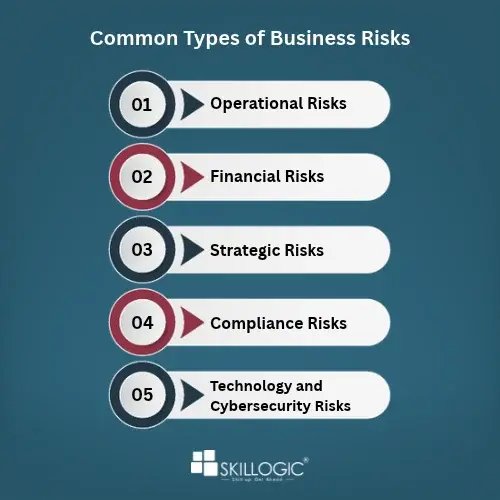
Common Types of Business Risks
Business risks can affect different areas of an organisation. Understanding the main types helps business analysts identify potential problems and decide where attention is needed.
Operational Risks
Operational risks arise from problems in daily business activities, including process failures, human errors, supply chain disruptions, and service delays.
For example, inaccurate inventory records may cause production delays. Business analysts can review stock data and workflows to identify the issue.
Financial Risks
Financial risks involve monetary losses or difficulties managing resources. These may include cash flow problems, unpaid loans, and unexpected expenses.
The banking, financial services, and insurance (BFSI) sector accounts for approximately 27.95% to 31% of the risk deployment market share as per Mordor Intelligence, highlighting the importance of risk evaluation in industries handling large financial transactions.
Business analysts in risk assessment examine transaction records, identify unusual patterns, and review financial processes to help reduce potential losses.
Strategic Risks
Strategic risks occur when business decisions or external changes affect long-term goals. Examples include entering new markets, launching unsuitable products, or failing to respond to customer needs.
Before expanding into a new region, for instance, a company must evaluate customer demand, competition, and operational costs. Business analysts help assess these factors and identify potential challenges.
Compliance Risks
Compliance risks arise when organisations fail to follow laws, regulations, industry standards, or internal policies, potentially leading to penalties and reputational damage.
Healthcare accounts for around 21% of the risk management market share in the industry breakdown provided. Healthcare organisations must protect sensitive patient information and follow strict data privacy and safety requirements.
Business analysts review processes and requirements to identify compliance gaps and recommend improvements.
Technology and Cybersecurity Risks
Technology risks include system failures, software issues, data breaches, and unauthorised access. These problems can disrupt operations and expose sensitive information.
For example, weak database access controls may increase the risk of data breaches. Business analysts in risk assessment work with IT teams to identify system gaps and support better security practices.
Read More:
- How to become a Business Analyst in India
- Business Analytics Scope in India
- How to Become a Business Analytics Expert in India
Tools and Techniques Business Analysts Use for Risk Assessment
Business analysts use software tools and structured techniques to identify risks, examine data, and evaluate their possible impact. While tools help organise and analyse information, techniques provide a systematic way to assess potential problems.
Tools Used for Risk Assessment
Some commonly used business analyst tools used for risk assessment include:
- Microsoft Excel: Helps organise risk data, calculate risk scores, track potential issues, and prepare assessment reports.
- SQL: Allows analysts to retrieve and examine database records to identify unusual patterns, errors, and possible risks.
- Microsoft Power BI: Helps create dashboards and visual reports to monitor risk indicators and business performance.
- Jira: Supports risk tracking during projects by recording issues, assigning responsibilities, and monitoring their status.
- Risk Management Software: Platforms such as Riskonnect and LogicGate help organisations document risks, monitor controls, and manage risk-related activities.
Techniques Used for Risk Assessment
Business analysts also apply different techniques to understand risks and determine suitable responses.
- SWOT Analysis: Examines strengths, weaknesses, opportunities, and threats that may affect business objectives.
- Risk Matrix: Classifies risks based on their likelihood and potential impact to help prioritise them.
- Root Cause Analysis: Identifies the underlying reasons behind a problem rather than focusing only on its visible effects.
- Scenario Analysis: Evaluates possible situations and their potential impact on business operations.
- Risk Register: Maintains a record of identified risks, their impact, assigned owners, and planned responses.
The Business Analytics Market Size, Trends & Forecast study by Mordor Intelligence reports that descriptive analytics accounts for 32.05% of analytical infrastructure, while predictive analytics is expanding at a CAGR of 8.74%.
This highlights the growing importance of using data to anticipate potential problems instead of only reviewing past performance. Business analysts can apply predictive analytics to examine trends, evaluate scenarios, and support activities such as credit risk assessment, demand forecasting, and operational planning.
Combining suitable tools with structured techniques helps business analysts in risk management turn business information into practical findings and support better decisions.
In short, business analysts help organisations identify potential risks, understand their impact, and evaluate ways to reduce them. By examining business processes, analysing data, communicating with stakeholders, and monitoring outcomes, they support more informed decisions. A combination of analytical thinking, technical knowledge, and business understanding allows analysts to contribute to risk assessment across different industries.
Developing a career in business analysis requires an understanding of business processes, risk assessment, stakeholder requirements, and data analysis. Enrolling in a business analyst course in Bangalore or Ahmedabad, Chennai, Coimbatore, Pune, Mumbai, Nagpur, Delhi, or Hyderabad can help learners build these skills and prepare for business analysis roles.
With a focus on industry-relevant education, SKILLOGIC has built its training approach around practical knowledge and professional skill development. The institute is recognised by Silicon India and has trained over 2,00,000 learners during its 13 years of experience. Its industry credibility is further supported by 25+ global accreditations and partnerships, including IABAC, PEOPLECERT, PMI, and ICFQ.
The SKILLOGIC AI-powered Certified Business Analyst Course, accredited by IABAC, covers requirement gathering, business process analysis, data interpretation, and reporting through practical exercises and real-world projects. The programme offers classroom and online learning options. Learners interested in offline training can explore SKILLOGIC's business analyst course in Hyderabad, Delhi, Pune, Mumbai, Bangalore, Chennai, and Ahmedabad.