Day-to-Day Responsibilities of a Cyber Security Professional: What to Expect
Discover the day-to-day responsibilities of a cyber security professional, key job roles, daily tasks, essential skills, tools, and career insights.
 Nashid Hussain CN
Cyber threats have become a major concern for businesses of all sizes. From ransomware and phishing attacks to data breaches and insider threats, organizations face security risks every day. As businesses continue adopting cloud technologies, remote work, and digital services, the demand for a skilled cyber security professional continues to grow.
A cyber security professional plays a vital role in protecting networks, systems, and sensitive data from cyber threats. Understanding the day-to-day responsibilities of a cyber security professional gives students, job seekers, and IT professionals a clear idea of what this career involves and the skills needed to succeed.
Here, we will discuss the day-to-day responsibilities of a cyber security professional, common cyber security job roles and responsibilities, essential skills, tools, daily challenges, and what you can expect in a typical workday.
What Does a Cyber Security Professional Do?
A cyber security professional is responsible for protecting an organization's digital assets, including networks, computers, applications, cloud environments, and sensitive data. Their primary objective is to prevent cyberattacks, detect security threats, minimize risks, and ensure business continuity.
The cyber security job description varies depending on the company, industry, and level of experience. For example, professionals working in banks focus heavily on protecting financial transactions, while healthcare organizations prioritize patient data security. Similarly, startups may have one security engineer handling multiple responsibilities, whereas large enterprises have dedicated teams for different security functions.
Some of the most common cyber security job roles include:
- SOC Analyst
- Security Analyst
- Penetration Tester
- Incident Responder
- Security Consultant
- Cloud Security Engineer
- Security Operations Engineer
- Digital Forensics Analyst
Although each role has specialized responsibilities, they all work toward the same goal keeping an organization's digital environment secure.
Refer these articles:
- How to Start a Career in Cyber Security
- Network Security Fundamentals: Beginner’s Guide
- Information Security vs Cybersecurity
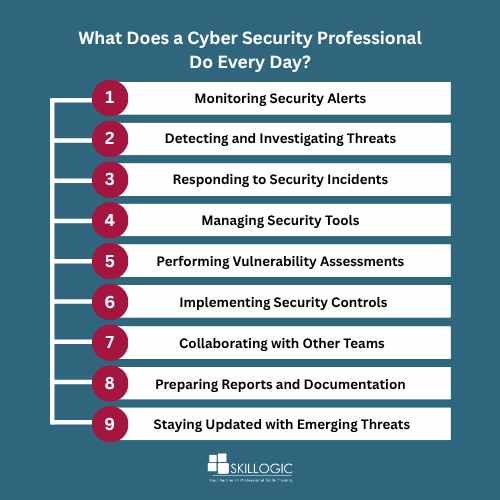
What Does a Cyber Security Professional Do Every Day?
No two working days are exactly the same in cyber security. New threats appear daily, requiring professionals to stay alert and respond quickly. Below are some of the most common daily responsibilities.
Monitoring Security Alerts
One of the first tasks every morning is reviewing alerts generated by security monitoring tools. Organizations receive thousands of alerts every day, but not all of them indicate real threats.
Security professionals regularly:
- Review SIEM dashboards
- Monitor authentication attempts
- Identify suspicious login activities
- Detect unusual user behavior
- Prioritize alerts based on risk level
The goal is to identify genuine threats before they impact business operations. Effective monitoring helps security teams detect attacks in their early stages and respond faster.
Detecting and Investigating Threats
After identifying suspicious activities, the next step is investigation.
The daily tasks of a cyber security expert often include analyzing unusual network traffic, reviewing endpoint logs, examining malware behavior, and identifying phishing attempts. They investigate whether an alert is a false positive or an actual attack.
During investigations, professionals may:
- Analyze system logs
- Review firewall records
- Track attacker activity
- Examine malware samples
- Identify compromised devices
Finding the source of an attack helps organizations understand how the breach occurred and prevents similar incidents in the future.
Responding to Security Incidents
Cyber incidents require immediate attention. Whether it is ransomware, malware, unauthorized access, or data leakage, quick action can significantly reduce business impact.
Incident response activities include:
- Isolating infected systems
- Blocking malicious IP addresses
- Removing malware
- Restoring affected services
- Coordinating with IT teams
- Documenting every action taken
Strong incident response minimizes downtime and helps organizations recover more efficiently after an attack.
Managing Security Tools
Organizations depend on various security solutions to protect their infrastructure. A cyber security professional spends time ensuring these tools are working correctly.
Daily tool management includes:
- Updating antivirus software
- Monitoring endpoint protection platforms
- Reviewing firewall rules
- Managing intrusion detection and prevention systems
- Checking email security gateways
- Verifying backup systems
Poorly configured security tools can create vulnerabilities, making regular maintenance an essential responsibility.
Performing Vulnerability Assessments
Cyber attackers continuously search for weaknesses in systems. To stay ahead, security teams regularly perform vulnerability assessments.
Typical activities include:
- Running automated vulnerability scans
- Identifying outdated software
- Reviewing missing security patches
- Detecting configuration errors
- Evaluating network security
After identifying vulnerabilities, professionals prioritize them based on severity and recommend remediation measures before attackers can exploit them.
Implementing Security Controls
Finding security weaknesses is only the beginning. The next step is strengthening defenses.
This involves implementing security controls such as:
- Applying operating system updates
- Installing application patches
- Configuring two factor authentication
- Managing user access permissions
- Enforcing password policies
- Hardening servers and endpoints
These preventive measures reduce the organization's attack surface and improve overall security posture.
Every organization follows different security standards, but implementing strong controls remains one of the most important cybersecurity job responsibilities.
Collaborating with Other Teams
Cyber security is not an isolated function. Protecting an organization requires close collaboration with multiple departments. One of the important cyber security job roles and responsibilities is working with different teams to build and maintain a secure IT environment.
A cyber security professional regularly works with:
- Software developers to identify security flaws during application development.
- IT infrastructure teams to secure servers, networks, and cloud environments.
- System administrators to manage user accounts and permissions.
- Compliance teams to ensure the organization follows security regulations.
- Senior management to explain cyber risks and recommend security improvements.
Security professionals also participate in meetings before new applications or systems are launched. Their role is to identify potential security risks early and recommend preventive measures before deployment. This proactive approach reduces vulnerabilities and lowers the chances of future cyber security incidents.
Preparing Reports and Documentation
Documentation is an important part of every security team's daily routine. Maintaining accurate records helps organizations improve their security posture and meet compliance requirements.
Typical documentation includes:
- Incident response reports
- Vulnerability assessment reports
- Security audit findings
- Risk assessment summaries
- Compliance documentation
- Monthly security performance reports
These reports provide valuable insights into the organization's security status and help management make informed decisions.
For example, after investigating a phishing attack, a security analyst documents how the attack occurred, the systems affected, the actions taken, and recommendations to prevent similar incidents. Proper documentation also supports future investigations and regulatory audits.
Staying Updated with Emerging Threats
Cyber criminals constantly develop new attack techniques. As a result, learning never stops in cyber security.
One of the what does a cyber security expert do every day is staying informed about the latest threats, vulnerabilities, and security technologies.
Security professionals regularly:
- Read threat intelligence reports
- Follow cyber security news websites
- Monitor vulnerability databases
- Study newly discovered malware
- Participate in webinars and technical workshops
- Practice in cyber security labs
Keeping up with the latest trends enables professionals to detect attacks faster and apply the most effective defense strategies.
Cyber Security Professional Daily Responsibilities
The importance of skilled professionals is reflected in industry growth. According to the Persistence Market Research report 2026, the global cybersecurity market is projected to grow from US$ 234.2 billion in 2026 to US$ 486.2 billion by 2033, registering a compound annual growth rate (CAGR) of 11.0%. The report attributes this growth to the increasing number of sophisticated cyberattacks, rapid cloud adoption, AI-powered security solutions, and stricter regulatory compliance across industries such as banking, healthcare, government, and IT. This rapid market expansion continues to create strong demand for skilled cyber security professionals.
Refer these articles:
- How to Become a Cyber Security Expert in India
- How much is the Cyber Security Course Fee in India
- Cyber Security Scope in India
Essential Skills Needed for Daily Cyber Security Tasks
Daily cyber security work requires a combination of technical expertise and problem-solving abilities.
Cyber Security Technical Skills
Successful professionals should develop knowledge in:
- Computer networking
- Windows and Linux operating systems
- Cloud security concepts
- SIEM platforms
- Endpoint Detection and Response (EDR)
- Firewall management
- Vulnerability assessment tools
- Identity and Access Management (IAM)
- Basic scripting using Python, PowerShell, or Bash
- Incident response methodologies
These cyber security skills help professionals detect, investigate, and respond to cyber threats effectively.
Soft Skills
Along with technical knowledge, professionals need strong communication, analytical thinking, teamwork, and time management skills. They should be able to solve problems quickly, explain technical issues in simple language, and remain calm while handling security incidents under pressure.
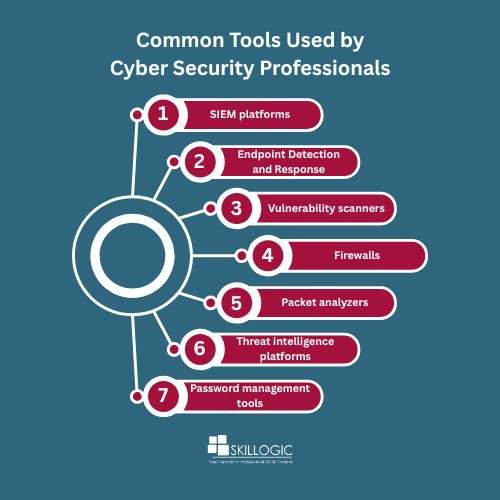
Common Tools Used by Cyber Security Professionals
A cyber security professional relies on various tools to monitor systems, detect threats, and strengthen security. While different organizations use different technologies, several cyber security tools are commonly found across the industry.
SIEM Platforms
Security Information and Event Management (SIEM) platforms collect and analyze logs from multiple systems, helping analysts identify suspicious activities quickly.
Examples include:
- Microsoft Sentinel
- Splunk
- IBM QRadar
- Google SecOps
Endpoint Detection and Response (EDR)
EDR solutions in cyber security continuously monitor endpoints such as laptops and servers to detect malware, ransomware, and suspicious behavior.
Popular EDR platforms include:
- Microsoft Defender for Endpoint
- CrowdStrike Falcon
- SentinelOne
Vulnerability Scanners
These tools identify known security weaknesses before attackers can exploit them.
Common vulnerability scanners include:
- Nessus
- Qualys
- OpenVAS
Firewalls
Firewalls filter network traffic and block unauthorized access to organizational systems.
Both hardware and software firewalls are used to strengthen network security.
Packet Analyzers
Packet analyzers help investigate suspicious network traffic.
Wireshark is one of the most widely used packet analysis tools for troubleshooting and forensic investigations.
Threat Intelligence Platforms
Threat intelligence platforms provide real-time information about malware campaigns, malicious IP addresses, ransomware groups, and emerging cyber threats.
Password Management Tools
Password managers help organizations securely store and manage credentials while supporting strong password policies and multi-factor authentication.
Common Cyber Security Tools
Refer these articles:
- How to Become an Ethical Hacker After Graduation in Mumbai
- Cyber Security in Mumbai: Market Growth and Industry Insights
- How to Choose Best Institute for Ethical hacking in Ahmedabad
- First Cyber Security Interview Tips for Ahmedabad Candidates
Challenges Cyber Security Professionals Face Every Day
Although cyber security is a rewarding career, professionals face several challenges in their daily work.
- Evolving Cyber Threats: Attack methods constantly change, requiring continuous learning and quick adaptation.
- Alert Fatigue: Security teams must filter thousands of alerts to identify real threats.
- Skill Shortages: Many organizations have limited cyber security staff, increasing workloads.
- Balancing Security and Business: Strong security measures must not disrupt daily business operations.
- Managing Multiple Incidents: Professionals often handle several security incidents simultaneously while prioritizing critical threats.
In short, the day-to-day responsibilities of a cyber security professional involve monitoring threats, responding to incidents, securing systems, and working with teams to protect organizational data. As cyber threats continue to grow, skilled professionals remain in high demand, making cyber security a rewarding career for those who build practical skills through continuous learning and hands-on experience. Enrolling in cyber security classes in Mumbai can be a great way to gain the practical knowledge and industry exposure needed to start a successful career in this field.
A structured cyber security course helps you gain practical skills through hands-on labs, real-time projects, and industry-relevant training. Choosing a program with certifications, internship opportunities, and placement support can help you build a strong foundation for a successful career in cyber security.
SKILLOGIC is a leading cyber security training institute that offers the Cyber Security Professional Plus Training, a comprehensive 4-month course accredited by IIFIS and NASSCOM FutureSkills. The program combines hands-on labs, live projects, internship opportunities, and industry-recognized certifications to help learners develop practical cyber security expertise. With 25+ training centers across India, including cyber security courses in Ahmedabad, Bengaluru, Hyderabad, Chennai, Pune, Mumbai, Nagpur and Delhi, SKILLOGIC provides job-oriented training designed to prepare learners for successful careers in cyber security.