How to Reduce Employee Attrition Using HR Analytics
Learn how HR analytics helps businesses identify employee turnover patterns, understand attrition causes, improve employee retention, and make data-driven workforce decisions.
 Aiswarya N
Employees play an important role in an organisation's success. When experienced employees leave, businesses may face higher recruitment costs, knowledge gaps, and reduced productivity. While some employees leave for better opportunities, others may be dissatisfied with their workload, compensation, or career growth.
HR analytics helps organisations understand these challenges by studying workforce data and identifying patterns.
Let's explore how to reduce employee attrition using HR analytics and improve employee retention through data-driven decisions.
What is Employee Attrition in HR Analytics?
Employee attrition refers to a reduction in an organisation's workforce when employees leave due to resignation, retirement, or other reasons. Unlike turnover, which often involves replacing departing employees, attrition may leave positions unfilled.
HR analytics examines employee data, including tenure, salary, performance, and exit feedback, to understand workforce changes. For example, if employees with less than two years of experience frequently resign, HR teams can investigate possible reasons such as workload, management, or limited career growth. This process is known as employee attrition analysis.
Refer these articles:
- The Hidden Role of Business Analysts in Successful Startups
- Agile for Business Analysts: A Practical Implementation Guide
- Boosting Employee Engagement Through HR Analytics Tools
Why is Employee Attrition a Challenge for Organisations?
Employee attrition can affect business operations in several ways:
- Higher recruitment costs: Finding and training replacements requires time and resources.
- Loss of knowledge: Experienced employees take valuable skills and organisational knowledge with them.
- Reduced productivity: Teams may struggle to maintain their usual output during staff changes.
- Lower employee morale: Frequent departures can create uncertainty among existing employees.
- Increased workload: Remaining employees may need to handle additional responsibilities.
Understanding these effects helps organisations recognise why employee retention should be a priority.
How to Reduce Employee Attrition Using HR Analytics
HR analytics helps organisations identify workforce concerns and develop practical solutions.
Here are ways to use data to improve employee retention using HR Analytics:
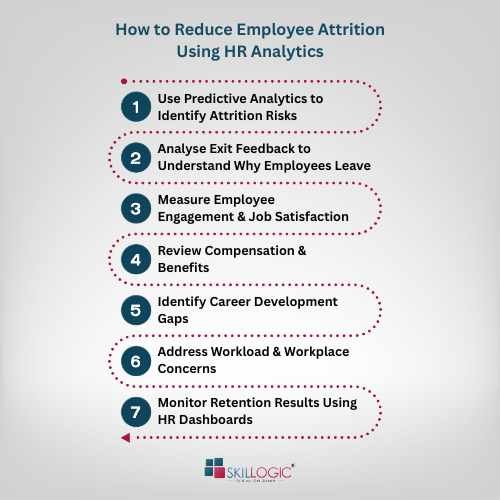
1. Use Predictive Analytics to Identify Attrition Risks
Predictive analytics uses historical data to identify patterns that may indicate a higher likelihood of employees leaving. HR teams can examine employee tenure, performance trends, promotion history, and engagement survey results to understand potential risks.
For example, if employees in a particular department report low satisfaction and limited career opportunities, HR can investigate these concerns before they lead to more resignations.
The IBM's The Augmented Workforce for an Automated, AI-Driven World explores how AI can transform workforce capabilities. The previously supplied claim that companies using predictive talent insights achieve 15% higher revenue growth could not be verified against this report, so I would not include that figure without a supporting source.
Predictive insights should guide further investigation rather than be treated as proof that a particular employee will resign. Combining these insights with HR expertise and employee feedback makes employee attrition using HR analytics more useful.
2. Analyse Exit Feedback to Understand Why Employees Leave
Employee exit interviews provide useful information about why people decide to leave an organisation. HR teams can combine this feedback with resignation records and employee surveys to identify recurring concerns.
For example, if several employees mention limited promotion opportunities, the organisation can review its career development policies. If employees repeatedly report excessive workloads, managers can assess staffing levels and task distribution.
This type of employee attrition analysis helps organisations address underlying problems instead of responding to each resignation separately.
3. Measure Employee Engagement and Job Satisfaction
Employee engagement reflects how motivated and connected people feel at work. Low engagement may indicate concerns about management, recognition, communication, or work-life balance.
HR teams can use engagement surveys, satisfaction scores, and feedback forms to identify areas that need improvement.
The Mercer Global Talent Trends 2026 Report highlights the importance of employee wellbeing. According to the report figures supplied for this article, the proportion of workers thriving at work fell from 66% in 2024 to 44% in 2026.
Organisations can respond by improving manager communication, recognising employee contributions, and addressing workplace concerns. These findings can support HR analytics for employee retention by helping HR teams identify where additional employee support may be needed.
4. Review Compensation and Benefits
Salary and benefits can influence an employee's decision to stay with an organisation. HR analytics helps businesses assess whether their compensation packages are competitive and consistent.
HR teams can compare salaries across roles, departments, and experience levels. They can also examine bonuses, benefits, and salary revision patterns to identify possible gaps.
For example, if employees with similar responsibilities receive significantly different compensation without a clear explanation, HR can investigate the issue.
Using employee attrition using HR analytics to evaluate compensation helps organisations identify concerns and make fairer, data-informed decisions.
5. Identify Career Development Gaps
Employees may leave when they cannot see a clear path for career progression. HR analytics can help identify employees who have limited training opportunities, few promotion prospects, or skills that are not being fully developed.
For example, if employees who receive relevant training show stronger retention than those who do not, the organisation can investigate whether additional learning opportunities would benefit other teams.
HR teams can use these findings to improve training programmes, encourage internal promotions, and create clearer career paths. This is an important part of HR analytics for employee retention, particularly when employees want to develop new skills or take on greater responsibilities.
6. Address Workload and Workplace Concerns
Heavy workloads, unclear expectations, and limited managerial support can affect employee satisfaction. HR teams can examine workload patterns, employee feedback, overtime records, and engagement scores to identify potential problems.
The PwC Global Workforce Hopes and Fears Survey found that 28% of workers were very or extremely likely to switch employers within the following 12 months, compared with 19% during the 2022 Great Resignation. The survey also found that 45% of workers experienced a significant increase in workload over the previous year.
Organisations can use workforce feedback to review working practices, distribute tasks more fairly, provide appropriate training, and help managers support their teams. Addressing these concerns can reduce avoidable frustration and improve the employee experience.
7. Monitor Retention Results Using HR Dashboards
After introducing retention measures, HR teams need to assess whether those changes are making a difference. HR dashboards bring important workforce metrics together in one place, making trends easier to monitor.
For example, an organisation might introduce a career development programme in a department with high attrition. HR teams can then compare attrition rates, engagement scores, and internal promotion figures before and after the programme.
If the results do not improve, the organisation can investigate other possible causes rather than assuming the initiative has failed for one specific reason.
Regular monitoring helps businesses evaluate their retention efforts and adjust them based on employee feedback and changing workforce needs.
Refer these articles:
- How to Become a Business Analytics Expert in India
- Business Analytics Scope in India
- How much is the Business Analytics Course Fee in India
Key HR Analytics Metrics to Measure Employee Attrition
HR teams use several metrics to understand workforce movement and evaluate retention efforts. The following are the key HR analytics metrics organisations can use to measure employee attrition and evaluate their retention efforts:
Metric |
What It Measures |
| Employee turnover rate | Rate at which employees leave and are replaced. |
| Employee retention rate | Percentage of employees who remain with the organisation. |
| Average employee tenure | Average length of time employees stay with the organisation. |
| Employee engagement score | Employees' reported level of engagement and connection with work. |
| Voluntary attrition rate | Percentage of employees who leave by choice. |
| Cost of employee turnover | Expenses associated with employee departures and replacements. |
The employee attrition rate is a useful starting point for measuring workforce changes.
Formula:
Employee Attrition Rate = (Number of Employees Who Left During a Period ÷ Average Number of Employees During That Period) × 100
For example, if an organisation has an average of 500 employees and 40 leave during a year, its annual attrition rate is 8%.
HR teams can compare this figure across periods and departments to identify areas that require further investigation. Looking at the rate alongside employee feedback and other workforce metrics provides a clearer picture of retention challenges.
Challenges of Using HR Analytics to Reduce Employee Attrition
Although HR analytics can support better workforce decisions, organisations need to consider several challenges.
These are some of the common challenges organisations may face when using HR analytics to reduce employee attrition:
- Incomplete or inaccurate data: Missing employee records or outdated information can lead to misleading findings.
- Employee data privacy: Salary details, performance records, and survey responses must be handled securely and responsibly.
- Bias in predictive models: Historical data may reflect existing workplace inequalities, which can influence predictions.
- Difficulty interpreting results: A pattern in workforce data does not always explain why an employee plans to leave.
- Limited action on insights: Identifying a problem is not enough if managers do not address the underlying concern.
Organisations can manage these challenges by maintaining accurate records, protecting employee confidentiality, reviewing analytical models for bias, and involving HR professionals in decision-making. Employees should not be labelled as likely to resign based solely on a prediction.
In short, understanding why employees leave helps organisations improve retention and reduce avoidable workforce disruptions. By examining employee engagement, compensation, career development, and workplace concerns, HR teams can make informed decisions that address the causes of attrition. Effective employee attrition using HR analytics combines reliable data with employee feedback and practical action. This approach helps organisations improve employee satisfaction and build a more stable workforce.
SKILLOGIC offers industry-focused training programmes designed to help learners develop practical skills across various domains, including HR Analytics, Business Analytics, Marketing Analytics, Cyber Security, and Ethical Hacking. With over 15 years of experience, more than 150,000 learners globally, over 100 expert trainers, and over 25 global accreditations, the institute combines structured learning with practical exercises and real-world case studies. Its IABAC-accredited HR Analytics Certification Course covers workforce data analysis, recruitment analytics, employee performance measurement, HR metrics, and dashboard creation. Learners who want to strengthen their analytical skills for HR roles can explore the HR analytics training to learn about the course curriculum and practical learning opportunities.