Using HR Analytics to Identify Skill Gaps
Learn how HR analytics helps identify employee skill gaps, assess workforce capabilities, and support targeted training and development for better business outcomes.
 Aiswarya N
Employees need the right skills to perform their jobs effectively and meet changing business requirements. However, organisations may not always know which capabilities their workforce already has, where employees need improvement, or what skills will be required in the future.
HR analytics to identify skill gaps helps HR teams understand these differences by examining employee data, performance records, training history, and job requirements. These insights help organisations make informed decisions about employee development, workforce planning, and future skill needs.
Let’s explore how using HR analytics to identify skill gaps can help organisations understand workforce needs and plan effective employee development strategies.
What Are Skill Gaps in the Workplace
A skill gap is the difference between an employee's current abilities and the skills required to perform a job effectively.
For example, a marketing employee may understand campaign planning but lack the data analysis skills needed to measure campaign results. Similarly, a team leader may have strong technical knowledge but need to improve communication or conflict resolution.
Skill gaps generally fall into two categories:
- Technical skill gaps: Missing knowledge of software, tools, systems, or job-specific processes.
- Soft skill gaps: Areas for improvement in communication, teamwork, leadership, adaptability, and problem-solving.
The scale of this challenge is highlighted in the World Economic Forum's Future of Jobs Report 2025. It projects that 39% of workers' existing core skills will change or become outdated by 2030. The report also estimates that 59 out of every 100 workers will need training by then, while 63% of employers identify skill gaps as a major barrier to business transformation. These findings show why organisations need to understand their current workforce capabilities and prepare for changing job requirements.
Refer these articles:
- The Hidden Role of Business Analysts in Successful Startups
- Agile for Business Analysts: A Practical Implementation Guide
- Boosting Employee Engagement Through HR Analytics Tools
How HR Analytics Helps Identify Skill Gaps
HR analytics helps organisations examine workforce information to understand where employees may need additional knowledge or practical experience. Rather than relying only on managers' observations, HR teams can compare employee capabilities with role expectations and identify patterns across departments.
For example, if several employees struggle to use a reporting platform, HR can examine their assessment results and work performance to determine whether they need additional training. This approach makes HR analytics for skill gap analysis useful for identifying specific development needs instead of assuming that every employee requires the same support.
The ManpowerGroup Global Talent Shortage Survey highlights the difficulty employers face in finding suitable talent. Its reported findings indicate that 72% of employers struggle to find the skilled workers they need, 75% of technology employers face difficulties filling key roles, and 84% of hiring managers consider soft skills as important and difficult to find as technical skills. This reinforces the need to assess both technical abilities and interpersonal competencies when evaluating workforce readiness.
Key HR Data Used to Identify Skill Gaps
Effective analysis depends on collecting relevant and reliable information. HR teams can use several data sources to understand employee capabilities.
The following data sources help HR teams assess employee capabilities and identify areas where additional training or development may be needed:
- Skills assessments: Practical tests and competency evaluations help measure employees' existing knowledge and proficiency.
- Performance reviews: Feedback and performance indicators can highlight areas where employees need additional support.
- Training records: Course completion, certifications, and assessment results provide information about previous learning.
- Employee surveys and manager feedback: These reveal employees' development needs, confidence levels, and work-related difficulties.
- Job descriptions and competency frameworks: These establish the skills and proficiency levels expected for each role.
Combining these sources provides a more complete picture than relying on a single record. For example, a performance review may highlight a problem, while a practical test can help determine whether the employee lacks the necessary knowledge or needs more experience applying it.
According to Gartner's HR research, 41% of surveyed HR leaders agreed that their workforce lacked required skills, 50% said their organisation did not effectively leverage employee skills, and 62% viewed uncertainty about future skills as a significant risk. Only 8% of organisations had reliable data on workforce skills and their impact on business success. These findings highlight the importance of maintaining accurate employee records and using consistent skills assessment in HR.
Steps to Identify Skill Gaps Using HR Analytics
Here are practical steps organisations can follow to assess employee capabilities, identify development priorities, and measure progress:
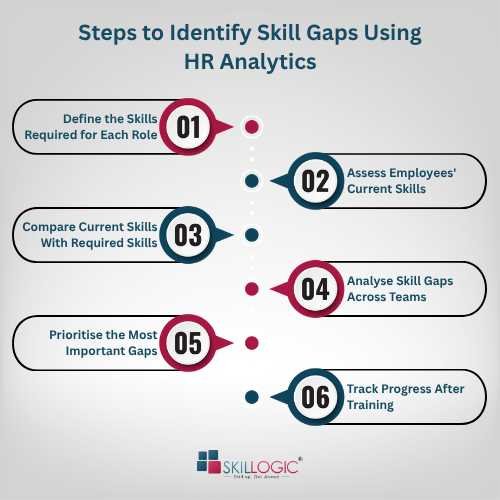
1. Define the Skills Required for Each Role
Start by identifying the competencies employees need to perform their responsibilities. These requirements may come from job descriptions, business objectives, new technologies, or changes in customer expectations.
For example, a business analyst may need proficiency in Excel, SQL, data visualisation, and stakeholder communication. Clear expectations give HR a benchmark for HR analytics to identify skill gaps accurately.
2. Assess Employees' Current Skills
Gather information about what employees can currently do using practical tests, certifications, self-assessments, manager feedback, and performance records. Choose assessment methods that match the actual requirements of each role.
A skills assessment in HR should measure demonstrated abilities wherever possible, rather than relying entirely on employees' opinions of their own capabilities. Practical exercises can help establish whether employees can apply their knowledge to work-related tasks.
3. Compare Current Skills With Required Skills
Compare each employee's current proficiency with the expected level for their role. This helps distinguish between skills that are missing, skills that need improvement, and competencies that already meet expectations.
For instance, an employee may understand basic SQL queries but struggle with complex data extraction. This employee may need advanced SQL training rather than a beginner course. A structured employee skill gap analysis helps HR identify the right level of support.
4. Analyse Skill Gaps Across Teams
Once individual results are available, examine patterns across departments and job roles. If several employees lack the same competency, a team-wide training programme may be more effective than separate interventions.
Gartner's research also identified challenges in moving talent to where it is needed. Fewer than 20% of surveyed organisations effectively moved talent to fill skill gaps, while just 23% effectively developed future skills. These findings suggest that organisations need to act on skills data by improving internal mobility and preparing employees for emerging responsibilities.
HR analytics for skill gap analysis can help HR teams recognise shared development needs and identify employees whose existing capabilities may suit other roles.
5. Prioritise the Most Important Gaps
Not every skill gap requires immediate attention. Consider business objectives, job requirements, operational risks, and the likely impact of improving each competency before deciding where to focus resources.
For example, if a company introduces a new reporting system, employees' ability to use it may become an immediate priority. Other development needs can be addressed over time. This helps organisations use HR analytics to identify skill gaps in a way that supports practical workforce planning.
6. Track Progress After Training
After employees complete training, evaluate whether their skills have improved. Compare pre-training and post-training assessment results, review relevant work outcomes, and collect feedback from employees and managers.
A follow-up skills assessment in HR can establish whether employees have reached the expected proficiency level. If progress is limited, HR may need to provide additional practice, adjust the learning approach, or offer individual support. Monitoring these results also helps determine whether the training programme is meeting its intended objectives.
Refer these articles:
- How to Become a Business Analytics Expert in India
- Business Analytics Scope in India
- How much is the Business Analytics Course Fee in India
In short, HR analytics to identify skill gaps gives organisations a structured way to understand the difference between employees' existing abilities and the skills their roles require. By combining reliable data with appropriate assessments and employee feedback, HR teams can identify development priorities, make better training decisions, and monitor progress. This helps employees build relevant capabilities while enabling organisations to prepare for changing workforce needs.
SKILLOGIC offers an HR Analytics Certification Course that helps learners develop practical skills in analysing workforce data, understanding HR metrics, evaluating recruitment patterns, and tracking employee performance. The training covers people analytics dashboards through hands-on projects and real-world case studies. Learners also receive IABAC certification, guidance from experienced trainers, and the flexibility to choose classroom or online learning. SKILLOGIC provides training options in Bangalore, Chennai, Coimbatore, Hyderabad, Ahmedabad, Pune, Mumbai, and Delhi.