A Complete Guide to HR Analytics
Discover a complete guide to HR Analytics, covering its importance, key metrics, tools, techniques, and real-world applications. Learn how HR Analytics helps organizations make data-driven workforce decisions, improve employee performance, optimize hiring, boost retention, and drive business growth.
 Kriti Maurya
Many HR professionals and graduates struggle to understand whether HR analytics is a technical role or a people-focused HR career. The truth lies in between it combines human understanding with data-driven decision-making. Five years ago HR teams relied on spreadsheets to monitor turnover. Many students and early-career HR professionals are unsure whether HR analytics is a technical data role or a human-focused HR career. This confusion is common because the field sits between people management and data interpretation. In reality, HR analytics is not about replacing HR judgment it is about improving workforce decisions using evidence rather than assumptions
A LinkedIn study revealed that companies implementing AI-driven HR solutions achieved a 30% reduction in time-to-hire. This demonstrates the growing role of AI in helping HR teams make faster hiring decisions while creating stronger and more future-ready organizations.This growth reflects not just tool adoption, but a shift where HR decisions are expected to show measurable impact on retention, hiring efficiency, and workforce cost optimization.
Organizations are investing in HR analytics software and intelligent dashboards to improve employee retention, enhance workforce productivity, and support strategic decision-making.
The Role of HR Analytics in the Modern Workplace
Modern organizations generate enormous amounts of employee data, including recruitment metrics, attendance records, performance evaluations, engagement surveys, learning outcomes, and compensation information. HR analytics converts this raw data into meaningful business insights that help organizations make smarter workforce decisions. HR analytics now supports organization-wide decision-making beyond HR functions. It helps finance, operations, and leadership optimize workforce planning, control labor costs, and forecast hiring needs for business expansion. The Gallup reports that companies with highly engaged workforces achieve 23% higher profitability and 18% higher productivity, demonstrating how data-driven HR strategies can enhance employee performance and organizational success.
For example, instead of HR guessing why employees leave, workforce analytics helps identify patterns like workload imbalance, manager feedback trends, or compensation gaps that directly influence attrition.
Some of the major benefits of HR analytics include:
- Better Hiring Decisions: HR analytics helps identify the most suitable candidates using recruitment data, improving hiring quality and reducing hiring time.
- Improved Employee Retention: Organizations can predict employee turnover and implement strategies to improve engagement and reduce attrition.
- Enhanced Workforce Productivity: By analyzing performance and workload data, HR analytics helps improve employee efficiency and overall business productivity.
- Reduced Recruitment Costs: HR analytics identifies the most effective hiring channels, lowering recruitment expenses and improving hiring ROI.
- Optimized Workforce Planning: It enables organizations to forecast future talent needs, address skill gaps, and align workforce planning with business growth.
For example, organizations can use HR analytics metrics such as employee turnover rate, cost per hire, absenteeism, training effectiveness, employee engagement scores, and productivity indicators to improve overall workforce performance.
A well-designed HR analytics dashboard enables HR leaders and executives to monitor these metrics in real time. Instead of reviewing multiple spreadsheets, decision-makers gain a centralized view of workforce health, enabling faster and more informed decisions.
The real value of HR analytics is not in collecting employee data, but in identifying patterns that influence workforce behavior. For example, a consistent drop in training participation may signal disengagement long before resignation occurs.
Refer to the articles for more info:
- The Hidden Role of Business Analysts in Successful Startups
- Agile for Business Analysts: A Practical Implementation Guide
- How Generative AI is Reshaping the Business Analyst Role
Types of HR Analytics and Its Importance
One of the most important aspects of this HR analytics guide is understanding the different types of HR analytics and how each supports business objectives. Organizations rarely implement all four analytics types simultaneously. Most organizations evolve through analytics maturity: starting with descriptive reporting, then diagnosing causes, followed by predictive forecasting, and finally prescriptive decision-making. Very few companies operate at all levels simultaneously.
1. Descriptive Analytics
Descriptive analytics is useful for reporting but does not explain business causes. For example, knowing that attrition increased by 12% is not actionable unless the reason behind it is understood. Descriptive analytics summarizes historical HR data to answer questions such as:
- How many employees were hired?
- What is the current turnover rate?
- Which departments experience the highest attrition?
These insights provide a strong foundation for workforce planning.
2.Diagnostic Analytics
Diagnostic analytics investigates the reasons behind workforce trends.
For example:
- Why has employee turnover increased?
- Why are certain teams outperforming others?
- Which factors influence employee engagement?
This type of analysis helps HR leaders identify operational improvements.
3.Predictive HR Analytics
Predictive HR models improve decision-making but are not fully autonomous. HR leaders still validate results because employee behavior is influenced by factors like leadership style, personal motivation, and workplace culture variables that models cannot fully capture. IBM Watson AI uses predictive HR analytics to identify employee attrition risks with over 95% accuracy, improving retention and reducing costs.
Common predictions include:
- Employee attrition risk
- Hiring demand
- Promotion readiness
- Skill shortages
- Future workforce capacity
Organizations increasingly rely on predictive analytics to proactively address workforce challenges before they become business problems.
4.Prescriptive Analytics
Prescriptive analytics goes one step further by recommending actions based on predictive insights.
Examples include:
- Identifying the best employee retention strategy
- Recommending personalized learning paths
- Optimizing recruitment channels
- Improving succession planning
Together, these types of HR analytics empower organizations to move from reactive HR management to proactive workforce strategy. Most companies start with descriptive analytics (what happened), but real value emerges when they progress to predictive analytics (what might happen) and prescriptive analytics (what should we do next).
Essential Skills for HR Analytics Professionals
Employers increasingly value professionals who can translate workforce data into business recommendations. While technical skills such as SQL, Power BI, and Excel remain important, hiring managers often prioritize communication, stakeholder management, and business acumen because analytics creates value only when decision-makers understand and act on the insights provided. Building these competencies is essential for anyone pursuing an HR analytics career.
Data Analysis Skills
HR professionals should understand how to collect, clean, analyze, and interpret workforce data.
Important concepts include:
- Statistical analysis
- Data interpretation
- Trend analysis
- Workforce reporting
- Performance measurement
Strong analytical thinking enables professionals to identify actionable insights rather than simply generating reports.
HR Domain Knowledge
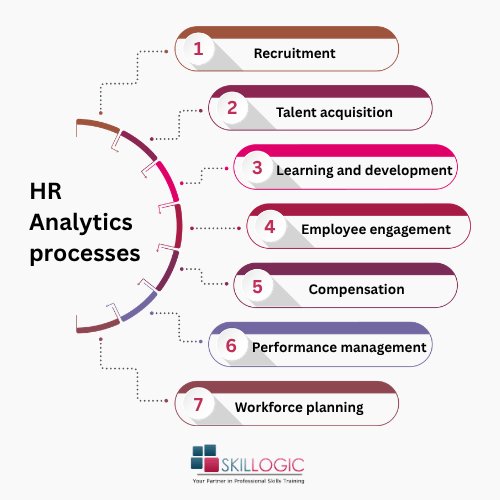
Technical expertise alone is insufficient. Professionals must understand HR processes such as:
- Recruitment
- Talent acquisition
- Learning and development
- Employee engagement
- Compensation
- Performance management
- Workforce planning
Understanding the complete HR analytics process ensures data is interpreted within the correct business context.
Data Visualization
Effective communication is critical.
Using interactive dashboards and visual reports helps HR leaders understand workforce trends quickly.
Popular visualization techniques include:
- Heat maps
- Trend charts
- KPI scorecards
- Workforce dashboards
- Attrition reports
A professional HR analytics dashboard transforms complex datasets into actionable business insights.
Technical Skills
Beginners often overestimate the need for advanced tools. In reality, SQL and Excel account for most entry-level HR analytics tasks, while Python becomes important for advanced predictive modeling roles. Modern HR analytics professionals benefit from working knowledge of:
- Excel
- SQL
- Python
- Power BI
- Tableau
- AI-powered HR platforms
These tools improve data processing efficiency and support advanced reporting capabilities.
Business Communication
In most HR analytics roles, success depends less on building complex models and more on explaining insights to non-technical managers in simple business language. Data only creates value when stakeholders understand it. Professionals should develop the ability to:
- Present findings clearly
- Explain business impact
- Recommend strategic actions
- Support executive decision-making
Communication remains one of the most valuable HR analytics skills in today's business environment. HR analysts do not use tools in isolation. They start with Excel for quick exploration, SQL to extract structured HR data, and Power BI to communicate insights in a way that influences leadership decisions
Future of AI in HR Analytics in Modern World
AI is transforming HR analytics by making workforce decisions faster and more data-driven, but most organizations still depend on human judgment to ensure fairness, context, and compliance. While AI supports tasks like resume screening, candidate matching, employee sentiment analysis, attrition prediction, learning recommendations, and workforce forecasting, it is not used as a standalone decision-maker. Instead, HR teams combine AI insights with experience to make balanced decisions. Generative AI is also helping professionals summarize reports and improve workforce planning efficiency.
Key AI-powered applications include:
- Resume screening
- Candidate matching
- Employee sentiment analysis
- Predictive attrition modeling
- Personalized learning recommendations
- Workforce demand forecasting
- Performance trend analysis
However, responsible use remains essential, focusing on transparency, bias reduction, and data privacy. The future of HR analytics lies in combining AI capabilities with human expertise to improve employee experience and organizational outcomes.
How AI is Making Workforce Decisions More Predictive
One of the most significant advancements is predictive HR analytics, which uses historical employee data, behavioral patterns, and machine learning algorithms to forecast future workforce outcomes. The Mordor Intelligence reports, the global HR analytics market is expected to grow from USD 4.89 billion in 2025 to USD 5.71 billion in 2026, reaching approximately USD 10.82 billion by 2031. The market is projected to expand at a compound annual growth rate (CAGR) of 13.64% between 2026 and 2031.
Organizations can now predict:
- Which employees are at risk of leaving
- Future hiring requirements
- Employee performance trends
- Leadership readiness
- Learning and development needs
- Workforce demand across departments
Instead of reacting to problems after they occur, HR leaders can proactively implement retention strategies, succession plans, and workforce development initiatives.
How HR Automation is Increasing Operational Efficiency
Routine HR activities such as resume screening, interview scheduling, attendance tracking, payroll verification, and employee onboarding are increasingly powered by HR automation.
AI significantly reduces administrative workload, allowing HR professionals to focus on strategic initiatives like organizational development, employee experience, and workforce planning.
For example, intelligent chatbots can answer employee queries 24/7, while AI-powered recruitment platforms shortlist qualified candidates within minutes based on predefined criteria.
Ethical AI Will Shape HR Analytics in 2026
Despite its benefits, organizations must ensure AI systems remain transparent, unbiased, and compliant with data privacy regulations.
Responsible AI practices include:
- Eliminating bias in recruitment algorithms
- Protecting employee data
- Maintaining transparency in decision-making
- Ensuring regulatory compliance
- Keeping humans involved in critical workforce decisions
The future of HR analytics will therefore depend not only on technological innovation but also on ethical implementation.
Top HR Analytics Tools for Professionals in 2026
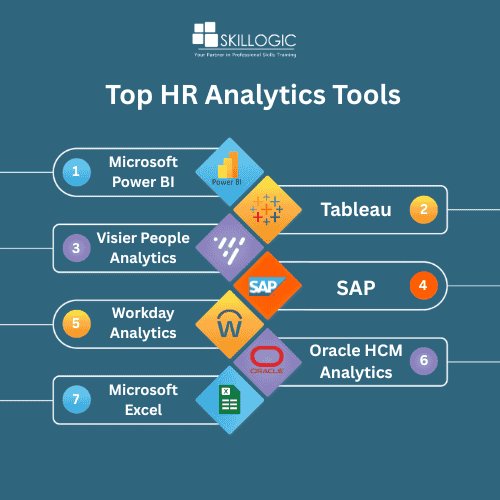
Tool selection depends on organization size: startups prioritize Excel + Power BI due to cost, while enterprises use SAP or Workday for integrated workforce analytics systems. Growing organizations may adopt Tableau for interactive visualizations, while enterprises managing thousands of employees typically invest in platforms such as Visier or SAP SuccessFactors to integrate predictive analytics, workforce planning, and talent management into a single ecosystem.
Choosing a tool that aligns with organizational goals often delivers greater value than selecting the platform with the most features.
| Tool | Primary Use | Best For |
| Microsoft Power BI | Interactive HR dashboards and visualization | Business reporting |
| Tableau | Workforce visualization and executive reporting | Large enterprises |
| Visier People Analytics | Workforce planning and predictive analytics | Enterprise HR |
| SAP SuccessFactors | HR management and analytics | Global organizations |
| Workday Analytics | Talent management and workforce insights | Medium and large businesses |
| Oracle HCM Analytics | HR performance reporting | Enterprise workforce management |
| Microsoft Excel | Data cleaning and HR reporting | Beginners and small businesses |
Power BI for Dashboards
Power BI helps HR teams create interactive HR analytics dashboards that visualize employee turnover, recruitment metrics, diversity statistics, and workforce productivity. Its seamless integration with Microsoft applications makes it a preferred choice for organizations of all sizes.
Tableau for visualization
Tableau is widely used for advanced workforce visualization. HR professionals leverage its interactive dashboards to identify workforce trends, compare performance metrics, and communicate insights effectively to leadership teams.
Visier for planning
Visier specializes in enterprise people analytics by combining workforce planning, predictive analytics, and AI-driven insights. It enables organizations to forecast talent gaps, succession planning, and employee retention risks.
SAP SuccessFactors for management
Large enterprises rely on SAP SuccessFactors to manage recruitment, employee performance, payroll, learning, and workforce analytics through a unified cloud platform.
Workday Analytics
Workday combines HR management with AI-powered analytics, helping organizations improve workforce planning, employee engagement, and performance management.
Choosing the right HR analytics software depends on organizational size, business objectives, data maturity, and integration requirements.
Refer to the articles below:
- HR Analytics for Business Leaders: Making HR a Strategic Partner
- From Excel to AI: A Look at the Best HR Analytics Platforms
- HR Analytics for Leadership Development and Succession Planning
Top Career Opportunities in HR Analytics
An HR analytics career is no longer limited to HR departments. Professionals often begin as HR Analysts or People Analytics Specialists before progressing into Workforce Planning, HR Consulting, Business Intelligence, or Strategic HR Leadership roles. As organizations increasingly integrate workforce analytics into executive planning, professionals who combine analytical expertise with business strategy can significantly expand their long-term career opportunities.
Popular HR Analytics Roles are mentioned below:
HR analytics is not just about studying workforce data it is about understanding real workplace challenges like staffing shortages, employee burnout, and retention problems, and using insights to solve them in practical ways. Salary mentioned from Glassdoor and Naukri.
1. HR Analyst
HR Analysts help organizations understand basic workforce trends like hiring, attrition, and performance through structured reports and dashboards.
The average salary of an HR Analyst in India typically ranges between ₹3.5 LPA and ₹7 LPA depending on skills, experience, and industry.
2. People Analytics Specialist
People Analytics Specialists focus on deeper insights into employee behavior, engagement, and retention patterns using advanced analytics tools.
The salary for a People Analytics Specialist in India usually ranges from ₹6 LPA to ₹12 LPA based on expertise and company size.
3. HR Business Analyst
HR Business Analysts connect HR functions with business goals by using data to improve workforce planning and decision-making.
In India, an HR Business Analyst typically earns between ₹5 LPA and ₹11 LPA depending on experience and domain knowledge.
4. Talent Analytics Specialist
Talent Analytics Specialists analyze recruitment data to improve hiring quality, reduce time-to-hire, and optimize talent pipelines.
The average salary of a Talent Analytics Specialist in India ranges from ₹6 LPA to ₹13 LPA depending on skills and industry demand.
5. Workforce Planning Analyst
Workforce Planning Analysts help organizations predict future hiring needs based on business growth, demand, and resource planning.
The salary for a Workforce Planning Analyst in India generally ranges between ₹7 LPA and ₹15 LPA depending on experience level.
6. Compensation Analyst
Compensation Analysts study salary structures, benefits, and market benchmarks to ensure fair and competitive employee pay.
In India, a Compensation Analyst earns approximately ₹5 LPA to ₹12 LPA depending on expertise and industry.
7. Employee Experience Analyst
Employee Experience Analysts focus on understanding employee satisfaction, engagement, and workplace experience through feedback and data.
The salary of an Employee Experience Analyst in India typically ranges from ₹6 LPA to ₹14 LPA based on skills and experience.
Most professionals begin as HR Analysts, transition into People Analytics roles, and later move into HR Business Partner or Workforce Strategy roles as they gain business exposure. Organizations increasingly recognize HR as a strategic business function. As digital transformation accelerates, professionals who combine HR expertise with analytical capabilities are becoming highly valuable.
An HR analytics career offers opportunities across industries, including healthcare, manufacturing, finance, retail, IT, consulting, education, and government sectors.
HR Analytics Real-World Use Cases
HR analytics delivers the greatest value when it helps solve real workforce challenges. Across industries, organizations use workforce data to improve hiring, optimize staffing, increase employee engagement, and make informed business decisions.
1. Retail Workforce Planning
HR analytics helps retail companies manage staff efficiently during peak and off-seasons. By analyzing sales trends, customer footfall, and historical staffing data, organizations can ensure the right number of employees are scheduled at the right time. This reduces overstaffing costs while maintaining customer service quality. According to the 2026 State of the Retail Workforce Report by Logile, retailers are increasingly adopting AI-driven workforce planning to improve scheduling accuracy and operational efficiency
2. Healthcare Staffing Optimization
Hospitals use HR analytics to balance workload across doctors, nurses, and support staff. By studying shift patterns, patient inflow, and burnout indicators, healthcare organizations can improve patient care and reduce employee stress. The Mordor Intelligence Workforce Analytics Market Report highlights healthcare as one of the fastest-growing adopters of workforce analytics due to increasing demand for efficient resource planning.
3. IT Talent Management
In IT companies, HR analytics is used to identify skill gaps and predict future hiring needs based on project demand. This helps reduce delays in project delivery and improves resource allocation.
4. Banking and Finance Efficiency
Banks use HR analytics to monitor compliance training, employee performance, and attrition trends. This improves workforce stability and strengthens leadership pipelines.
HR analytics ultimately helps organizations move from intuition-based decisions to smarter, evidence-driven workforce strategies that improve both employee experience and business performance.
Step-by-Step Guide to Become HR Analytics
Rather than learning tools randomly, aspiring professionals should adopt a project-based approach. Begin with Excel to understand HR data, progress to SQL for querying employee databases, and then master Power BI or Tableau for visualization. Once comfortable with reporting, explore predictive analytics and AI concepts through projects such as employee attrition prediction, recruitment dashboards, or workforce planning models. Building a portfolio of real-world projects often carries greater weight with employers than completing multiple certifications alone.
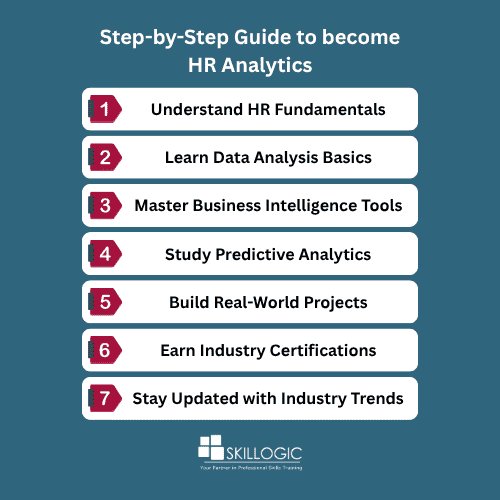
Step 1: Understand HR Fundamentals
Build a strong foundation in recruitment, employee lifecycle, compensation, performance management, workforce planning, and organizational behavior.
Step 2: Learn Data Analysis Basics
Develop knowledge of Excel, statistics, data cleaning, descriptive analytics, and reporting techniques.
Understanding the HR analytics process is essential before working with advanced analytical tools.
Step 3: Master Business Intelligence Tools
Gain hands-on experience with Power BI, Tableau, Excel, and SQL.
These technologies are widely used for building HR analytics dashboards, workforce reports, and executive presentations.
Step 4: Study Predictive Analytics
Learn forecasting techniques, machine learning fundamentals, and predictive HR analytics to solve workforce challenges proactively.
Understanding AI-powered analytics prepares professionals for future HR roles.
Step 5: Build Real-World Projects
Apply your knowledge through practical projects such as:
- Employee attrition prediction
- Recruitment analytics dashboard
- Diversity and inclusion dashboard
- Workforce planning analysis
- Employee engagement reporting
Hands-on experience strengthens portfolios and improves employability.
Step 6: Earn Industry Certifications
Pursuing professional certifications demonstrates practical expertise and validates analytical capabilities.
Industry-oriented training programs covering HR analytics, visualization tools, AI fundamentals, and workforce analytics can significantly enhance career prospects.
Step 7: Stay Updated with Industry Trends
The field continues to evolve rapidly with advances in AI, automation, and workforce intelligence. Professionals should regularly follow industry research, participate in webinars, and continuously upgrade their skills to remain competitive.
Refer to the below articles for more info:
- How to Become a Business Analytics Expert in India
- Business Analytics Scope in India
- How much is the Business Analytics Course Fee in India
HR analytics is becoming a decision-making function rather than a reporting function. Professionals who combine HR knowledge with analytical thinking will play a key role in shaping workforce strategy in the coming years.
SKILLOGIC HR Analytics Course equips learners with practical skills in workforce analytics, HR metrics, people analytics, employee performance analysis, recruitment analytics, and HR dashboard creation through hands-on projects and real-world case studies. The course includes industry-recognized certifications and global IABAC certification, and SKILLOGIC. With expert trainers, an industry-focused curriculum, and 10+ training centers across India, including Bangalore, Chennai, Coimbatore, Hyderabad, Ahmedabad, Pune, Mumbai, and Delhi, SKILLOGIC is recognized as a leading HR analytics training institute in India for aspiring HR and analytics professionals.