From AI Graduate to SOC Analyst: Srijith’s Cyber Security Career Journey
Discover Srijith’s inspiring journey from an AI graduate to a SOC Analyst in banking. Learn how practical training, continuous learning, and cyber security skills helped him build a successful career
 Nashid Hussain CN
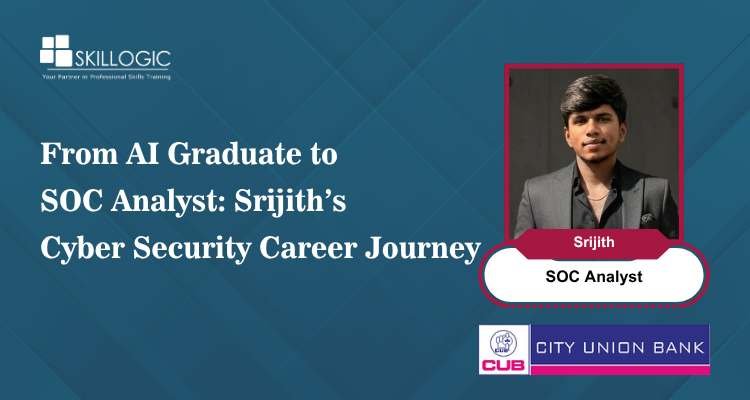
Cyber security is one of the fastest-growing career fields today, and many professionals are successfully transitioning into it from different backgrounds. Sri’s journey is a great example of how continuous learning, practical skills, and consistency can help someone enter the cyber security domain.
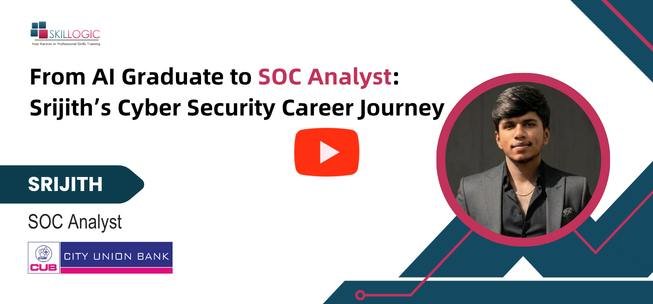
After completing his master’s degree in Artificial Intelligence and Robotics, Srijith explored opportunities in IT and eventually discovered his passion for cyber security. With focused training, hands-on practice, and determination, he secured a role as a SOC Analyst at City Union Bank, where he now works on monitoring security alerts and responding to cyber threats in the banking environment. In this interview-style story, Srijith shares his background, learning experience, and valuable advice for aspiring cyber security professionals.
Let’s explore how Srijith transformed his academic background in Artificial Intelligence into a successful cyber security career through dedication, practical learning, and consistent skill development.
Srijith’s Transition from AI Graduate to SOC Analyst in Banking
In this article, we explore how Srijith transitioned from an Artificial Intelligence graduate to a SOC Analyst in the banking sector at City Union Bank with the support of SKILLOGIC. With focused training, hands-on practice, and continuous learning, he built strong cyber security skills and gained the confidence needed to start his professional journey. His story shows that with dedication and the right guidance, aspiring professionals can successfully launch a career in cyber security.
Refer these articles:
- Application Security Engineer Career Guide
- What is SQL Injection and How to Prevent Attacks
- Why is Cybersecurity Important
Q1. Can you tell us about your educational background and where you are from?
My name is Srijith, and I am from Coimbatore. I completed my master’s degree in Artificial Intelligence and Robotics from Manipal University in Dubai. During my academic journey, I developed a strong interest in technology and security. My education helped me understand advanced concepts like automation and intelligent systems, which later supported my transition into the cyber security field. My technical background gave me a good foundation to explore new career opportunities in IT security.
Q2. What inspired you to choose cyber security as a career?
During my college days, I worked on a cyber security-related project that introduced me to the network security domain. That project sparked my interest in protecting systems and identifying threats. Later, when I worked in an organization in the UAE, most tasks were focused on development using AI tools. I realized that I wanted a more challenging and dynamic field where I could continuously learn and solve real-world problems. Cyber security offered exactly that, so I decided to shift my career in that direction.
Q3. How did you begin your journey in cyber security?
I started by building a strong foundation in network security fundamentals. After understanding the basics, I focused on developing SOC-related skills such as log analysis, threat detection, and incident response. I practiced regularly using different tools and studied real-world cyber attack scenarios. Continuous learning and hands-on practice helped me gain confidence in analyzing suspicious activities and responding to security incidents effectively.
Q4. What was your first professional experience in cyber security?
My first professional experience was in an IT company in the UAE, where I worked on cyber security-related projects for around four months. In that organization, we mainly used AI-based security tools such as Microsoft Defender and SentinelOne to detect threats. This experience helped me understand how automated tools work in real-time security monitoring. It also strengthened my technical skills and prepared me for future opportunities in the cyber security field.
Q5. How did you get your current job in the banking sector?
I regularly followed job updates and applied for opportunities that matched my skills. I shared details about my previous work experience, education, and technical knowledge during the interview process. The hiring team was interested in my practical experience with security tools and my understanding of network security concepts. After completing the interview rounds successfully, I was selected for the SOC Analyst role in a bank.
Q6. What was the interview process like for your current role?
The interview process had two main rounds. The first round was a basic screening call where they asked about my background and experience. The second round was a technical interview where they tested my knowledge of networking and cyber security tools. They asked questions about the OSI model, network packet transfer, and how security tools detect threats. Since I had already practiced these topics, I found the interview manageable and was able to answer confidently.
Q7. What does your day-to-day work look like as a SOC Analyst in a bank?
As a SOC Analyst, my daily responsibilities include monitoring security alerts, analyzing Indicators of Compromise (IOCs), and responding to potential threats. In the banking sector, the process is more manual compared to automated environments. We follow strict Standard Operating Procedures (SOPs) and use cyber security tools like IBM QRadar to investigate suspicious activities. Although the work can be challenging, it provides valuable learning opportunities and helps me improve my technical skills every day.
Q8. How has your learning experience been during your cyber security training?
My training experience has been very positive and interactive. The classes focus on practical learning, which helps me understand concepts more effectively. While theory is important, hands-on practice allows me to apply knowledge in real-world situations. The training sessions are conducted on weekends, making it easier to balance work and learning. This combination of theory and practical exercises has helped me strengthen my understanding of both defensive and offensive security techniques.
Q9. What new skills are you currently learning in cyber security?
Currently, I am expanding my knowledge in offensive security techniques. Earlier, I was more familiar with the defensive side of cyber security, such as monitoring and threat detection. Now, I am learning how attackers think and how vulnerabilities can be identified and tested. Understanding both offensive and defensive security helps professionals become more effective in protecting systems and networks.
Q10. What advice would you give to students who want to start a career in cyber security?
My main advice is to stay focused and consistent. Many students change their career direction when they face challenges, but success comes from continuous learning and practice. Choose one field, build strong skills, and keep improving every day. Cyber security is a growing industry with many opportunities, but it requires dedication and patience. If you stay committed and keep learning, you will eventually achieve your career goals.
Refer these articles:
- How to Choose Best Institute for Cyber Security in Hyderabad
- Is Cyber Security Still a Hot Career Choice in Hyderabad
- Your Path to Becoming a Cyber Security Engineer in Hyderabad
Key Takeaways from Srijith’s Cyber Security Career Journey
Sri’s journey highlights the importance of practical learning, consistency, and the right guidance in building a successful career in cyber security.
- A strong foundation in networking and security basics helped Srijith successfully transition into the cyber security field from an AI background.
- Hands-on practice and real-time lab experience played a key role in building his confidence and preparing him for a SOC Analyst role.
- Continuous learning and consistency helped him stay focused and improve his technical skills in a competitive job market.
- Practical project experience made it easier for him to handle technical interviews and understand real-world security scenarios.
- Cyber security provides strong career opportunities in sectors like banking, where skilled professionals are always in demand.
In short, Srijith’s journey from an Artificial Intelligence graduate to a SOC Analyst at City Union Bank highlights how dedication, practical learning, and continuous skill development can open doors to rewarding opportunities in cyber security. His success reflects the growing demand for skilled professionals in this field, especially in critical sectors like banking and finance. SKILLOGIC, a leading cyber security institute in India, plays an important role in supporting learners with industry-relevant training, hands-on practice, and career guidance to help them succeed in the cyber security domain.
According to a recent report by Grand View Research, the global cyber security market was valued at USD 271.88 billion in 2025 and is projected to reach USD 663.24 billion by 2033, growing at a compound annual growth rate (CAGR) of 11.9%, driven by increasing cyber threats and rapid digital transformation across industries.
This strong market growth indicates that professionals like Srijith will continue to find long-term career stability and advancement opportunities. His story serves as motivation for students and fresh graduates, proving that with the right training, hands-on practice, and consistent learning through institutes like SKILLOGIC, it is possible to build a successful career in the ever-expanding cyber security industry.
Refer these articles:
- Cyber Security Course Fees in Pune
- Why Cyber Security Career in Pune
- Why Pune is Popular for Cyber Security Course
Choosing the right institute and structured learning path can make a big difference in starting a successful career in this field. Enrolling in a cyber security course in Hyderabad can provide hands-on experience, expert mentorship, and exposure to real-world security scenarios.
SKILLOGIC offers industry-oriented cyber security courses that focus on practical skills such as ethical hacking, SOC operations, and threat detection. With experienced trainers and hands-on learning methods, the institute helps students become job-ready for real-world security roles. Professionals interested in building a strong foundation can consider enrolling in a cyber security training in Pune to gain relevant technical experience.
SKILLOGIC Institute has major branches in cities like Bangalore, Hyderabad, Chennai, Coimbatore, Delhi, Mumbai, Nagpur, Ahmedabad, and Pune, making training accessible across India. SKILLOGIC programs are supported by recognized certifications and accreditations from NASSCOM FutureSkills and IIFIS, and students receive a SKILLOGIC course completion certification after successfully finishing their training.