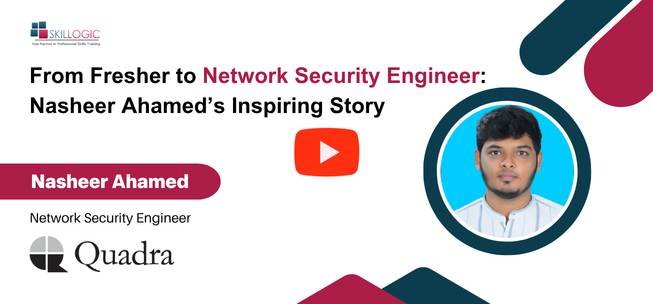
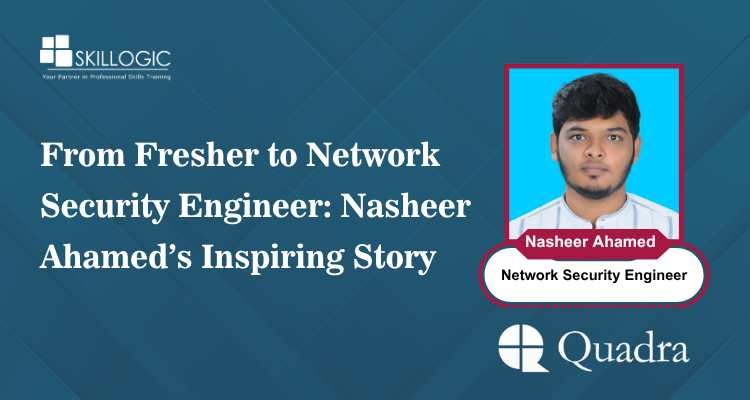
From Fresher to Network Security Engineer: Nasheer Ahamed’s Inspiring Story
Discover how Nasheer Ahamed transitioned from a networking professional to a Network Security Engineer. Learn his cyber security career journey, skills, training, and tips for beginners to succeed in the cyber security field.
 Nashid Hussain CN
Switching careers can feel challenging, especially when moving from one technical domain to another. But with the right mindset, guidance, and consistent effort, it is absolutely possible. In this interview-style article, Nasheer Ahmed shares his journey from working as a Network Engineer at Quadra Systems Pvt. Ltd. to becoming a cyber security professional. His transition highlights how real-world experience in networking can build a strong foundation for moving into security roles. With the support of SKILLOGIC, particularly through its nMW (Next-Gen Managed Workforce) program, he was able to gain the right skills, hands-on experience, and industry exposure needed to successfully step into the cyber security domain.
His story shows that with consistent learning, hands-on practice, and the right guidance, anyone can build a successful career in cyber security.
From Fresher to Network Security Engineer: Nasheer Ahamed’s Inspiring Story
In this article, we explore how Nasheer Ahamed transitioned from a networking professional to a Network Security Engineer at Quadra Systems Pvt. Ltd. With the support of SKILLOGIC, structured training, and hands-on projects, he built a strong foundation in cyber and network security. His background in computer science and networking helped him smoothly move into the security domain.
His journey highlights the importance of continuous learning, practical exposure, and the right mentorship. From feeling stuck in his previous role to building a successful cyber security career, Nasheer’s story shows that with consistent effort, professionals can transition into advanced roles. Programs like SKILLOGIC’s cyber security classes in Chennai and cyber security courses in Mumbai, along with its 25+ centers across India, help learners gain real-world skills and become job-ready.
Refer these articles:
- Top Cyber Security Skills You Need to Master
- Why is Cybersecurity Important
- Top 10 SIEM Use Cases in Cyber Security
Q1. Can you briefly introduce yourself and your background?
My name is Nasheer Ahmed. I completed my BE in Computer Science Engineering from Hindustan College in Coimbatore in 2022. After graduation, I worked for two years in the networking domain. During that time, I gained hands-on experience working on multiple networking projects. However, after a while, I felt like my learning had slowed down and I needed a new challenge, which led me to explore cyber security.
Q2. What made you switch from networking to cyber security?
While working in networking, I started feeling stagnant in my role. I wanted something more dynamic where I could face new cyber security challenges regularly. When I started researching cyber security, I found it very interesting because it involves continuous learning and problem-solving. That motivated me to shift my career toward the security domain.
Q3. How did you choose the right cyber security institute?
I actively searched online and also visited institutes in person to understand the course structure and quality of training. After comparing different options, I found SKILLOGIC to be a good choice. Their course structure, practical approach, and support system stood out to me, so I decided to enroll in their Cyber Security Professional Plus Training.
Q4. Did you study online or offline? How was your learning experience?
I attended an offline weekend cyber security course in Chennai. The classes were well-structured and included both theory and practical sessions. For example, when we learned about SQL injection, the trainer first explained the concept and types, and then we immediately practiced it in the lab. This approach helped me understand concepts much better.
Q5. How much time did you spend studying outside the classroom?
I didn’t focus too much on strict timing, but I made sure to revise all the topics covered during the week. On average, I spent around 1.5 to 2 hours daily reviewing concepts and practicing. Consistency was more important than the number of hours.
Q6. How were your doubts cleared during the course?
One of the best things was the LMS (Learning Management System). It provided recorded sessions from different trainers, so I could revisit topics anytime. Also, I had the option to go back to the classroom and ask trainers directly. Having multiple ways to clear doubts really helped me understand topics deeply.
Q7. What kind of projects did you work on during your internship?
During the internship phase, I worked on two projects using Nmap and Nessus. These projects were related to network scanning, vulnerability assessment and Penetration testing. Each project took around 15 days, and completing them gave me practical exposure to real-world tools and scenarios.
Q8. How did you prepare for interviews?
After completing the course and projects, I attended mock interviews conducted by the placement team. These mock interviews were very helpful because they gave me feedback on my strengths and weaknesses. Based on that feedback, I improved my preparation and gained confidence before attending real interviews.
Q9. How many interviews did you attend before getting selected?
I attended two interviews. The first one was for a penetration testing role, which I couldn’t clear due to nervousness. However, I learned from that experience and improved my communication and confidence. The second interview was for a network security engineer role, and I successfully cleared it.
Q10. What was the interview process like?
The interview had two rounds:
- Telephonic Round: Basic discussion about my background and job role
- Technical Round: Questions on networking concepts, firewalls, VPNs, and Network security fundamentals
There was supposed to be a third round, but it was skipped, and I received the offer after the second round.
Q11. How important was resume preparation in your journey?
Resume preparation played a very important role. I worked closely with the placement team to improve my resume. They helped me make it ATS-friendly and suggested corrections multiple times. A good resume increases your chances of getting shortlisted, which is the first step toward landing a job.
Q12. What advice would you give to beginners in cyber security?
If you are interested in cyber security:
- Keep learning and exploring the field
- Focus on basics and practice regularly
- Choose a good training institute
- Be patient, as success may take time
Most importantly, practice is key. If you don’t practice what you learn, you will forget it quickly.
Q13. Is daily practice important, and when are you starting your new job?
Yes, daily practice is very important because cyber security is a practical field. Just attending classes is not enough, you need to revise and practice regularly. Even 1–2 hours of focused learning every day can make a big difference. As for my job, I haven’t started yet. My joining date is next week, and I’m really excited to begin this new journey in cyber security.
Refer these articles:
- How to Become a Cyber Security Expert in India
- Cyber Security in India: What You Need to Know
- Why Chennai is the Next Big Destination for Cyber Security Jobs in India
Key Points from Nasheer Ahamed’s Cyber Security Career Journey
Nasheer’s journey offers valuable insights for anyone planning to build a career in cyber security. Here are some key takeaways:
- Transitioned from a networking role to cyber security after identifying the need for career growth
- Built a strong foundation with a BE in Computer Science and 2 years of networking experience
- Chose cyber security for its dynamic nature and continuous learning opportunities
- Enrolled in SKILLOGIC’s training program for structured, practical learning
- Maintained consistency by practicing and revising concepts regularly
- Gained hands-on experience through projects using cyber security tools like Nmap and Nessus
- Improved interview performance through mock interviews and feedback sessions
- Successfully secured a Network Security Engineer role after learning from initial interview challenges
These points show that consistent effort, practical learning, and the right guidance can help anyone successfully transition into cyber security.
In short, Nasheer’s journey clearly shows that transitioning into cyber security is achievable with the right approach. From feeling stuck in networking to landing a role as a network security engineer, his story highlights the importance of consistent practice, proper guidance, and self-belief. According to Grand View Research, India’s cyber security market was valued at around USD 10.15 billion in 2026 and is expected to grow to nearly USD 38.7 billion by 2033, with a strong 18%+ CAGR. This rapid growth clearly shows the increasing demand for roles like Network Security Engineers in India.
Refer these articles:
- Why Mumbai is popular for cyber security course
- Cyber Security Career Scope in Mumbai
- Cyber Security in Ahmedabad: Market Growth and Industry Insights in 2026
- How much is the Cyber Security Course Fee in Ahmedabad
If you are planning to start a career in cyber security, take inspiration from his journey, focus on basics, practice regularly, and never stop learning. If you are serious about building a career in cyber security, enrolling in a good cyber security course can give you the right guidance, hands-on skills, and industry exposure needed to succeed.
SKILLOGIC offers practical cyber security training that helps learners build skills in areas like ethical hacking, SOC operations, and threat detection. The course focuses more on hands-on practice, so students can understand real-time scenarios easily. With guidance from experienced trainers, learners can gain the confidence needed to become job-ready. Those interested can choose SKILLOGIC cyber security institute in Ahmedabad to start their career.
SKILLOGIC also has training centers in many major cities and operates across 25+ centers in India, making it easy for students to access quality training. The courses are supported by certifications from NASSCOM FutureSkills, IIFIS, and EC-Council, and students receive a SKILLOGIC certification after completion, which helps in building a strong career profile