Best 5 Marketing Analytics Tools for 2026
Explore the best 5 marketing analytics tools for 2026, compare their key features, and learn how to choose the right tool to measure campaigns, track customer behaviour, and improve marketing performance.
 Aiswarya N
Businesses use different marketing channels to reach customers, from search engines and websites to email and social media. But how can they tell which activities bring visitors, generate leads, and contribute to sales? This is where marketing analytics tools become useful.
These tools help marketers understand campaign performance, study customer behaviour, and identify areas that need improvement. Instead of relying on assumptions, businesses can use data to make informed decisions about their marketing activities.
In this guide, we will explore 5 best marketing analytics tools, their main features, and the types of marketing tasks they support. We will also explain how to choose a suitable option based on your goals, budget, and reporting needs.
What Are Marketing Analytics Tools?
Marketing analytics tools are software applications that help businesses collect, measure, and analyse information about their marketing activities. They can track website visits, campaign engagement, conversions, customer interactions, and other useful metrics.
For example, a business running a paid advertising campaign can use analytics software to check how many people clicked an advertisement, visited its website, and completed a purchase. This helps the marketing team understand whether the campaign is delivering useful results.
Some platforms focus on website traffic, while others specialise in search performance, customer journeys, or reporting. These insights can also support customer segmentation in marketing analytics, helping businesses understand different audience groups and evaluate how they respond to marketing activities. Business intelligence platforms can bring data from different sources into one dashboard.
The growing importance of this field is reflected in a Mordor Intelligence report, which estimates that the global marketing analytics market will reach USD 8.02 billion in 2026 and USD 14.55 billion by 2031. The report identifies digital adoption and first-party data strategies among the factors supporting market growth.
The best marketing analytics tools for a business depend on the information it needs and the decisions it wants to make. Let's look at 5 options and what each one offers.
Refer these articles:
- Mastering E-Commerce Marketing Analytics for Success
- A Beginner’s Guide to Understanding Marketing Analytics
- Why Data Visualization is Critical for Marketing Analytics
Best 5 Marketing Analytics Tools for 2026
The following 5 marketing analytics tools offer different features to help businesses track performance, understand customer behaviour, and make data-driven marketing decisions:
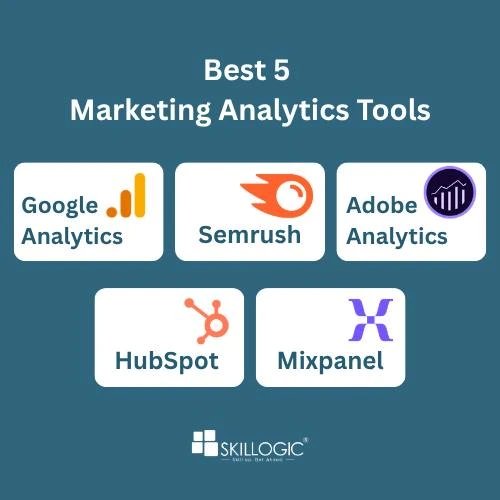
1. Google Analytics 4 (GA4)
Google Analytics 4 helps businesses understand how people interact with their websites and mobile apps. It tracks user interactions as events, allowing marketers to study activities such as page views, product selections, form submissions, and purchases.
Key features:
- Website and app traffic reports
- Event and conversion tracking
- Traffic source analysis
- Audience and engagement reports
For example, an online business can use GA4 to identify which channels bring visitors and which pages lead to purchases. This information helps marketers review their website content and campaign performance.
Best suited for: Businesses, content publishers, and marketers who want to understand website traffic, user behaviour, and conversions.
Google provides documentation on recommended events and key events to help users measure important website and app actions.
2. Semrush
Semrush is a digital marketing platform known for its search engine optimization (SEO), keyword research, and competitor analysis features. It helps marketers understand what people search for and examine how competing websites attract traffic.
Key features:
- Keyword research and ranking tracking
- Competitor traffic and keyword analysis
- Backlink analysis
- Organic and paid search research
For example, a company publishing educational articles can use Semrush to identify relevant search terms, study competing pages, and find content opportunities. The team can then use this information to plan its SEO activities.
Semrush is particularly useful for understanding search visibility. However, it is not a replacement for every form of analytics, such as detailed customer relationship management (CRM) or revenue attribution reporting.
Best suited for: SEO professionals, content marketers, digital marketing teams, and businesses that want to improve search visibility.
3. Adobe Analytics
Adobe Analytics supports detailed analysis of customer interactions across digital channels. It is designed for organisations that need to study complex customer journeys and understand how different interactions contribute to business outcomes.
Key features:
- Customer journey analysis
- Audience segmentation
- Conversion and attribution analysis
- Custom reports and visualisations
Consider a customer who discovers a brand through an advertisement, visits its website later, and finally purchases through another channel. Adobe Analytics can help teams examine these interactions and understand how customers move towards conversion.
Its advanced reporting capabilities can be valuable when businesses need to combine large amounts of customer data and investigate specific patterns.
Best suited for: Large organisations and experienced analytics teams that need detailed, cross-channel analysis.
4. HubSpot Marketing Analytics
HubSpot provides marketing analytics features that connect campaign activity with contact and sales information. This helps businesses understand how marketing interactions contribute to lead generation and revenue.
Key features:
- Website traffic and source reports
- Campaign performance reporting
- Contact and lead tracking
- Multi-touch revenue attribution
For example, a business can examine whether website content, email campaigns, or paid advertisements are contributing to qualified leads. When connected to its CRM, the team can also follow leads through the sales process.
According to HubSpot’s State of Marketing Report, 80% of marketers use AI for content generation and 75% for media production. As content production increases, AI-driven marketing analytics can help businesses evaluate campaign performance and identify which activities generate leads and conversions.
Best suited for: Marketing and sales teams that use CRM data to manage leads, campaigns, and customer relationships.
5. Mixpanel
Mixpanel focuses on product analytics. It helps businesses understand what users do inside websites, applications, and digital products, rather than simply counting visits.
Key features:
- User interaction tracking
- Funnel analysis
- Retention reports
- Engagement and behaviour analysis
For example, a subscription-based application can examine how many users register, complete onboarding, try a key feature, and return later. Funnel reports help identify where users stop progressing, while retention reports show whether they continue using the product.
These insights can help marketing and product teams understand which acquisition sources bring engaged users and where the user experience may need improvement.
Best suited for: App-based businesses, software companies, product teams, and marketers who need to understand user engagement.
How to Choose the Right Marketing Analytics Tool
Choosing between the best marketing analytics tools becomes easier when you start with the decisions you need to make. A business that mainly wants to understand website traffic may not need the same platform as an organisation combining advertising, CRM, and sales data.
Consider these factors before making a decision.
- Identify your goals: Decide whether you need to measure website traffic, improve SEO, track leads, understand user engagement, or compare campaign spending with revenue.
- Set a realistic budget: Check subscription fees, usage limits, implementation costs, and any additional charges for integrations or extra users.
- Review integrations: Make sure the tool can connect to the platforms and data sources your team already uses.
- Check reporting needs: Consider whether standard reports are sufficient or whether you need custom dashboards, advanced segmentation, or attribution analysis.
- Consider privacy and data quality: Ensure that data collection follows applicable privacy requirements and that reports use accurate, consistently defined metrics.
Budget is particularly important. Gartner's CMO Spend Survey found that marketing budgets averaged 7.7% of company revenue, while paid media accounted for 30.6% of marketing budgets. The survey also highlighted data analytics as one way marketing leaders seek to improve productivity. These findings underline the importance of choosing tools that address genuine business needs rather than paying for features a team will rarely use.
When comparing the best 5 marketing analytics tools in 2026, remember that each platform serves a different purpose. A combination of tools may work better than relying on one platform for every task.
Refer to these articles:
- How much is the Business Analytics Course Fee in India?
- Business Analytics Scope in India
- How to become a Business Analyst in India?
Common Mistakes to Avoid When Choosing Marketing Analytics Tools
Even the best marketing analytics tools cannot solve every reporting problem automatically. Avoid these common marketing analytics mistakes when evaluating or using them.
- Choosing a tool because it is popular: A well-known platform may not match your team's goals, technical skills, or budget.
- Tracking too many metrics: Focus on meaningful measures such as qualified leads, conversion rates, customer acquisition costs, and revenue contribution.
- Ignoring data quality: Incomplete tracking, duplicate records, and inconsistent campaign naming can produce misleading reports.
- Overlooking integration needs: Data spread across disconnected systems can make it difficult to understand overall marketing performance.
- Forgetting training and ongoing costs: Consider the time required to set up reports, maintain data connections, and help employees use the platform correctly.
It is also important to understand what each tool measures. Website visits, engagement, leads, and sales are different outcomes. Looking at them together can provide a more useful picture than treating one metric as proof of overall marketing success.
In short, the right marketing analytics platform helps businesses measure performance and make informed decisions. Google Analytics 4, Semrush, Adobe Analytics, HubSpot, and Mixpanel serve different needs, from website traffic and SEO to customer journeys and user engagement. When choosing among the best 5 marketing analytics tools in 2026, consider your goals, budget, and reporting needs to find the most suitable option.
For professionals who want to build stronger data analysis skills, learning how to interpret marketing metrics and turn reports into practical decisions is an important step.
SKILLOGIC is a global professional training institute that offers industry-focused programmes to help learners build practical, job-relevant skills. SKILLOGIC’s Marketing Analytics Certification Course covers marketing metrics, campaign performance analysis, customer behaviour tracking, conversion optimisation, and dashboard creation through hands-on projects and real-world case studies. The programme includes expert guidance, an industry-focused curriculum, and industry-recognised certifications, including global IABAC certification. With over 25 training centres across India, including Bangalore, Chennai, Coimbatore, Hyderabad, Ahmedabad, Pune, Mumbai, Nagpur, and Delhi, SKILLOGIC provides marketing analytics training for aspiring marketing and analytics professionals.