A Complete Guide to Marketing Analytics Career
Learn the essentials of a marketing analytics career, from key skills and tools to job roles, salary potential, and career growth. Discover how data-driven insights help businesses make smarter marketing decisions.
 Prerana B A
From a business perspective, marketing analytics goes beyond reporting campaign performance. It connects data analysis with marketing strategy to improve decision-making using customer insights. Earlier it relied on spreadsheets and manual tracking, but now it’s a structured, data-driven approach focused on actionable insights. It helps businesses understand customer behavior, improve campaigns, and optimize key metrics like conversions, engagement, customer acquisition cost, and lifetime value. This is part of the Guide to Marketing Analytics, which explains how data supports better marketing decisions and outcomes.
The industry reflects this transformation. According to Research and Markets, the global marketing analytics market was valued at US$5.8 billion in 2025 and is projected to reach US$17.6 billion by 2032, growing at a CAGR of 17.1%. This growth is driven by rising digital ad spending, increasing customer data availability, and the demand for measurable marketing performance. As a result, organizations are investing heavily in analytics tools and dashboards to improve targeting, optimize campaigns, and measure outcomes more accurately while turning insights into measurable business growth.
The Importance of Marketing Analytics in Modern Business
Modern businesses generate vast amounts of customer and campaign data, including website traffic, ad impressions, click-through rates, conversion data, social media engagement, email performance, and purchase history.
Marketing analytics transforms this raw data into actionable insights that help organizations make smarter decisions about campaigns, audiences, and channels. It now plays a key role not just within marketing teams but across the business, supporting sales strategy, product development, and revenue forecasting.
For example, instead of guessing why a campaign underperforms, marketing analytics helps identify whether the issue is targeting, messaging, creative design, timing, or channel selection.
Key benefits of marketing analytics include:
- Improved Campaign Performance: Helps identify what messaging, creatives, and channels drive the highest engagement and conversions.
- Better Customer Targeting: Enables precise audience segmentation based on behavior, demographics, and interests.
- Higher Marketing ROI: Optimizes budget allocation across channels to maximize returns.
- Reduced Acquisition Costs: Identifies the most cost-effective customer acquisition strategies.
- Stronger Customer Retention: Tracks customer behavior to improve loyalty and lifetime value strategies.
For example, marketers use metrics such as customer acquisition cost (CAC), conversion rate, click-through rate (CTR), return on ad spend (ROAS), bounce rate, and customer lifetime value (CLV) to evaluate and improve performance.
A marketing analytics dashboard gives teams a real-time, unified view of campaign performance across channels, replacing scattered reports and enabling faster decisions. Its real value lies in spotting behavioral patterns early, such as funnel drop-offs or engagement declines, which can signal issues before they impact revenue.
Refer to these articles:
- A Complete Guide to HR Analytics
- How to Avoid Bias in AI-Driven Marketing Analytics
- Understanding Funnel Analysis in Marketing
- Marketing Analytics in Retail – Boosting Sales with Data
Types of Marketing Analytics and Its Importance
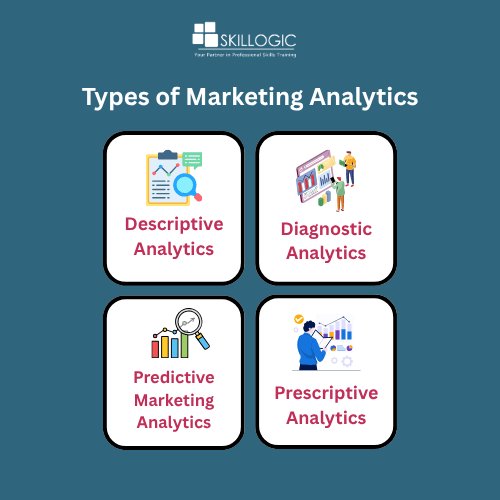
Understanding the different types of marketing analytics is essential to building a strong data-driven marketing strategy. Organizations typically evolve through stages of analytics maturity, starting with basic reporting and gradually advancing toward predictive and prescriptive decision-making.
Most companies do not operate at all levels simultaneously; they progress step by step.
Descriptive Analytics
Descriptive analytics focuses on summarizing historical marketing performance. It answers questions such as:
- How many leads were generated?
- What was the conversion rate last month?
- Which campaigns performed best?
This type of analytics is useful for reporting but does not explain why performance changed.
Diagnostic Analytics
Diagnostic analytics goes deeper to understand the reasons behind performance outcomes.
For example:
- Why did conversion rates drop in a specific campaign?
- Why is one channel outperforming another?
- What caused an increase in bounce rate?
This helps marketers identify weaknesses and optimize campaign execution.
Predictive Marketing Analytics
Predictive analytics uses historical data and statistical models to forecast future marketing outcomes. However, it is not fully autonomous. Human judgment is still required because customer behavior is influenced by emotions, trends, and external factors that models may not fully capture.
Common predictions include:
- Likelihood of customer conversion
- Future campaign performance
- Customer churn probability
- Demand forecasting
- Lead scoring and qualification
Organizations use predictive analytics to make proactive marketing decisions instead of reactive adjustments.
Prescriptive Analytics
Prescriptive analytics goes beyond prediction and suggests actionable steps to improve outcomes.
Examples include:
- Recommending the best marketing channel mix
- Suggesting personalized content or offers
- Optimizing ad spend allocation
- Improving customer journey strategies
Together, these types of marketing analytics help organizations move from basic reporting to strategic, data-driven marketing execution. Most businesses begin with descriptive reporting, but the real competitive advantage comes from predictive insights and prescriptive recommendations that directly influence marketing performance and growth.
Essential Skills for Marketing Analytics Professionals
Employers increasingly value professionals who can turn customer and campaign data into clear business recommendations. While technical tools such as SQL, Power BI, Google Analytics, and Excel are important, hiring managers often prioritize communication, business thinking, and stakeholder management. Data only creates impact when decision-makers understand and act on it.
Building the right mix of technical and strategic skills is essential for anyone pursuing a marketing analytics career.
Data Analysis Skills
Marketing professionals need the ability to collect, clean, analyze, and interpret customer and campaign data. Key areas include:
- Statistical analysis
- Data interpretation
- Trend analysis
- Campaign performance reporting
- Conversion analysis
- Customer behavior analysis
Strong analytical thinking helps professionals move beyond surface-level reporting and uncover insights that actually improve marketing performance.
Marketing Domain Knowledge
Technical skills alone are not enough. Professionals must understand core marketing functions such as:
- Digital marketing
- Brand management
- Customer acquisition
- Content marketing
- Performance marketing
- Customer journey mapping
- Funnel optimization
Understanding the full marketing process ensures data is interpreted in the right business context, not in isolation.
Data Visualization
Clear communication is critical in marketing analytics. Visual dashboards and reports help teams quickly understand performance and make faster decisions.
Common visualization techniques include:
- Funnel charts
- Heat maps
- Campaign performance dashboards
- KPI scorecards
- Cohort analysis charts
A strong marketing dashboard turns complex datasets into clear insights that guide real campaign decisions.
Technical Skills
Many beginners assume advanced coding is required, but most marketing analytics work starts with simple tools. Excel and SQL handle a large portion of daily tasks, while Python becomes useful for advanced modeling and automation.
Key tools include:
- Excel
- SQL
- Python
- Google Analytics / GA4
- Power BI
- Tableau
- Marketing automation platforms
These tools help streamline data processing, reporting, and performance tracking across marketing channels.
Business Communication
In most marketing analytics roles, success depends less on building complex models and more on explaining insights in simple business terms. Data is only valuable when marketing teams can act on it.
Professionals should be able to:
- Present campaign insights clearly
- Explain performance drivers
- Recommend optimization strategies
- Support budget and media decisions
Strong communication ensures analytics directly influences marketing outcomes, not just reporting dashboards.
Future of AI in Marketing Analytics in the Modern World
AI is increasingly used in marketing analytics to improve how organizations analyze data, understand customer behavior, and optimize campaign performance. According to Global Market Insights, the marketing analytics market was valued at USD 5.3 billion in 2023 and is expected to grow at a CAGR of over 16% from 2024 to 2032, reflecting the growing adoption of AI-driven analytics solutions. While AI enhances speed and accuracy, most companies still depend on human expertise to interpret insights and align decisions with brand strategy and customer needs.
In practice, AI supports tasks such as campaign optimization, audience segmentation, content personalization, sentiment analysis, and demand forecasting. Generative AI is also used to summarize reports and assist in content and insight generation. However, these tools are primarily decision-support systems rather than replacements for marketing professionals.
Key AI applications include:
- Customer segmentation and targeting
- Campaign performance optimization
- Sentiment and brand analysis
- Predictive lead scoring
- Personalized recommendations
- Demand forecasting
- Ad performance analysis
Responsible use of AI is essential, especially in areas like data privacy, bias control, and transparency in decision-making. This ensures insights remain reliable and ethically applied.
AI is Making Marketing Decisions More Predictive
Predictive analytics is becoming a core part of marketing analytics. AI models analyze historical campaign data and customer behavior to forecast future outcomes, helping marketers make more informed decisions.
Common predictions include:
- Customer conversion likelihood
- Campaign performance outcomes
- Customer churn risk
- Lead quality scoring
- Demand and channel trends
This allows teams to shift from reactive reporting to proactive planning, although human validation remains important to account for changing market conditions.
Marketing Automation is Increasing Efficiency
Marketing automation is widely used to reduce manual work in repetitive tasks like email scheduling, audience segmentation, ad optimization, and lead nurturing.
Key automation use cases include:
- Personalized email campaigns
- Automated ad bidding
- Dynamic audience segmentation
- Trigger-based customer journeys
While automation improves efficiency, human oversight is still needed to maintain accuracy, relevance, and brand consistency.
Ethical AI Will Shape Marketing Analytics in 2026
Despite its advantages, AI in marketing must be used responsibly. Customer trust depends on transparency, fairness, and data privacy.
Responsible AI practices include:
- Avoiding biased targeting models
- Protecting customer data
- Ensuring transparent personalization
- Following privacy regulations
- Keeping humans involved in key decisions
The future of marketing analytics will depend on both innovation and ethical responsibility.
Refer to these articles:
- The Hidden Role of Business Analysts in Successful Startups
- How Generative AI is Reshaping the Business Analyst Role
- Why Domain Knowledge Matters for Every Business Analyst
Top Marketing Analytics Tools for Professionals in 2026
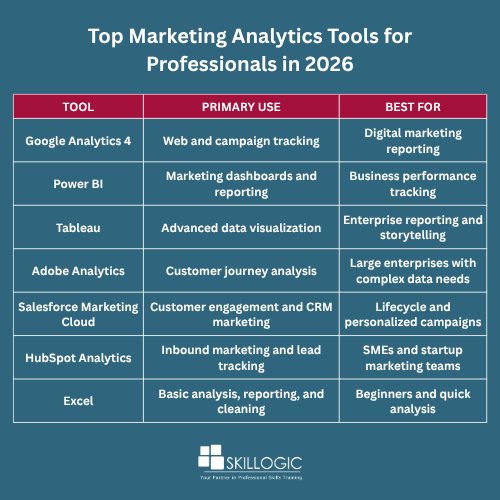
Marketing analytics tools help teams track performance, understand customer behavior, and optimize campaigns across channels. In 2026, the focus is less on individual tools and more on how well they work together to deliver a complete view of marketing performance.
How These Tools Are Used in Practice
in practice, they act as different layers of a single marketing intelligence system, where data flows from tracking tools to reporting dashboards and finally into execution decisions.
Google Analytics 4 (GA4)
GA4 typically serves as the foundational behavioral tracking layer. It helps teams understand where users come from, how they interact with digital properties, and where they drop off in the funnel.
In most mature setups, GA4 is not the final source of truth. Instead, it feeds structured data into BI tools for deeper business interpretation.
Power BI
Power BI functions as the operational reporting layer in many organizations. Marketing, finance, and leadership teams use it to monitor KPIs like CAC, ROAS, conversion rates, and pipeline contribution in a unified dashboard.
Its strength lies in consolidating fragmented data sources into a single decision view, reducing dependency on manual reporting.
Tableau
Tableau is generally used for exploratory and strategic analysis. It is especially common in organizations where leadership teams require visual storytelling around performance trends, cohort behavior, or campaign comparisons.
Unlike operational dashboards, Tableau is often used for interpretation rather than day-to-day monitoring.
Adobe Analytics
Adobe Analytics is designed for enterprise-scale environments with complex customer journeys across multiple channels. It supports advanced attribution, segmentation, and cross-channel behavior analysis.
However, its effectiveness depends heavily on implementation quality. In many organizations, it is powerful but underutilized due to setup complexity.
Salesforce Marketing Cloud
This platform sits closer to execution than pure analytics. It connects customer data with campaign delivery across email, CRM workflows, and personalized journeys.
In mature systems, it acts as the activation layer that translates analytics insights into targeted marketing actions.
HubSpot Analytics
HubSpot is widely used by SMBs and growth-stage companies due to its ease of use and integrated approach to CRM and marketing analytics.
It provides sufficient visibility into lead generation, content performance, email engagement, and funnel conversion without requiring heavy technical setup.
Excel
Despite the rise of advanced platforms, Excel remains a critical tool in most analytics environments. It is commonly used for quick validation, early-stage analysis, and troubleshooting inconsistencies in larger datasets.
Its continued relevance comes from flexibility and speed, especially in fast-moving marketing teams.
Choosing the Right Marketing Analytics Tool
The right choice depends on business size, data maturity, and marketing goals. Startups often prioritize simplicity and cost efficiency, while enterprises focus on integration, scalability, and advanced customer insights.
At the end of the day, the most powerful tool is the one that aligns with how the marketing team actually makes decisions.
Career Opportunities in Marketing Analytics
A career in marketing analytics is no longer confined to campaign reporting teams. Professionals often begin as Marketing Analysts or Digital Analytics Specialists before progressing into roles such as Growth Analyst, Marketing Intelligence Lead, Customer Insights Manager, Business Intelligence Consultant, or Strategic Marketing Leader.
As organizations increasingly rely on data to optimize customer acquisition, retention, and ROI, professionals who combine analytical thinking with marketing strategy are unlocking significantly broader long-term career growth.
Popular Marketing Analytics Roles
Marketing analytics goes beyond tracking clicks and impressions. It focuses on solving real business problems like low conversion rates, high customer acquisition costs, weak campaign performance, and poor customer retention using data-backed insights. This makes it a strong field for those considering a marketing analytics career, where professionals use data to improve strategy, optimize performance, and drive better business outcomes.
Salary insights referenced from Glassdoor and Naukri.
Marketing Analyst
Marketing Analysts interpret campaign performance, customer behavior, and channel effectiveness through dashboards and reporting tools.
In India, salaries typically range between ₹3.5 LPA to ₹7 LPA, depending on skills, experience, and industry.
Digital Marketing Analytics Specialist
These professionals dive deeper into user behavior across digital platforms, analyzing engagement, conversion funnels, and retention patterns using advanced analytics tools.
Salary typically ranges from ₹6 LPA to ₹12 LPA based on expertise and company size.
Marketing Business Analyst
Marketing Business Analysts bridge marketing execution with business outcomes by translating data into strategic decisions around growth, campaigns, and customer acquisition.
In India, salaries typically fall between ₹5 LPA to ₹11 LPA depending on domain knowledge and experience.
Customer Insights Analyst
Customer Insights Analysts focus on understanding audience behavior, segmentation, and preferences to improve targeting and personalization strategies.
Average salary ranges from ₹6 LPA to ₹13 LPA depending on skills and industry demand.
Growth Analytics Specialist
Growth Analysts work closely with product and marketing teams to optimize acquisition funnels, improve conversion rates, and scale revenue channels.
Salaries generally range between ₹7 LPA to ₹15 LPA based on experience.
Marketing Performance Analyst
These analysts evaluate campaign effectiveness, ROI, attribution models, and marketing spend efficiency across channels.
In India, salaries typically range from ₹5 LPA to ₹12 LPA depending on expertise and industry.
Customer Experience Analyst
Customer Experience Analysts study feedback, journey data, and satisfaction metrics to improve overall brand experience and retention.
Salaries typically range from ₹6 LPA to ₹14 LPA based on skills and experience.
Most professionals begin in entry-level marketing analytics roles, transition into customer insights or growth-focused positions, and eventually move into strategic marketing leadership or business growth roles as their business exposure deepens.
Organizations now view marketing as a core revenue-driving function rather than just a support function. As digital ecosystems expand, professionals who combine marketing knowledge with analytical capability are becoming highly valuable.
Marketing analytics careers span across industries including e-commerce, fintech, retail, SaaS, media, healthcare, education, and consulting.
Refer to these articles:
- How much is the Business Analytics Course Fee in India?
- Business Analytics Scope in India
- How to become a Business Analyst in India?
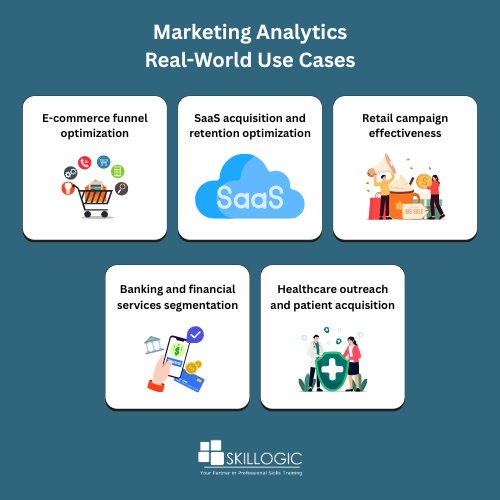
Marketing Analytics Real-World Use Cases
In practice, marketing analytics is most valuable when it connects customer behavior data with measurable business outcomes like revenue, retention, and acquisition efficiency. Across industries, teams use it to move beyond reporting and into decision-driven execution.
E-commerce funnel optimization
E-commerce teams use behavioral and conversion data to map the full customer journey from ad click to purchase. By analyzing funnel drop-offs, cart abandonment, and product page engagement, they identify friction points and improve conversion rates through targeted changes in UX, pricing, and checkout flow.
SaaS acquisition and retention optimization
In SaaS environments, marketing analytics is closely tied to growth metrics like CAC, activation rate, and churn. Teams evaluate which channels bring high-retention users and track in-product behavior to identify churn signals early, improving onboarding flows and increasing customer lifetime value.
Retail campaign effectiveness
Retail organizations use marketing analytics to evaluate promotional performance across offline and digital channels. This includes analyzing seasonal demand patterns, campaign ROI, and channel contribution, helping optimize budget allocation toward higher-performing campaigns.
Banking and financial services segmentation
Financial institutions rely on customer segmentation models to improve targeting for loans, credit cards, and investment products. Analytics helps identify high-value customer segments, improve cross-sell performance, and reduce acquisition inefficiencies while maintaining compliance requirements.
Healthcare outreach and patient acquisition
Healthcare providers use marketing analytics to measure the effectiveness of awareness campaigns and patient acquisition strategies. By tracking engagement-to-appointment conversion rates, they refine outreach messaging and improve access to services.
Across industries, the consistent pattern is clear: marketing analytics is not just about reporting performance but about diagnosing behavior, predicting outcomes, and improving business decisions with measurable evidence.
Step-by-Step Guide to Becoming a Marketing Analytics Professional
This Guide to Marketing Analytics Career outlines a structured learning path for aspiring professionals. Instead of learning tools randomly, follow a step-by-step approach: start with Excel for understanding marketing data, move to SQL for database queries, and then learn Power BI or Tableau for visualization.
Once comfortable with reporting, move into predictive analytics, attribution modeling, and customer behavior analysis using projects like conversion optimization, funnel analysis, and campaign dashboards. A strong portfolio often matters more than certifications. This is key for building a marketing analytics career, where practical experience drives real growth.
Step 1: Understand Marketing Fundamentals
Build a strong foundation in digital marketing, customer journey mapping, branding, SEO, paid media, and campaign management.
Step 2: Learn Data Analysis Basics
Develop skills in Excel, statistics, data cleaning, reporting, and descriptive analytics to interpret marketing performance data effectively.
Step 3: Master BI & Analytics Tools
Gain hands-on experience with Power BI, Tableau, Excel, and SQL to build dashboards and analyze campaign performance.
Step 4: Learn Predictive & Advanced Analytics
Explore forecasting, A/B testing, attribution models, and machine learning basics to understand customer behavior and predict outcomes.
Step 5: Build Real-World Projects
Work on practical projects such as:
- Customer segmentation analysis
- Marketing funnel optimization dashboard
- Campaign ROI analysis
- Churn prediction model
- Attribution modeling dashboard
Step 6: Earn Industry Certifications
Certifications in marketing analytics, data visualization, and digital analytics help validate skills and improve job readiness.
Step 7: Stay Updated with Industry Trends
Marketing analytics evolves rapidly with AI, automation, and personalization technologies. Continuous learning through industry reports, webinars, and case studies is essential to stay competitive.
Marketing analytics is evolving from reporting dashboards into a core growth strategy function. Professionals who combine marketing intuition with analytical depth will shape how businesses acquire, engage, and retain customers in the coming years.
Marketing analytics has become a key driver of modern business success, helping organizations shift from intuition-based decisions to data-driven strategies by improving customer understanding, campaign performance, and key metrics like conversions, engagement, and customer acquisition cost. As highlighted in this Guide to Marketing Analytics, building expertise in reporting, predictive analytics, and real-world project work is essential for long-term growth, as a strong mix of technical skills and practical experience enables professionals to turn data into actionable insights and deliver measurable business impact.
SKILLOGIC’s Marketing Analytics Course equips learners with practical skills in marketing metrics, campaign performance analysis, customer behavior tracking, conversion optimization, and marketing dashboard creation through hands-on projects and real-world case studies. The program includes industry-recognized certifications along with global IABAC certification. With expert trainers, an industry-focused curriculum, and 25+ training centers across India including Bangalore, Chennai, Coimbatore, Hyderabad, Ahmedabad, Pune, Mumbai, Nagpur, and Delhi, SKILLOGIC is recognized as a leading marketing analytics training institute in India for aspiring marketing and analytics professionals.