Top 5 Marketing Analytics Strategies for Your Business
Explore the top 5 marketing analytics strategies to understand customer behaviour, measure campaign performance, improve ROI, and support business growth.
 Aiswarya N
Marketing teams collect information from websites, social media, email campaigns, advertisements, and customer interactions. However, having access to data does not automatically lead to better decisions. Businesses need to understand what the numbers mean and how to use them to improve their marketing efforts.
This is where marketing analytics becomes useful. It helps businesses understand customer behavior, measure campaign results, identify opportunities, and allocate budgets more effectively.
In this guide, we will explore 5 practical marketing analytics strategies, explaining how businesses can apply them.
Why Are Marketing Analytics Strategies Important?
Marketing decisions can become expensive when they are based only on assumptions. Analytics helps businesses understand which activities deliver results, where customers lose interest, and which areas need improvement.
Here are some important benefits:
- Better customer understanding: Businesses can identify customer preferences, interests, and purchasing patterns.
- Improved campaign performance: Marketing teams can compare campaign results and focus on activities that perform well.
- More effective budget allocation: Data helps businesses evaluate where their marketing spending generates meaningful returns.
- Stronger customer relationships: Understanding customer behavior helps brands create more relevant experiences.
- Informed business planning: Performance trends help marketers plan future campaigns and set realistic goals.
These marketing analytics strategies also help teams connect marketing activities with business outcomes. Rather than measuring success only through clicks or impressions, businesses can examine how their campaigns contribute to leads, sales, and customer retention.
Refer these articles:
- How to Use Marketing Analytics in the Financial Services Industry
- The Role of Machine Learning in Marketing Analytics
- How to Use Power BI & Tableau for Marketing Insights
Top 5 Marketing Analytics Strategies for Your Business
Here are the top 5 marketing analytics strategies businesses can use to understand their audience, improve campaign performance, and make data-driven marketing decisions:
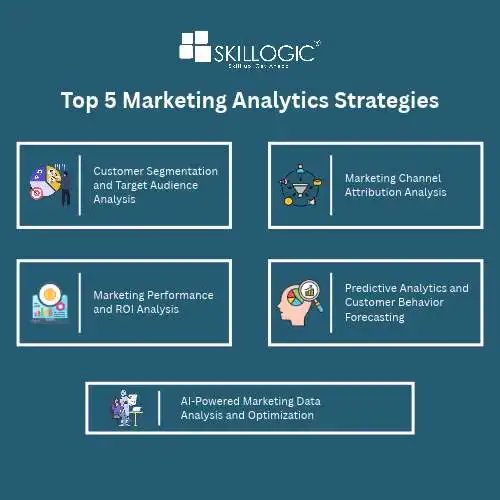
1. Customer Segmentation and Target Audience Analysis
Customer segmentation involves dividing an audience into smaller groups based on shared characteristics, interests, purchasing habits, or engagement patterns. This helps businesses understand how different customers respond to products, offers, and marketing messages.
For example, an online retailer can group customers according to their purchase history and browsing activity. It can then recommend relevant products to repeat buyers while creating different campaigns for first-time visitors.
Businesses can also use Customer Data Platforms (CDPs) to combine information from multiple sources into unified customer profiles. According to MarketsandMarkets' Customer Data Platform Market report, the global CDP market is projected to grow from USD 7.34 billion in 2026 to USD 14.04 billion by 2031, with a reported CAGR of 13.8%. This provides useful context for discussing the growing role of customer data management, segmentation, and personalization.
By applying customer segmentation in marketing analytics, marketers can create more relevant campaigns, understand customer needs, and reduce spending on audiences that are unlikely to respond. However, customer data should be collected and used responsibly, with appropriate privacy safeguards.
2. Marketing Channel Attribution Analysis
Marketing channel attribution helps businesses understand how different channels and customer touchpoints contribute to conversions. A customer may first discover a brand through an organic search result, return through a social media advertisement, and eventually purchase after receiving an email. Attribution analysis helps marketers evaluate these interactions instead of giving all the credit to the final click.
The SNS Insider Marketing Attribution Software Market Report values the global market at USD 6.30 billion in 2026, with projections reaching USD 21.43 billion by 2035 at a CAGR of 14.57%. The report also identifies multi-source attribution models as holding 49% of the market share. These figures provide context for the growing role of attribution tools in evaluating how multiple marketing touchpoints contribute to conversions.
Businesses can apply this approach by:
- Comparing channel contributions: Evaluate the roles of organic search, paid advertising, email, and social media in generating leads and sales.
- Tracking customer touchpoints: Examine customer interactions across available marketing channels.
- Identifying assisted conversions: Recognize channels that influence purchasing decisions even when they do not generate the final click.
- Comparing attribution with costs: Evaluate channel contributions alongside campaign spending and sales outcomes.
For example, if social media introduces customers to a product but organic search generates many final purchases, evaluating both interactions gives the business a more complete picture of its marketing performance.
Attribution results depend on the model used, the quality of tracking data, and the customer journey being measured. Marketers should therefore avoid assuming that a channel caused a conversion simply because it appeared in the journey. Combining attribution data with campaign experiments and other performance measures can lead to more reliable decisions.
3. Marketing Performance and ROI Analysis
Marketing performance analysis helps businesses determine whether their campaigns are meeting their objectives and generating worthwhile results. Instead of relying only on website visits or social media engagement, marketers can evaluate how their activities contribute to leads, sales, and revenue.
Some important metrics to measure include:
- Customer acquisition cost (CAC): The average cost of acquiring a new customer.
- Conversion rate: The percentage of people who complete a desired action.
- Cost per lead (CPL): The amount spent to generate a potential customer.
- Return on marketing investment (ROMI): The financial return generated by marketing activities relative to their cost.
- Customer lifetime value (CLV): The estimated revenue a customer generates over the course of their relationship with a business.
For example, a company spending ₹30,000 on paid advertising may generate 150 leads, giving it a cost per lead of ₹200. However, it should also examine how many leads become paying customers and how much revenue those customers generate to assess the campaign's overall performance.
HubSpot's State of Marketing Report identifies lead-to-customer conversion rate (34%) and customer acquisition cost (30%) among the leading metrics marketers use to evaluate performance. These findings highlight the importance of measuring both conversion outcomes and acquisition expenses.
By reviewing these metrics regularly, businesses can identify underperforming campaigns, compare marketing channels, and make better budget allocation decisions. This approach also helps teams understand which activities contribute to business objectives rather than simply generating attention.
4. Predictive Analytics and Customer Behavior Forecasting
Predictive analytics uses historical data, statistical methods, and machine learning to estimate future outcomes. It helps businesses identify patterns in customer behavior and use those patterns to plan marketing activities.
For example, an online retailer can analyze previous festive-season sales to forecast demand for certain products. A subscription business can study changes in customer engagement to identify users who may be at risk of cancelling their subscriptions.
Businesses can apply predictive analytics to:
- Forecast product demand and seasonal sales.
- Estimate the likelihood of leads converting into customers.
- Identify customers who may stop purchasing or using a service.
- Predict campaign outcomes based on historical performance.
- Support marketing budget and resource planning.
These forecasts can help marketers prepare campaigns, prioritize promising leads, and allocate resources more effectively. However, predictions are not guarantees. Their reliability depends on the quality of the available data, the assumptions used, and changes in customer behavior.
Businesses should compare predictions with actual results and update their models when necessary. This makes predictive analytics a useful approach for planning marketing activities while allowing teams to respond to changing conditions.
5. AI-Powered Marketing Data Analysis and Optimization
AI-powered marketing analytics uses artificial intelligence to process data, identify patterns, automate reporting, and support campaign optimization. It can help marketing teams analyze information more efficiently and identify areas that require attention.
Common applications include:
- Automated reporting: Summarize campaign results and highlight important changes in performance.
- Trend detection: Identify changes in engagement, conversions, and customer behavior.
- Audience analysis: Discover patterns in customer preferences and interactions.
- Campaign optimization: Compare targeting, bidding, and messaging options.
- Customer feedback analysis: Identify recurring themes in reviews, surveys, and customer enquiries.
For example, a marketing team may notice a decline in email engagement over several weeks. An AI-powered tool can summarize the trend and help the team investigate possible reasons, such as sending frequency, subject lines, or audience relevance. The team can then test improvements and measure their impact.
Forrester reports that 55% of surveyed organizations use AI in production for advertising and media buying. The article highlights AI's growing role in data-intensive marketing activities, including campaign optimization and analysis.
AI can help marketing teams identify opportunities, reduce repetitive work, and improve operational efficiency. By using AI driven marketing analytics, businesses can make more informed decisions based on campaign data and customer behavior.
However, AI-generated insights should be checked for accuracy before they inform important decisions, and businesses must protect customer information while accounting for possible bias or gaps in their data.
Refer these articles:
- How to become a Business Analyst in India
- Business Analytics Scope in India
- How to Become a Business Analytics Expert in India
How to Choose the Right Marketing Analytics Strategy for Your Business
The most suitable approach depends on what the business wants to improve. A small business may need only basic website analytics and campaign reports, while a larger organization may require integrated customer data and predictive tools.
Use these steps to choose an approach:
- Define the business objective: Decide whether the priority is increasing sales, improving retention, reducing acquisition costs, or generating qualified leads.
- Identify the required data: Determine which information is needed to measure progress toward that objective.
- Choose suitable tools: Select platforms that fit your business size, budget, existing systems, and technical capabilities.
- Set measurable targets: Establish clear benchmarks so the team can evaluate performance.
- Review and improve: Analyze results regularly and adjust campaigns based on reliable evidence.
The most effective marketing analytics strategies do not require businesses to track every available metric. They focus on the information that helps answer specific questions and supports practical decisions.
For businesses aiming to use marketing analytics for business growth, it is also important to connect campaign results with broader outcomes, such as revenue, customer loyalty, and sustainable profitability. Data should help explain what is working, what needs attention, and where further testing is worthwhile.
In short, marketing analytics helps businesses understand their audiences, measure campaign results, forecast possible trends, and improve customer experiences. Customer segmentation, campaign performance tracking, predictive analytics, customer journey optimization, and AI-supported analysis each address different marketing needs.
Businesses can make more informed decisions by selecting suitable methods, monitoring relevant metrics, and reviewing results consistently. The goal is not simply to collect more data, but to turn reliable information into practical actions that support long-term business performance.
SKILLOGIC is a professional training institute that offers practical, industry-relevant education to help learners develop career-ready skills. SKILLOGIC’s Marketing Analytics Certification Course covers campaign performance, marketing metrics, customer behaviour, conversion tracking, and data visualisation through hands-on exercises and real-time projects. Learners also benefit from expert guidance, an industry-relevant curriculum, and globally recognised IABAC certification. With training centres across India, including Bangalore, Chennai, Coimbatore, Hyderabad, Ahmedabad, Pune, Mumbai, Nagpur, and Delhi, SKILLOGIC offers learning opportunities for aspiring professionals. The marketing analytics certification course helps learners interpret marketing data and use insights to support informed business decisions.