AI Agents in Marketing Analytics: A Comprehensive Guide
Explore how AI agents are transforming marketing analytics by automating data analysis, tracking campaign performance, understanding customer behaviour, and supporting smarter marketing decisions.
 Aiswarya N
Marketing teams need to understand what customers want, which products perform well, how pricing affects demand, and where marketing budgets deliver the best results. These decisions often require information from sales records, customer feedback, market research, advertising campaigns, and other business sources.
AI agents can help bring this information together, identify patterns, and support marketing decisions. Rather than focusing only on website traffic or digital campaigns, AI agents in marketing analytics can help businesses understand broader marketing performance and customer needs.
In this comprehensive guide, we will explore how AI agents work, their benefits and challenges, practical use cases, and the steps businesses can take to implement them.
What Are AI Agents in Marketing Analytics?
AI agents are systems that can work towards a goal by analysing information, selecting appropriate steps, and using connected tools to complete tasks. Unlike a basic chatbot that mainly answers questions, an AI agent can perform a sequence of actions, evaluate results, and continue working within defined permissions.
In marketing, these systems can help analyse customer preferences, monitor product demand, compare sales trends, assess pricing strategies, and evaluate campaign results. AI agents in marketing analytics combine data analysis with the ability to take action through connected applications.
Businesses are exploring this technology as part of a wider shift towards automation. According to Grand View Research's AI Agents Market report, the global AI agents market was valued at USD 7.6 billion in 2025 and is projected to reach USD 182.9 billion by 2033, with a forecast CAGR of 49.6% from 2026 to 2033. These figures cover the overall AI agents market, rather than marketing analytics alone, but they indicate the growing interest in agent-based technology.
How AI Agents Work in Marketing Analytics
AI agents follow a series of steps to complete a task. The process depends on the business objective, available data, connected applications, and permissions.
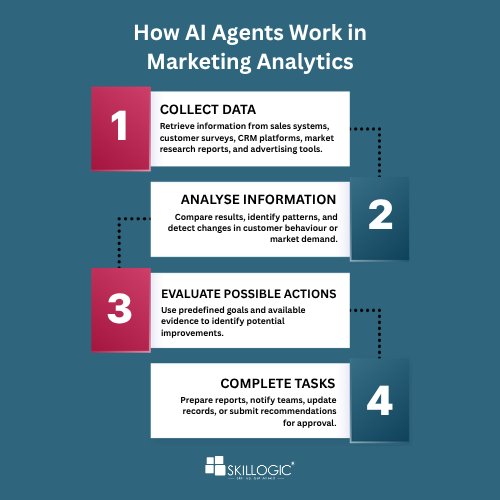
- Collect data: Retrieve information from sales systems, customer surveys, CRM platforms, market research reports, and advertising tools.
- Analyse information: Compare results, identify patterns, and detect changes in customer behaviour or market demand.
- Evaluate possible actions: Use predefined goals and available evidence to identify potential improvements.
- Complete tasks: Prepare reports, notify teams, update records, or submit recommendations for approval.
For example, an AI agent could compare monthly sales data with customer feedback and promotional activity. It might identify that a product's sales are declining in a particular region and prepare a report highlighting possible factors for the marketing team to investigate.
This approach also shows how AI-driven marketing analytics can help teams connect information from different sources and identify areas that need attention.
The findings still need to be checked against reliable evidence. A change in sales does not automatically establish its cause.
Refer these articles:
- The Ethics of Marketing Analytics: Protecting Customer Data
- The Future of Marketing Analytics: Trends to Watch and Leverage
- How to Use Marketing Analytics in the Financial Services Industry
Benefits of Using AI Agents in Marketing Analytics
AI agents can help marketing teams analyse information more efficiently and spend more time on planning and decision-making. Here are some key benefits:
- Faster analysis: Review information from multiple business sources without manually compiling every report.
- Better customer understanding: Identify patterns in customer preferences, purchasing behaviour, and feedback.
- Improved planning: Compare product demand, pricing, sales performance, and campaign results.
- Reduced repetitive work: Automate data collection, report preparation, and routine notifications.
- More informed decisions: Present relevant findings that help teams evaluate marketing opportunities.
These benefits help explain why businesses are considering AI agents in marketing analytics for more than routine reporting.Gartner has predicted a USD 58 billion market shakeup by 2027 as generative AI and AI agents challenge mainstream productivity software. This prediction concerns productivity software broadly, rather than marketing analytics specifically.
The practical value comes from choosing tasks where automation saves time without compromising accuracy or control.
Challenges of Using AI Agents in Marketing Analytics
Although AI agents can improve efficiency, they also come with limitations that businesses need to consider. The following are some key challenges:
- Data quality: Incomplete sales records or outdated customer information can produce misleading findings.
- Privacy and security: Customer and commercial information must be protected through appropriate access controls.
- Integration difficulties: Different systems may use incompatible data formats or permissions.
- Cost and reliability: AI model usage, integrations, and maintenance can increase expenses.
- Human oversight: Agents may misinterpret market changes or recommend unsuitable actions.
Gartner has predicted that more than 40% of agentic AI projects could be cancelled by the end of 2027 because of rising costs, unclear business value, or inadequate risk controls. This forecast covers agentic AI projects overall, not marketing projects specifically.
Businesses should therefore begin with a clear objective, test their workflows, and measure whether the results justify the cost. Human approval should remain part of important pricing, budget, and customer-related decisions. Avoiding common marketing analytics mistakes, such as relying on incomplete data or treating correlation as proof of cause, is equally important.
Use Cases of AI Agents in Marketing Analytics
AI agents can support different marketing functions, from understanding market demand to evaluating product performance and customer relationships.
The following are practical examples of how businesses can use them:
1. Understanding Market Demand and Customer Preferences
Businesses need to understand what customers want before developing products or planning marketing activities. However, customer surveys, sales records, feedback, and market research may be spread across different systems.
How the agent solves it: An agent workflow can collect approved research data, review customer feedback, compare purchasing patterns, and group recurring preferences. A language model such as Claude can help summarise the findings, while n8n can connect data sources and automate the workflow. The marketing team can use the report to identify customer needs and areas that deserve further research.
These insights can also support customer segmentation in marketing analytics by helping teams group customers according to shared preferences and purchasing patterns.
Tools: n8n, Claude, CRM systems, customer survey data, sales records.
2. Analysing Product Performance and Demand Trends
A product may sell well in one region but struggle in another. Marketing teams need to understand these differences before changing promotional plans, distribution priorities, or product positioning.
How the agent solves it: An agent can compare sales volumes, regional demand, customer reviews, and historical performance. It can highlight products with declining demand, identify regional differences, and prepare recommendations for further investigation. The findings can help teams review product positioning and marketing priorities without treating correlation as proof of cause.
Tools: Make or n8n, Claude, sales databases, spreadsheets, customer feedback systems.
3. Evaluating Pricing and Promotional Strategies
Discounts may increase sales volume but reduce profit margins. Marketing teams need to understand whether a promotion is attracting additional purchases or simply reducing revenue from customers who would have bought the product anyway.
How the agent solves it: An agent can compare sales before, during, and after a promotion, alongside discount levels, revenue, and available margin data. It can identify patterns across products or customer groups and prepare a comparison of promotional outcomes. Managers can then evaluate whether a discount strategy should be continued or tested differently.
Tools: Claude, n8n, sales data, pricing records, spreadsheets.
4. Improving Customer Retention and Lifetime Value
Acquiring customers is only one part of marketing. Businesses also need to understand why customers stop purchasing, which groups return regularly, and where retention efforts may be useful.
How the agent solves it: An agent can analyse purchase frequency, customer engagement, support feedback, and transaction history to identify changes in customer behaviour. It can flag groups with declining activity and suggest retention opportunities for review. The marketing team can use these insights to assess loyalty programmes, customer communication, and repeat-purchase strategies.
Tools: Claude, CRM platforms, customer transaction data, n8n or Make.
5. Measuring Marketing Performance Across Channels
Businesses may invest in digital advertising, email, retail promotions, events, sales partnerships, and traditional media. Reviewing each activity separately can make it difficult to understand the overall contribution of marketing.
How the agent solves it: An agent can consolidate available spending, sales, lead, and conversion data from different channels. It can compare results against campaign objectives and highlight where performance differs from expectations. For offline activities, teams may need to connect sales records, event results, or other available measurement data. The final report can help managers assess budget allocation across channels.
Tools: n8n or Make, Claude, sales systems, advertising APIs, spreadsheets.
6. Analysing Brand Perception and Market Feedback
Customer opinions can influence brand preference, product consideration, and future purchasing decisions. However, feedback may be spread across surveys, reviews, interviews, and customer support records.
How the agent solves it: An agent can organise feedback, identify recurring themes, and summarise positive and negative customer perceptions. It can compare feedback across products or customer groups and flag changes that require attention. Marketing teams can use these findings to review brand messaging, product communication, and customer experience.
Tools: Claude, customer survey platforms, feedback databases, n8n.
These examples show how AI agents in marketing analytics can support core marketing decisions, not just digital campaign management. The tools are most useful when they connect reliable information to a clearly defined business question.
Refer these articles:
- How much is the Business Analytics Course Fee in India?
- Business Analytics Scope in India
- How to become a Business Analyst in India?
How to Implement AI Agents in Marketing Analytics
The following steps can help businesses introduce AI agents into existing marketing workflows:
- Define the objective: Choose a specific goal, such as understanding customer demand, evaluating promotions, or improving retention.
- Identify relevant data: Determine which sales, customer, market research, or campaign records are required.
- Select suitable tools: Choose an AI model and a workflow platform based on the task and technical requirements.
- Build and test the workflow: Start with a limited dataset and verify whether the agent produces useful, accurate findings.
- Set approval rules: Require human confirmation before changing prices, allocating budgets, or sending customer communications.
- Measure performance: Evaluate accuracy, time saved, implementation costs, and the usefulness of recommendations.
For beginners, a useful first project could be a monthly product performance report combining sales data and customer feedback. Once the workflow produces reliable results, it can be extended to other marketing activities.
Future of AI Agents in Marketing Analytics
AI agents may increasingly help businesses connect market research, customer insights, product performance, and marketing planning. Instead of simply preparing reports, more advanced workflows could investigate changes across several data sources and suggest actions for human review.
Gartner predicts that at least 15% of day-to-day work decisions will be made autonomously through agentic AI by 2028, compared with 0% in 2024. It also forecasts that 33% of enterprise software applications will include agentic AI by 2028, up from less than 1% in 2024. These are cross-industry forecasts rather than marketing-specific estimates.
Human judgement will remain important as these systems develop. Capgemini Research Institute's research on AI agents found that 38% of organisations expected AI agents to work as members of human teams by 2028, based on a survey of 1,500 senior executives across 14 countries. This points towards collaboration between people and AI, particularly where business decisions require context and experience.
In short, AI agents can help marketing teams understand customer needs, evaluate product and pricing performance, analyse market feedback, and make better use of business data. Their value depends on selecting relevant use cases, using reliable information, and validating recommendations before taking action.
SKILLOGIC is a globally recognised professional training institute focused on helping learners develop practical skills for their chosen careers. SKILLOGIC’s Marketing Analytics Certification Course provides hands-on learning in campaign analysis, marketing metrics, customer insights, conversion tracking, and data visualisation through practical exercises and real-world projects. The programme also offers expert guidance, an industry-relevant curriculum, and globally recognised IABAC certification. With more than 25 training centres across India, including Bangalore, Chennai, Coimbatore, Hyderabad, Ahmedabad, Pune, Mumbai, Nagpur, and Delhi, SKILLOGIC offers a marketing analytics course for learners looking to build skills in marketing data analysis and performance measurement.