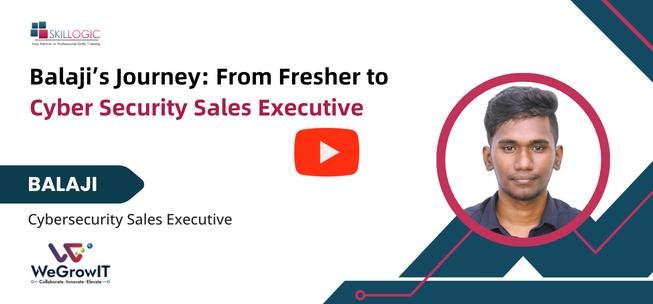
Balaji’s Journey: From Fresher to Cyber Security Sales Executive
Discover Balaji's journey from an MCA graduate to a Cyber Security Sales Executive. Learn about his cybersecurity training, interview preparation, projects, and career success with SKILLOGIC.
 Aiswarya N
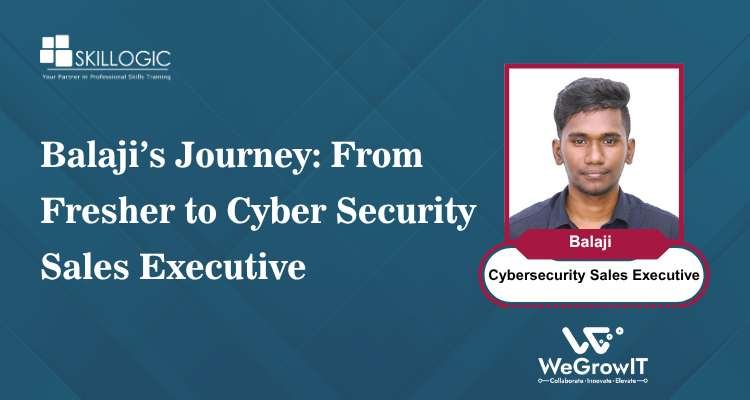
Cyber security has become one of the most promising career paths for graduates passionate about networking, ethical hacking, and information security. Balaji’s journey is a testament to how curiosity, consistent practice, and the right guidance can help transform a fresher into an industry-ready cyber security professional. After completing his Master of Computer Applications (MCA), Balaji chose to specialize in cyber security, driven by his fascination with computer networks and the importance of securing digital systems.
To build practical expertise, he enrolled at DigiDefense, the cyber security training division and sister concern of SKILLOGIC, where he gained hands-on experience through practical labs, real-world projects, and industry-focused mentoring. With continuous guidance, mock interview preparation, and placement support from SKILLOGIC and DigiDefense, Balaji strengthened his technical skills and interview confidence, ultimately securing his first role as a Cyber Security Sales Executive at WegrowIT Technologies India Private Limited.
In this interview, Balaji shares his journey into cyber security, his training experience, project work, interview preparation strategies, and practical advice for fresh graduates looking to build a successful career in the cyber security industry.
Refer these articles:
- Jaya Krishna’s Journey from Fresher to SOC Analyst
- From HR Executive to Cyber Security Researcher: Indhu's Journey
- From Fresher to SOC Analyst: Bhuvanesh’s Inspiring Journey
Balaji’s Cyber Security Journey in His Own Words
In this section, Balaji shares his educational background, cyber security learning journey, hands-on project experience, interview preparation, placement journey, and valuable advice for aspiring cyber security professionals:
Q1: Could you please introduce yourself and tell us about your educational background?
Balaji: My name is Balaji. I completed my Master of Computer Applications (MCA) in July 2024 from Rathinam College, Coimbatore, Tamil Nadu. After completing my post-graduation, I decided to pursue a career in cyber security because I had a strong interest in networking and cyber security. I immediately joined a cyber security training program to build my practical and technical skills in this domain.
Q2: What inspired you to choose cyber security as your career after completing your MCA?
Balaji: During my MCA, I developed a strong interest in computer networking. I was fascinated by how networks operate, how data is transmitted, and how communication happens between systems. As I learned more about networking, I became curious about the security aspects of these technologies. That curiosity eventually led me to cyber security, and I realized this was the career path I wanted to pursue.
Q3: Did you work anywhere before joining the cyber security course?
Balaji: No. Right after completing my MCA, I joined the cyber security course because I wanted to start my career in this field without any delay.
Q4: Where did you complete your cyber security training?
Balaji: I completed my cyber security training at DigiDefense in Kudlu Gate, Bangalore. I attended offline classroom sessions where I learned both theoretical concepts and practical cyber security skills.
Q5: How was your initial experience when you entered the cyber security domain?
Balaji: Since I came from an MCA background, I already understood networking concepts, but cyber security itself was new to me. The trainers introduced me to various security concepts, practical tools, Kali Linux, and real-world cyber security scenarios. Although everything was new initially, the learning process became comfortable because the trainers and advisors were very supportive. They understood the learning pace of every student and provided additional guidance whenever required.
Q6: How did you continue learning outside your classroom sessions?
Balaji: After every class, I spent at least one additional hour discussing my doubts with the trainers and advisors. Once I returned to my hostel, I continued practicing using Hack The Box. I also watched cyber security-related videos on YouTube and kept myself updated with the latest vulnerabilities and security incidents happening around the world. This continuous practice helped me improve my technical understanding.
Q7: Whenever you faced difficulties, how did you solve your doubts?
Balaji: Whenever I had questions, I wrote them down and discussed them with my advisor during the next session. If I still wanted more clarity, I referred to YouTube and AI-based learning tools. The trainers were always available to explain concepts in detail until I understood them completely.
Q8: What kind of projects did you work on during your training?
Balaji: I worked on two cyber security projects involving WhatsApp security analysis and Wireshark. These projects were completed as team activities where we collaborated with classmates, discussed different approaches, and learned how various security concepts work in practical environments. Working together helped us gain better exposure to real-world cyber security practices.
Q9: Did your projects help during your interviews?
Balaji: Yes, they definitely helped. During interviews, the interviewers focused more on technical knowledge than theoretical concepts. Initially, I lacked confidence while answering technical questions, but after attending multiple mock interviews, my confidence improved significantly. The mock interviews helped me understand what employers expected and prepared me well for actual interview situations.
Q10: How did you get your interview opportunity?
Balaji: The placement opportunity was shared by the SKILLOGIC and DigiDefense placement teams. They guided me throughout the placement process and helped me attend the interview.
Q11: Can you explain your interview process?
Balaji: The company first shortlisted my resume. After that, I attended two rounds of technical interviews where they evaluated my domain knowledge and technical understanding. Finally, I attended an in-person interview where they again assessed my technical skills and also explained the company's working tools and technologies. The final stage included salary negotiations before the offer was confirmed.
Q12: How long did your complete interview process take?
Balaji: The entire interview process took around two weeks. During the process, I requested the HR team for two extra days to prepare because I wanted to improve my understanding of the domain before attending the next round.
Q13: How did the HR respond when you requested additional preparation time?
Balaji: Initially, the HR team declined my request. However, when I explained that I was entering a new domain and wanted some additional time to prepare properly, they understood my situation and agreed to extend the timeline. That extra preparation time gave me much more confidence during the interview.
Q14: What advice would you give to freshers who want to build a career in cyber security?
Balaji: I would strongly recommend focusing more on practical learning than only studying theory. Platforms like Hack The Box and TryHackMe provide excellent opportunities to practice real cyber security concepts. Students should continuously improve their technical skills by referring to YouTube, AI tools, and other practical learning resources. The more practical exposure you gain, the better prepared you will be for interviews and real-world work.
Q15: How important is time management while learning cyber security?
Balaji: Time management is extremely important. I used to study in focused sessions of one and a half hours by keeping my phone away and concentrating only on learning. After each study session, I took a short break before continuing again. Maintaining this routine every day helped me stay consistent and avoid distractions.
Q16: Finally, what message would you like to share with aspiring cyber security professionals?
Balaji: Discipline and consistency are the most important factors. You do not have to learn everything in one day. Instead, make sure you learn something new every single day. The goal is not simply to study for exams but to genuinely understand how cyber security works. If you know more today than you knew yesterday, you are making progress. Continuous learning is the key to building a successful cyber security career.
Refer these articles:
- How to Become a Cyber Security Expert in Bangalore
- How to Choose the Best Institute for Cyber Security in Bangalore
- Cyber Security Career in Bangalore: Skills, Salaries, and Success Tips
Highlights from Balaji’s Cyber Security Journey
With consistent learning, practical training, and placement support, Balaji successfully transitioned from an MCA graduate to a Cyber Security Sales Executive. Here are the key highlights of his journey:
- Practical-Focused Learning: Built a strong foundation in cyber security through hands-on training with Kali Linux, Wireshark, and other cyber security tools, gaining practical knowledge beyond classroom theory.
- Consistent Self-Learning: Dedicated time every day to practicing on Hack The Box, exploring cyber security topics on YouTube, and staying updated with the latest vulnerabilities and security trends.
- Collaborative Project Experience: Worked on practical cyber security projects involving WhatsApp security analysis and Wireshark, collaborating with peers to understand real-world security concepts and techniques.
- Continuous Trainer Support: Received one-on-one guidance from trainers and advisors whenever doubts arose, ensuring every concept was clearly understood through additional mentoring sessions.
- Mock Interview Preparation: Participated in multiple mock interviews that significantly improved technical confidence and prepared him to handle real interview questions effectively.
- Smart Interview Strategy: Requested additional preparation time during the interview process to strengthen his domain knowledge, allowing him to perform with greater confidence in the technical rounds.
- Successful Placement: Secured his first role as a Cyber Security Sales Executive at WegrowIT Technologies India Private Limited through dedication, disciplined preparation, and continuous practical learning.
In short, Balaji’s journey demonstrates that consistent learning, practical experience, and disciplined preparation are the key ingredients for building a successful career in cyber security. With the structured training, mentorship, and placement support provided by SKILLOGIC, he successfully transitioned from completing his MCA to securing his first role as a Cyber Security Sales Executive at WegrowIT Technologies India Private Limited. His story highlights how determination, hands-on practice, and continuous upskilling can help fresh graduates confidently launch their careers in the ever-growing cyber security industry.
Refer these articles:
- How to Become a Cyber Security Expert in Chennai
- Tips for Selecting the Top Cyber Security Institute in Chennai
- Building a Cyber Security Career in Chennai: Key Skills, Salaries, and Tips
As cyber threats continue to evolve, the demand for skilled cyber security professionals is rising rapidly across India. To address this growing need, leading training institutes offer comprehensive online and classroom-based programs that equip learners with practical, industry-relevant skills. Major cities such as Bangalore, Hyderabad, Chennai, Mumbai, Pune, Delhi, Ahmedabad, Coimbatore, and Kochi have become prominent destinations for cyber security training, and enrolling in a cyber security course in Bangalore offers learners access to hands-on labs, real-world projects, expert mentorship, and strong placement opportunities that prepare them for successful careers in the field.
SKILLOGIC is recognized as one of the top cyber security institutes in India, offering industry-focused training designed to prepare learners for successful careers in cybersecurity. In addition to its comprehensive Cyber Security programs, SKILLOGIC also provides professional certification courses in Ethical Hacking, Business Analytics, Project Management Professional (PMP), and Six Sigma, helping learners build expertise across multiple high-demand domains. SKILLOGIC’s Cyber Security Professional Plus Course combines theoretical knowledge with extensive practical learning through live labs, case studies, cyber security tools, and real-world projects. Accredited by organizations such as NASSCOM FutureSkills and IIFIS, the program helps learners earn globally recognized certifications while developing the technical expertise required by today's employers.
With flexible online and classroom learning options, SKILLOGIC supports aspiring cyber security professionals across India through expert mentorship, mock interviews, and dedicated placement assistance. Whether you are looking for a cyber security course in Chennai, Bangalore, Hyderabad, Mumbai, Pune, Delhi, Ahmedabad, Coimbatore, or Kochi, SKILLOGIC provides a structured learning pathway to help you build practical skills and launch a successful career in roles such as Cyber Security Engineer, Security Analyst, Ethical Hacker, SOC Analyst, and other in-demand cyber security positions.