Akshay’s Inspiring Journey from Fresher to Security Analyst
Discover Akshay’s inspiring journey from a fresher to a Security Analyst, as he shares how consistent practice, hands-on learning, and strong fundamentals helped him break into the cyber security industry and land his first job successfully.
 Aiswarya N
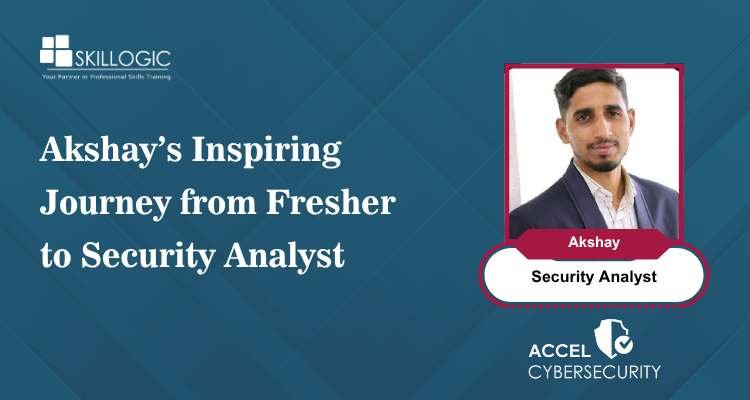
Cyber security is a fast-growing and ever-evolving domain, and for freshers, the right guidance and consistent practice can play a crucial role in building a successful career. Akshay’s journey is a great example of how dedication and structured learning can help someone transition from a non-IT background into the cyber security industry. After completing his Electronics and Communication Engineering, Akshay chose to pursue cyber security and successfully secured a role as a Security Analyst at Accel Limited soon after his training.
In this interview, Akshay shares his complete journey, from discovering his interest in cyber security to building strong fundamentals through practical learning. He discusses how he mapped theoretical concepts to real-world tools, maintained a disciplined study routine, and overcame initial challenges. He also highlights his internship experience, interview preparation strategy, and how he cracked his first job interview.
For anyone looking to start a career in cyber security, especially from a non-technical background, Akshay’s experience offers clear insights, practical tips, and a realistic roadmap to entering the industry.
Refer these articles:
- Jaya Krishna’s Journey from Fresher to SOC Analyst
- From HR Executive to Cyber Security Researcher: Indhu's Journey
- From Fresher to SOC Analyst: Bhuvanesh’s Inspiring Journey
Akshay’s Cyber Security Journey: From Fresher to Security Analyst
Here’s how Akshay discovered his passion for cyber security, built strong practical skills, and successfully transitioned from a fresher to a Security Analyst:
Q1: Can you start by telling us about your background and what led you to choose cyber security as a career?
Akshay: I come from an Electronics and Communication Engineering background. Even during my studies, I was very curious about cyber security. I was interested in ethical hacking and exploring different tools. Over time, I realized that cyber security has strong growth potential and is highly relevant today, which motivated me to pursue it as a career.
Q2: Since your background wasn’t purely IT-focused, how did you begin your learning journey in cyber security?
Akshay: I started by searching for platforms where I could learn cyber security in a structured way. That’s when I found a training institute where the trainers focused not just on theory but also on practical implementation. They helped me build a strong foundation and taught me how to connect theoretical knowledge with real-world tools.
Q3: You mentioned mapping theory to practical skills. Can you explain how you actually did that?
Akshay: Learning theory gives you the base, but applying it makes everything clear. During classes, concepts were explained first, and then we worked on tools related to those concepts. After class, I practiced regularly using platforms like TryHackMe and PortSwigger labs. This helped me understand how theoretical concepts work in real scenarios, which made a big difference in my learning.
Q4: What did your daily learning routine look like?
Akshay: My classes were around two hours long. After that, I would spend another two and a half to three hours practicing what I learned. Consistency was key. I made sure to revisit concepts and apply them using tools so that I could build confidence over time.
Q5: Did you face challenges while learning, especially in the beginning?
Akshay: Yes, definitely. In the beginning, everything felt confusing because it was completely new to me. But whenever I had doubts, I reached out to my trainers, and they clarified things quickly. Over time, with consistent practice, those confusions started to fade.
Q6: At what point did you start feeling confident in your skills?
Akshay: Initially, it was difficult, especially coming from a non-IT background. But as I continued practicing and learning every day, my confidence gradually increased. By the time I completed the course, I felt ready to face interviews and apply my knowledge.
Q7: Tell us about your internship experience. What kind of work did you do?
Akshay: During my internship, I worked with a teammate on two projects focused on practical cyber security tools. These projects helped me gain hands-on experience and understand how cyber security concepts are applied in real-world scenarios. It gave me more clarity and strengthened my practical knowledge.
Q8: How did your training and internship help you during job interviews?
Akshay: In interviews, especially for freshers, companies focus a lot on fundamentals. Having a strong foundation really helped me. I was able to answer questions about networking basics, common cyber security attacks, and core concepts confidently. My practical exposure also helped me demonstrate my skills effectively.
Q9: Can you walk us through your interview process?
Akshay: The process had two technical rounds. In the first round, I was asked about networking basics, cyber security fundamentals, and common attack types. In the second round, I had to perform practical tasks. I was asked to conduct basic scans using tools, which I had already practiced during my training. That hands-on experience helped me perform well.
Q10: Did you face multiple interviews or rejections before getting this job?
Akshay: No, this was actually my first interview, and I got selected. I was confident during the interview, and I could feel that it went well.
Q11: That’s impressive. When did you join your current role, and what is your designation?
Akshay: I joined on February 9th as a Security Analyst.
Q12: What does your current role involve?
Akshay: I work as part of a team, and we monitor client systems continuously. We use a security platform to track and analyze activities across different environments. It’s a 24/7 monitoring setup, and I’m learning new things every day.
Q13: What new skills or areas have you been exploring since joining?
Akshay: Recently, I’ve been learning about vulnerability assessment and operational technology security. We are also preparing for new projects, which is helping me expand my knowledge further.
Q14: Looking back, what do you think was the most important factor in your success?
Akshay: Consistency and practice. Spending a few hours every day and not giving up when things felt difficult made a big difference. Also, having the right guidance helped me stay on track.
Q15: What advice would you give to someone considering a career in cyber security, especially from a non-IT background?
Akshay: Cyber security is open to everyone, regardless of background. You don’t need deep programming knowledge to get started. What matters is your problem-solving mindset and willingness to learn. If you are interested and consistent, you can definitely build a career in this field.
Q16: Any final thoughts for aspiring cyber security professionals?
Akshay: Keep learning and don’t become complacent. Technology keeps evolving, so it’s important to stay updated. Even after getting a job, continue practicing and improving your skills. That mindset will help you grow in the long term.
Refer these articles:
- How to Become a Cyber Security Expert in Bangalore
- How to Choose the Best Institute for Cyber Security in Bangalore
- Cyber Security Career in Bangalore: Skills, Salaries, and Success Tips
Key Findings from Akshay’s Cyber Security Success Story
Akshay’s journey showcases how a fresher from a non-IT background can successfully enter the cyber security industry through consistent effort, practical learning, and the right guidance. His experience highlights the importance of building strong fundamentals, practicing regularly, and staying confident during the job search process.
Here are the key takeaways from his journey:
- Career Transition Right After Graduation is Possible: Akshay moved directly from an Electronics and Communication Engineering background into cyber security without prior work experience, proving that early career shifts are achievable.
- Non-IT Background is Not a Limitation: Despite coming from a non-technical domain, he was able to understand and apply cyber security concepts through structured learning and practice.
- Consistency in Practice is Key: Spending 2 to 3 hours daily on hands-on practice helped him strengthen his understanding and build confidence over time.
- Practical Skills is Essential: Applying theoretical concepts through tools and labs like TryHackMe and PortSwigger made learning more effective and interview-ready.
- Strong Fundamentals Help Crack Interviews: His focus on networking basics, cyber attacks, and core concepts played a crucial role in clearing technical interview rounds.
- Guidance and Mentorship Matter: Regular doubt clarification and support from trainers helped him overcome confusion and stay on track.
- Internship Experience Adds Value: Working on real-time projects during internship helped him gain practical exposure and strengthen his profile.
- First Interview Success is Achievable: With proper preparation and confidence, Akshay was able to crack his very first interview and secure a job.
- Continuous Learning is Crucial: Even after getting placed, he continues to learn new areas like vulnerability assessment and operational technology security, emphasizing the importance of ongoing upskilling.
In short, Akshay’s journey shows how structured learning, consistent practice, and determination can help freshers enter the cyber security field. With SKILLOGIC’s practical training and mentorship, he built strong fundamentals and secured his first role as a Security Analyst.
Refer these articles:
- How to Become a Cyber Security Expert in Chennai
- Tips for Selecting the Top Cyber Security Institute in Chennai
- Building a Cyber Security Career in Chennai: Key Skills, Salaries, and Tips
SKILLOGIC offers a comprehensive cyber security course in Bangalore designed to equip learners with the practical skills required to succeed in the information security industry. The Cyber Security Professional Plus course covers key domains such as Ethical Hacking, SOC training, network security, threat detection, and vulnerability management. Spanning over four months with more than 200 hours of training, the program includes hands-on labs, real-time projects, and in-depth coverage of essential cyber security concepts. It also prepares learners for globally recognized certifications like NASSCOM FutureSkills and IIFIS. With flexible learning options, the course is suitable for both beginners and working professionals looking to upskill.
The curriculum is structured to provide a strong foundation along with advanced practical exposure. It includes critical areas such as penetration testing, IDS/IPS management, SIEM tools, malware analysis, and security compliance standards. The ethical hacking module focuses on identifying and exploiting system vulnerabilities, while the SOC training module enables learners to monitor networks, detect threats, and respond effectively to security incidents. Together, these modules offer a complete understanding of real-world cyber security operations.
SKILLOGIC has a strong presence across India, with cyber security training institutes in Chennai, Bangalore, Pune, Hyderabad, Jaipur, Noida, Kochi, Ahmedabad, and Mumbai. The training programs are designed and delivered by experienced professionals who ensure that learners gain both theoretical knowledge and hands-on expertise. This approach helps students understand practical challenges and prepares them for industry requirements.
Upon successful completion of the course, learners are well-prepared to earn certifications recognised by organisations such as NASSCOM FutureSkills and IIFIS and a course completion certification from SKILLOGIC. They can explore career opportunities in roles like SOC Analyst, Penetration Tester, Security Consultant, and Cyber Security Engineer.
With a focus on practical learning, career support, and placement assistance, SKILLOGIC enables learners to build a solid and sustainable career in cyber security.