
Role of a Business Analyst in FinTech
Explore the role of a Business Analyst in FinTech, including key responsibilities, financial technology trends, required skills, and how business analysts support digital financial solutions.
 Aiswarya N

Financial services now rely on technology for activities such as digital payments, online banking, loan processing, and investment management. Behind these services, businesses need professionals who understand customer needs, analyse business processes, and help technical teams build suitable solutions.
This is where a Business Analyst in FinTech plays an important role. They connect business stakeholders with developers, testers, product teams, and other professionals to ensure that financial technology solutions meet business requirements.
Let’s explore the role of a Business Analyst in FinTech, including their key contributions, essential skills, and opportunities in the financial technology industry.
What is a Business Analyst in FinTech?
A Business Analyst in FinTech identifies business needs and translates them into requirements for technology teams. The role combines business analysis skills with knowledge of financial services and digital systems.
For example, when a mobile banking company wants to simplify account opening, the analyst reviews the existing process, gathers requirements, and identifies improvements.
A FinTech Business Analyst works with stakeholders and technical teams to develop solutions that meet business objectives, whether improving existing services or building new financial products.
Read More:
- Cybersecurity Considerations for Business Analysts
- How Business Analysts Drive Digital Transformation
- Bridging the Gap Between IT & Business as a Business Analyst
Key Responsibilities of a Business Analyst in FinTech
A Business Analyst in FinTech helps financial organisations understand business needs, improve workflows, and develop reliable technology solutions.
Here are the key responsibilities of a Business Analyst in FinTech:
1. Gathering and Documenting Business Requirements
Business Analysts gather requirements through stakeholder discussions, interviews, and workshops. They document them as business requirement documents (BRDs), user stories, and acceptance criteria so development and testing teams understand what the solution must deliver.
For example, when a digital wallet introduces a payment feature, the analyst defines transaction limits, confirmation messages, and error handling.
2. Analysing Financial Processes and Workflows
A Business Analyst in FinTech reviews financial workflows to identify delays, repeated tasks, and process gaps. They recommend improvements and measure results using indicators such as processing time, error rates, and operating costs.
According to Global Insight Services, the global business analytics in FinTech market is projected to grow from USD 4.5 billion in 2025 to USD 9.8 billion by 2035, at a CAGR of 8.0%. This growth reflects increasing demand for data-driven decisions and digital transformation.
3. Supporting FinTech Product Development
A FinTech Business Analyst works with product managers, developers, designers, and testers to turn requirements into practical features. They clarify user stories, review proposed solutions, and coordinate stakeholder feedback. Understanding agile for Business Analysts can also help them manage changing requirements and collaborate effectively with development teams. For example, they may define how customers schedule, modify, or cancel recurring payments in a digital banking app.
4. Analysing Financial Data and Business Metrics
Analysts examine transaction volumes, payment failures, customer activity, and loan processing times to identify patterns and support decisions. Tools such as Excel, SQL, Power BI, and Tableau help them analyse data and present findings through reports and dashboards. Knowledge of data visualization in business analysis helps them communicate financial trends and performance metrics clearly to stakeholders.
5. Supporting Testing and Regulatory Compliance
Business Analysts help prepare test scenarios, support user acceptance testing (UAT), document defects, and check whether solutions meet agreed requirements. They also work with risk and compliance teams on customer verification, data protection, and transaction monitoring.
The World Economic Forum reports that 84% of surveyed fintechs collaborate with established financial institutions. These partnerships can involve API integrations, making clear system requirements and appropriate security and regulatory checks important. A Business Analyst in FinTech supports this work alongside technical and compliance specialists.
Applications of Business Analysis Across FinTech
Business analysis supports different financial services, from digital banking to investment platforms.
Here are 4 common applications of business analysis across FinTech:
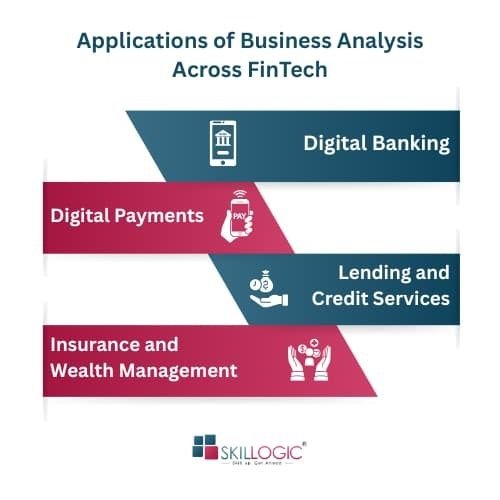
1. Digital Banking
Analysts help improve account opening, identity verification, fund transfers, and mobile banking features. According to Mordor Intelligence, neobanking is projected to grow at a CAGR of 18.7% through 2030, increasing the need for reliable digital banking experiences.
2. Digital Payments
In digital payments, analysts examine payment flows, failed transactions, refunds, and reconciliation processes. Mordor Intelligence reports that digital payments accounted for 46.2% of the fintech market's service-proposition share in 2024, highlighting the importance of payment services.
3. Lending and Credit Services
A FinTech Business Analyst maps loan application and approval workflows, identifies processing delays, and documents requirements for lending systems. They work with lending, risk, compliance, and technology teams to improve application processing while following established credit policies.
4. Insurance and Wealth Management
In insurance, analysts help improve policy applications and claims processing. In wealth management, they support portfolio dashboards, account reporting, and personalised digital services.
According to Capgemini's World Wealth Report 2026, global high-net-worth individual wealth reached USD 98.3 trillion by the end of 2025, yet only 17% of surveyed high-net-worth individuals felt their wealth advisory experience was seamless and personalised. These findings highlight opportunities to improve digital customer experiences and the systems supporting financial advisers.
Essential Skills for a FinTech Business Analyst
A FinTech Business Analyst needs analytical ability, communication skills, technical knowledge, and an understanding of financial services.
The key skills for a FinTech business analyst include:
1. Business Analysis Skills
- Requirements gathering: Understanding stakeholder needs and expectations.
- Process mapping: Identifying workflow gaps and unnecessary steps.
- Documentation: Preparing business requirements, user stories, and acceptance criteria.
- Communication and problem-solving: Coordinating business and technical teams and evaluating solutions.
These skills help a Business Analyst in FinTech translate business needs into clear, actionable requirements.
2. Technical Skills
- Excel and SQL: Organising, retrieving, and analysing data.
- Power BI or Tableau: Creating dashboards and presenting business metrics.
- Jira and Confluence: Tracking requirements and documenting project activities.
- API fundamentals: Understanding how financial applications exchange data.
Software development expertise is not always required, but understanding databases and system integrations helps analysts work effectively with technical teams.
3. Financial Domain Knowledge
A Business Analyst working in FinTech should understand relevant financial services and processes, including:
- Banking operations and digital payments.
- Lending and credit assessment.
- Customer onboarding and identity verification.
- Know Your Customer (KYC) and Anti-Money Laundering (AML) procedures.
- Financial data security and regulatory requirements.
Combining these skills helps a FinTech Business Analyst develop solutions that meet business objectives and financial industry requirements.
Read More:
- How to become a Business Analyst in India
- Business Analytics Scope in India
- How to Become a Business Analytics Expert in India
Global FinTech Companies Hiring Business Analysts
Business Analysts can explore opportunities with companies that specialise in digital payments, payment processing, and payment technology.
Some well-known global payment-focused FinTech companies include:
- Google Pay – Digital wallet and payment services.
- PayPal – Online payments and digital money transfers.
- Stripe – Online payment processing and payment infrastructure.
- Adyen – Payment technology for online, mobile, and in-store transactions.
- Checkout.com – Digital payment processing for businesses.
- Worldpay – Payment processing and merchant payment solutions.
- Block (Square) – Payment technology and point-of-sale systems for merchants.
- Klarna – Digital checkout and buy-now-pay-later payment solutions.
- Razorpay – Payment gateways and payment infrastructure for businesses.
- PhonePe – Digital payments and merchant payment solutions.
- Wise – International money transfers and cross-border payment technology.
- Airwallex – Cross-border payments and business payment infrastructure.
Business Analysts at these companies may work on payment workflows, transaction processing, payment gateway integrations, merchant onboarding, reconciliation, and customer checkout experiences. Actual job titles and openings vary by company.
In short, the role of a Business Analyst in FinTech involves understanding business needs, improving financial processes, analysing data, and supporting technology development. With strong analytical, technical, and financial domain knowledge, aspiring professionals can explore opportunities in digital payments, banking technology, lending, and other FinTech sectors.
If you're interested in understanding the role of a Business Analyst in FinTech, developing practical business analysis skills can help you prepare for opportunities in the industry. Whether you're exploring a business analyst course in Pune, Mumbai, Bangalore, Chennai, Coimbatore, Hyderabad, Ahmedabad, Nagpur, or Delhi, learning about requirements gathering, process analysis, data interpretation, and financial workflows can help you build a strong foundation for this career.
SKILLOGIC offers industry-focused training to help learners develop practical business analysis skills. The Certified Business Analyst Course includes hands-on exercises and real-world projects covering business requirements, data analysis, process improvement, and stakeholder communication. SKILLOGIC’s Certified Business Analyst Course also provides expert guidance and IABAC certification. Learners can explore the business analyst course in Mumbai, along with training options in Bangalore, Chennai, Coimbatore, Hyderabad, Ahmedabad, Pune, Nagpur, and Delhi to strengthen their knowledge and prepare for business analysis opportunities.