How to Become an Ethical Hacker in 2026
Discover how to start a career in ethical hacking in 2026 with step-by-step guidance, required skills, tools, certifications, and industry insights.
 Swagatam Sinha
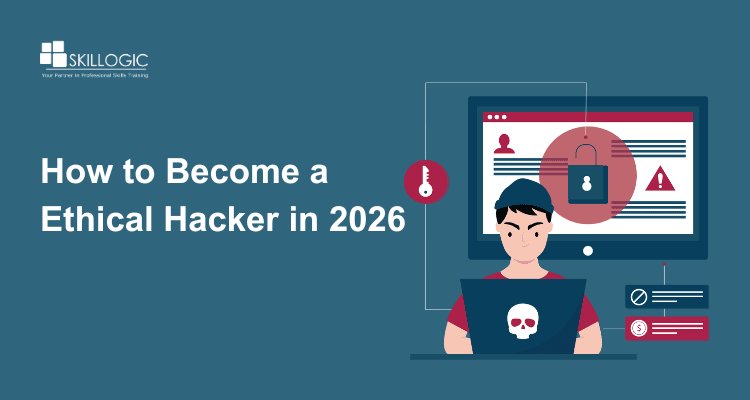
Cybercrime is growing faster than ever. From banking frauds to data leaks, organizations are facing serious threats every day. This is where ethical hackers come in.
An ethical hacker is a cybersecurity professional who legally tests systems to find vulnerabilities before real hackers exploit them.
In 2026, companies are not just hiring ethical hackers they depend on them.
According to Statista Cybersecurity Market Forecast the global cybersecurity market is expected to reach $345 billion by 2026.
This demand is creating huge opportunities for beginners who want to build a career in ethical hacking.
What Does an Ethical Hacker Actually Do?
An ethical hacker is a cybersecurity professional who is legally authorized to simulate real-world cyberattacks to identify, test, and fix security weaknesses in digital systems. Their work helps organizations prevent data breaches, ransomware attacks, and system exploitation before attackers can cause damage.
With global cybercrime increasing rapidly, ethical hacking has become a core part of modern cybersecurity strategies across industries such as finance, healthcare, IT, e-commerce, government, and telecom.
Core Responsibilities of an Ethical Hacker
Ethical hackers focus on proactive defense through controlled testing and security validation:
- Vulnerability Assessment (VA): Identifying weak points in networks, servers, and applications
- Penetration Testing (PEN Testing): Simulating real cyberattacks to evaluate system resilience
- Web Application Security Testing: Detecting flaws like SQL injection, XSS, and authentication bypass
- Malware & Threat Analysis: Studying malicious software behavior to prevent infections
- Security Audits & Risk Analysis: Evaluating overall security posture and compliance gaps
- Reporting & Remediation Guidance: Documenting vulnerabilities and recommending fixes for developers and IT teams
In practice, ethical hackers act like attackers but with permission and a defensive objective.
According to recent industry research, the penetration testing and ethical hacking market is growing rapidly from about $2.74 billion in 2025 to over $7.4 billion by 2034, driven by rising cyber threats and compliance requirements, showing strong long-term demand for skilled ethical hackers. (Source: Fortune Business Insights)
Refer to these articles:
- HIPAA Security Rule Explained: Protecting Healthcare Data in 2026
- Top SIEM Tools in Cybersecurity and How They Work
- How Cybersecurity Works in Blockchain and Web3 Ecosystems
Skills You Need to Become an Ethical Hacker
Becoming an ethical hacker requires a combination of technical knowledge, analytical ability, and security understanding. You do not need advanced academic excellence, but you must build practical, job-relevant skills.
Technical Skills:
These are the core technical foundations required to start ethical hacking.
1. Networking Basics
Understanding how systems communicate over a network:
- TCP/IP protocol suite
- DNS (Domain Name System)
- HTTP/HTTPS communication
- VPN and proxy concepts
- Subnetting and routing basics
Networking knowledge is essential for identifying how attacks travel through systems.
2. Operating Systems
Ethical hackers must be comfortable with multiple environments:
- Linux (most important)
- Command line usage
- File permissions
- Process management
- Windows systems
- User management
- System logs
- Security policies
Linux distributions like Kali Linux are widely used in security testing.
3. Programming Skills
Coding helps in understanding vulnerabilities and automating tasks:
- Python (most recommended for beginners)
- JavaScript (important for web security testing)
- Basic scripting for automation
- Understanding of C/C++ (helpful for low-level exploitation concepts)
4. Web Security Concepts
Modern hacking focuses heavily on web applications:
- Authentication and session management
- SQL Injection
- Cross-Site Scripting (XSS)
- CSRF attacks
- API security basics
Analytical Skills:
These skills help you think like an attacker and solve complex security problems.
1. Problem-Solving Mindset
- Breaking down complex systems into smaller parts
- Finding weak points in logic or design
2. Logical Thinking
- Understanding cause-effect relationships in systems
- Predicting how vulnerabilities can be exploited
3. Attention to Detail
- Spotting misconfigurations
- Identifying small security flaws that lead to major risks
Security Knowledge:
These concepts form the backbone of cybersecurity expertise.
1. Cryptography Basics
- Encryption and decryption methods
- Hashing algorithms (SHA, MD5 concepts)
- Public and private key systems
2. Risk Assessment
- Identifying security risks in systems
- Evaluating impact and likelihood of attacks
- Prioritizing vulnerabilities
3. Vulnerability Analysis
- Scanning systems for weaknesses
- Understanding CVEs (Common Vulnerabilities and Exposures)
- Assessing exploit potential
Refer to these articles:
- What Is Malware? Types, Examples, and How It Works
- Top Programming Languages for Cybersecurity in 2026: Complete Guide
- How to Become a Cyber Security Analyst in 2026
Step-by-Step Roadmap to Start Your Ethical Hacking Career
Ethical hacking has become one of the most in-demand cybersecurity careers in 2026 due to the rapid rise in cyberattacks, cloud adoption, and AI-driven security threats, making structured learning and hands-on practice essential for building a successful career in this field.
Step 1: Learn Networking and Internet Fundamentals
A strong understanding of networking is the foundation of ethical hacking. Modern cyberattacks heavily target network layers, APIs, and cloud infrastructure.
You should learn:
- TCP/IP, DNS, HTTP/HTTPS protocols
- IP addressing and subnetting
- Routing, switching, firewalls, VPNs
- How data moves across the internet
In 2026, more than 60% of cyberattacks target web applications and network services, making networking knowledge essential for penetration testing and security analysis.
Step 2: Master Linux and Operating Systems
Linux is the primary operating system used in cybersecurity environments and penetration testing tools like Kali Linux.
Focus areas include:
- Linux command line operations
- File permissions and process management
- Bash scripting basics
- Windows security architecture
Recent industry surveys show that Linux-based systems dominate over 70% of cybersecurity tools and environments, making it a mandatory skill for ethical hackers.
Step 3: Learn Programming for Security Automation
Programming is essential for exploit analysis, automation, and vulnerability research.
Recommended languages:
- Python (most important for beginners)
- JavaScript (web vulnerabilities)
- Bash scripting
- Basic C/C++ (memory-level exploitation understanding)
AI-driven cybersecurity tools are also increasing demand for scripting knowledge, as automation now plays a major role in threat detection and penetration testing workflows.
Step 4: Understand Cybersecurity Fundamentals
Before advanced hacking, you must understand how security works.
Key concepts:
- CIA Triad (Confidentiality, Integrity, Availability)
- Types of cyber attacks (phishing, malware, ransomware)
- OWASP Top 10 web vulnerabilities
- Cryptography basics
- Security frameworks and controls
Reports from 2025–2026 highlight that AI-powered attacks, cloud misconfigurations, and credential-based breaches are the fastest-growing threats globally.
Step 5: Hands-on Practice Using Real Platforms
Practical experience is critical. Employers prioritize skills over certifications.
Best platforms:
- TryHackMe
- Hack The Box
- PortSwigger Web Security Labs
- Capture The Flag (CTF) competitions
Industry data shows that candidates with hands-on lab experience are 3x more likely to get entry-level cybersecurity roles compared to purely theoretical learners.
Step 6: Start Bug Bounty Hunting and Real-World Exposure
Bug bounty hunting allows ethical hackers to earn income by identifying vulnerabilities in real systems.
Platforms:
- HackerOne
- Bugcrowd
- Synack
Current cybersecurity reports show:
- Web application attacks increased from 41% to over 60% in recent threat analyses
- Organizations are increasingly relying on external ethical hackers to identify vulnerabilities before exploitation
This makes bug bounty hunting one of the fastest-growing freelance cybersecurity income streams in 2026.
Step 7: Certifications and Career Acceleration
Certifications improve credibility and job opportunities:
- CEH (Certified Ethical Hacker)
- CompTIA Security+
- Certified Ethical Hacking Professional Course
- eJPT (Junior Penetration Tester)
- OSCP (Advanced penetration testing)
Entry-level cybersecurity salaries in India typically range from ₹4–8 LPA, while experienced professionals can reach ₹20–35 LPA or higher depending on specialization.
Ethical hacking in 2026 is not just a technical skill but a long-term career path driven by global digital transformation. A structured roadmap combining networking, Linux, programming, cybersecurity fundamentals, and hands-on practice can lead to entry-level roles within 6–12 months of consistent learning.
Cybersecurity workforce data shows that a significant global talent gap remains unfilled, with estimates indicating that only about 70% of cybersecurity roles are currently staffed, increasing demand for ethical hackers in finance, healthcare, government, and technology sectors. (Source: Mordor Intelligence)
Refer to these articles:
- Autonomous SOC Explained: The Future of Intelligent Security Operations
- Top 10 Cybersecurity Tools for Small Businesses on a Budget
- Post-Quantum Cryptography (PQC) Explained: A Roadmap to Quantum-Safe Security
Tools Used by Ethical Hackers
Ethical hacking tools are categorized based on skill level and use case, helping professionals progress from basic reconnaissance to advanced exploitation and security testing.
In 2026, cybersecurity professionals rely on layered toolsets that combine network scanning, traffic analysis, exploitation frameworks, and password security testing to simulate real-world attacks and strengthen defense systems. These tools are essential for identifying vulnerabilities across networks, applications, and wireless environments.
Beginner Ethical Hacking Tools (Foundation Level)
These tools are used for learning networking, traffic analysis, and reconnaissance.
1. Nmap (Network Mapper)
Used for network discovery, host scanning, and open port detection. It remains a core tool in nearly every penetration testing workflow, forming the base of attack surface mapping .
2. Wireshark
A packet analysis tool used to inspect real-time network traffic. Helps beginners understand protocols, DNS activity, HTTP requests, and suspicious data flows.
3. Netcat
A simple but powerful utility for reading/writing network connections, useful for testing ports and connections.
Intermediate Ethical Hacking Tools (Practical Exploitation Skills)
These tools focus on web application security and vulnerability exploitation.
1. Burp Suite
Industry-standard web security testing platform used for:
- Intercepting HTTP/HTTPS traffic
- Testing SQL injection and XSS
- Web vulnerability scanning
It is widely used in enterprise security testing and compliance-driven audits.
2. Metasploit Framework
A powerful exploitation framework used to:
- Simulate real-world cyberattacks
- Validate vulnerabilities
- Execute payloads and post-exploitation actions
It is a core tool for professional penetration testers and red teams .
3. SQLmap
Automates detection and exploitation of SQL injection vulnerabilities in databases.
Advanced Ethical Hacking Tools (Professional & AI-Driven Security)
These tools are used in enterprise environments, WiFi testing, and advanced exploitation scenarios.
1. Aircrack-ng
Used for WiFi security auditing, password cracking, and network monitoring. It plays a key role in wireless penetration testing for enterprise and IoT environments.
2. John the Ripper
A high-performance password cracking tool used to test password strength and hash security.
3. Nessus / OpenVAS
Advanced vulnerability scanners used in enterprise cybersecurity to detect:
- Misconfigurations
- Critical vulnerabilities
- Compliance gaps (PCI DSS, ISO 27001, GDPR)
Ethical hacking in 2026 is no longer an optional cybersecurity skill it is a critical defense mechanism for modern organizations. With increasing cyber threats, cloud migration, and AI-driven attack techniques, companies are actively investing in skilled professionals who can identify and fix vulnerabilities before attackers exploit them.
A structured learning path that includes networking, Linux, programming, cybersecurity fundamentals, and hands-on practice can help beginners build a strong foundation. Consistent practice on real-world platforms and exposure to industry tools significantly improves job readiness. As the cybersecurity talent gap continues to grow globally, ethical hacking offers long-term career stability, high demand, and strong earning potential for skilled professionals.
SKILLOGIC Institute is a leading professional training provider offering industry-focused cybersecurity programs designed for real-world job roles. The institute provides practical, hands-on learning with expert mentorship to help learners build strong technical skills in ethical hacking, penetration testing, and information security.
SKILLOGIC offers a comprehensive Cyber security course in Ahmedabad designed for beginners and working professionals. The program focuses on practical labs, certification guidance, and placement-oriented training aligned with current industry requirements.