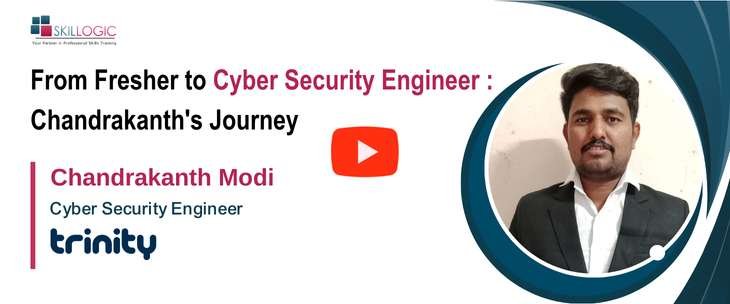
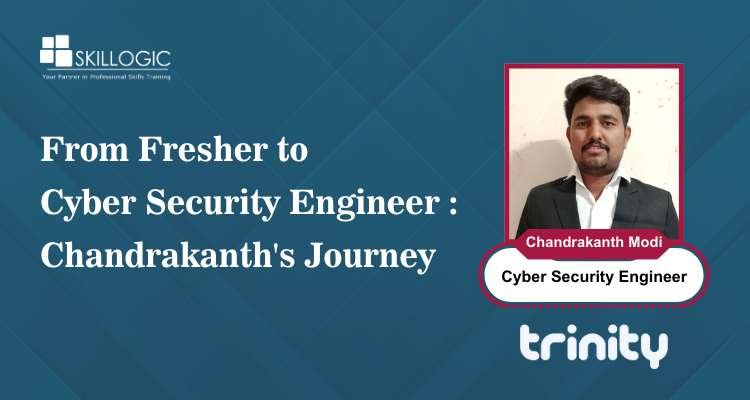
From Fresher to Cyber Security Engineer : Chandrakanth's Inspiring Journey
Discover how Chandrakanth transformed from a fresher into a Cyber Security Engineer through ethical hacking training, hands-on practice, and expert guidance. An inspiring cyber security career journey.
 Nashid Hussain CN
Career transitions into cyber security are growing rapidly as organizations face increasing digital threats and data security challenges. Many professionals from non-IT backgrounds are now choosing cyber security as a stable and rewarding career because of its strong demand and long-term growth. With the right training, practical exposure, and continuous learning, building a successful career in this field is possible for anyone.
Chandra Kanth Modi’s journey highlights this shift perfectly. After completing his graduation in electronics and communication engineering, he followed his passion for cyber security and gradually built strong technical skills. Today, he is working as a cyber security engineer at Trinity, applying his knowledge to protect systems and manage security risks.
Let’s explore his inspiring journey and the key lessons from his career transition.
Chandrakanth's Transition from Fresher to Associate Cyber Security Engineer
In this section, we explore how Chandrakanth moved from a fresher to an associate Cyber Security Engineer at Trinity with the support of SKILLOGIC. Starting with limited industry exposure, he built a strong foundation in core cyber security concepts and gained hands-on experience with real-world cyber security tools. Regular lab practice, practical projects, and continuous mentor guidance from skillogic helped him develop confidence and job-ready skills. His journey shows that with the right training and mindset, freshers can successfully build a career in cyber security.
Refer these articles:
- Jaya Krishna’s Journey from Fresher to SOC Analyst
- From HR Executive to Cyber Security Researcher: Indhu's Journey
- From Fresher to SOC Analyst: Bhuvanesh’s Inspiring Journey
Q1. Can you introduce yourself and your educational background?
I completed my graduation in electronics and communication engineering in 2024. Even though my academic background was not computer science, I always had an interest in technology and security. During my college days, I became curious about how hacking works and how systems are protected from cyber attacks. That curiosity slowly turned into a career goal, and I decided to move into the cyber security field after graduation.
Q2. What motivated you to choose cyber security as a career?
My interest in cyber security started with learning about ethical hacking and capturing the flag challenges. I enjoyed understanding how vulnerabilities are found and fixed. Cyber security is a field where learning never stops, and that excited me. Also, the growing demand for cyber security professionals made me confident that this career choice would offer long-term growth and stability.
Q3. How did you select the right cyber security training institute?
While searching for cyber security courses, I explored multiple options and did proper research. I checked course structure, trainer experience, placement support, and student reviews. I wanted an institute that focused on practical learning rather than just theory. After comparing different options, I felt confident about choosing a structured training program that aligned with industry needs.
Q4. Did coming from a non-it background create challenges?
Yes, initially it was challenging because concepts like networking, linux, and security tools were new to me. However, cyber security is not impossible for non-IT students. With the right training and daily practice, the learning curve becomes manageable. Once I understood the basics, advanced topics became easier. Consistency and patience helped me overcome the background gap.
Q5. How was your classroom and training experience?
The training experience was very positive and well-structured. Each topic was explained clearly, and trainers focused on real-world examples. Classes included theory, demonstrations, and hands-on labs. Trainers encouraged questions and ensured that every student understood the concepts before moving ahead. This approach helped me build strong fundamentals in cyber security.
Q6. How important was hands-on practice during the course?
Hands-on practice was the most important part of my learning. I spent time daily working on labs, tools, and virtual machines. Platforms like tryhackme helped me understand real attack scenarios. Practical exposure improved my confidence and problem-solving skills. Cyber security is a practical field, and without hands-on practice, learning remains incomplete.
Q7. How were doubts and learning difficulties handled?
Whenever I had doubts, dedicated doubt-clearing sessions were conducted. Trainers were approachable and supportive, even outside regular class hours. Instead of just giving answers, they explained the logic behind each solution. This helped me think independently and develop a proper understanding of cyber security concepts.
Q8. Can you explain your internship and project experience?
During my internship, I worked on web application security and vulnerability assessment projects. Selecting the right project was important, and I received guidance on that. While working on projects, I faced real challenges, which helped me learn more deeply. These projects gave me practical exposure and strengthened my resume for job interviews.
Q9. How was your placement and interview process?
The placement process included multiple interview rounds such as hr screening, technical assessments, and final discussions. Technical questions were based on core cyber security concepts like vapt, siem, and Network security fundamentals. Mock interviews helped me prepare better and improve my confidence. Proper guidance made the interview process smoother.
Q10. What skills helped you succeed in interviews?
Strong fundamentals, regular practice, and clear understanding of tools helped me perform well in interviews. Communication skills also played an important role. Explaining concepts clearly and confidently made a positive impression. Practicing interview questions and understanding real-world scenarios helped me answer technical questions effectively.
Q11. What advice would you give to freshers and non-technical students?
My advice is simple: practice daily and stay consistent. Cyber security is not limited to technical backgrounds. Anyone with interest and dedication can learn it. Start with basics, work in labs, and keep improving your skills. Platforms like tryhackme are very useful for beginners. With the right guidance and regular effort, success in cyber security is achievable.
Key Insights from Chandrakanth’s Cyber Security Career Journey
Chandrakanth’s journey in cyber security highlights the key factors that can transform passion into a successful career, even for those from a non-IT background.
- Passion Drives Success – Chandrakanth’s genuine interest in ethical hacking and cyber security motivated him to learn continuously, even coming from a non-IT background.
- Importance of Hands-On Practice – Regular lab sessions, projects, and using real-world tools helped him gain cyber security skills that were crucial for interviews and job readiness.
- Structured Learning with Mentorship – Training at SKILLOGIC provided clear guidance, mentor support, and doubt-clearing sessions, making the learning process smooth and effective.
- Consistency and Discipline – Daily study routines and dedicated practice helped Chandrakanth strengthen his concepts and gain confidence in tackling real cyber security challenges.
- Leveraging Placement Support – Career guidance, mock interviews, and project advice from Skillogic’s placement team played a key role in helping him secure his role as an Associate Cyber Security Engineer at Trinity.
By combining hands-on practice, structured learning, and consistent effort, Chandrakanth exemplifies how dedication and the right guidance can lead to a rewarding career in cyber security.
Refer these articles:
- Ethical Hacking Scope in Chennai
- How much is the Ethical Hacking Course Fee in Chennai
- Ethical Hacking Scope in Pune
- Why Ethical Hacking Career in Pune
In short, Chandrakanth’s journey shows that with passion, consistent practice, and the right mentorship, anyone can transition into a successful cyber security career. Hands-on learning, structured guidance, and leveraging placement support, along with enrolling in ethical hacking training in Chennai, were crucial in helping him secure his role as an Associate Cyber Security Engineer at Trinity. His story proves that dedication and discipline, combined with practical exposure, can open doors to rewarding opportunities in the ever-growing field of cyber security.
If you want to start a career in cyber security, joining a top institute for cyber security courses in India and focusing on hands-on practice, real-world projects, and regular learning will help you build the skills needed for success in this rapidly growing field.
According to The Economic Times, India had around 40,000 open cyber security jobs as of May 2023, with a 30 % demand–supply gap due to a shortage of skilled professionals. The cyber security market is projected to reach USD 3.5 billion by 2027, growing at a CAGR of 8.05 %. Entry-level salaries range from INR 3 to 6 LPA, while senior experts can earn INR 50 to 80 LPA. Upskilling in areas like ethical hacking, cloud security, and AI security is crucial to meet this growing demand.
SKILLOGIC provides complete cyber security courses designed to give learners practical knowledge and industry-ready skills. Their training covers areas like network security, ethical hacking, threat detection, SOC operations, and vulnerability management. The 4-month program includes over 200 hours of learning with hands-on labs, real-time projects, and guidance to prepare students for global certifications such as NASSCOM FutureSkills and IIFIS.
Students also get training in penetration testing, malware analysis, SIEM tools, IDS/IPS management, and compliance standards. With ethical hacking courses in pune and branches in cities like Hyderabad, Jaipur, Noida, Kochi, Ahmedabad, and Chennai, SKILLOGIC ensures learners gain expert support and practical experience. After completing the course, students are ready for roles such as SOC Analyst, Security Consultant, Penetration Tester, or Cyber Security Engineer, with strong placement assistance to help start a successful career in cyber security.