Top Programming Languages for Cybersecurity in 2026
Explore the top programming languages for cybersecurity in 2026, key trends, and future insights to build in-demand skills and advance your cybersecurity career.
 Swagatam Sinha

Cybersecurity is no longer limited to firewalls and antivirus tools. In 2026, it has evolved into a highly dynamic field where professionals are expected to think like attackers, automate defenses, and build secure systems from the ground up.
At the center of this transformation lies programming.
With cyber threats becoming more sophisticated ranging from AI-powered attacks to zero-day vulnerabilities organizations are actively looking for professionals who can write scripts, analyze exploits, and develop secure applications.
Recent industry insights show that Python, JavaScript, and Java dominate hiring demand, with nearly 45.7% of recruiters prioritizing Python skills alone. This clearly indicates that programming knowledge is no longer optional it is a core cybersecurity skill.
This guide explores the most relevant programming languages for cybersecurity in 2026, supported by real data, use cases, and future trends.
Why Programming Matters More Than Ever in Cybersecurity
Cyber security is evolving beyond traditional firewall protection. Today’s security professionals need to:
- Automate threat detection
- Analyze malware behavior
- Secure cloud infrastructures
- Identify vulnerabilities in real-time
Recent data highlights the urgency:
- The average cost of a data breach reached $4.45 million globally
- It takes 277 days on average to detect and contain a breach
- Cybersecurity spending is projected to exceed $1.75 trillion cumulatively
According to the World Economic Forum Global Cybersecurity Outlook 2026,
- 87% of organizations identified AI-driven vulnerabilities as the fastest-growing cyber risk
- Cyber-enabled fraud and attacks are increasing globally, affecting both individuals and enterprises at scale
In terms of overall industry growth, the Fortune Business Insights Cybersecurity Market Report 2026 estimates that the global cybersecurity market will expand from $248.28 billion in 2026 to $699.39 billion by 2034, showing long-term exponential demand.
These numbers clearly show that cybersecurity is becoming code-driven, not just tool-driven.
Refer to these articles:
- How to Become a Cyber Security Analyst in 2026
- Autonomous SOC Explained: The Future of Intelligent Security Operations
- Top 10 Cybersecurity Tools for Small Businesses on a Budget
How to Choose the Right Programming Language for Cybersecurity
Choosing the right programming language depends on your cyber security career goals, the specific tasks you want to perform, and the industry demand for those skills.
- Define your career goal first: Identify whether you want to become an ethical hacker, security engineer, or malware analyst. Your role determines the languages you need.
- Start with beginner-friendly languages: Learn Python for automation and scripting, as it is easy to understand and widely used in cybersecurity.
- Match language to use case:
- Automation → Python, Bash
- Web security → JavaScript
- System-level analysis → C, C++
- Enterprise security → Java
- Cloud security → Go
- Secure systems → Rust
- Focus on practical application: Choose languages that allow you to build real-world projects like vulnerability scanners or security scripts.
- Consider industry demand: Prioritize languages that are commonly required in cybersecurity job roles.
- Build a multi-language skillset: Do not rely on just one language. Combine 2–3 languages for better career growth.
- Understand system fundamentals: Pair programming skills with networking, operating systems, and security concepts.
- Keep learning and updating skills: Cybersecurity evolves rapidly, so continuously adapt to new tools and languages.
- Choose based on long-term growth: Select languages that will remain relevant in future security trends.
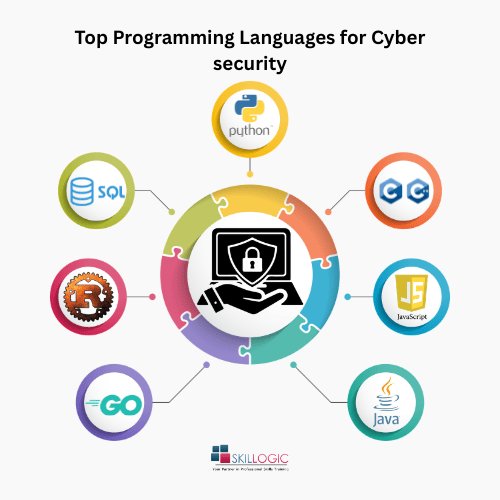
Top Programming Languages for Cybersecurity in 2026
Choosing the right programming languages for cybersecurity in 2026 is essential for building in-demand skills, strengthening security expertise, and staying ahead of evolving cyber threats across industries.
1. Python – The Backbone of Modern Cybersecurity
Python continues to dominate cybersecurity and for good reason.
Its simplicity and massive ecosystem make it ideal for both beginners and professionals. Security experts use Python to quickly build tools that would take much longer in other languages.
- Ranked #1 in TIOBE Index (2026) with 21.81% share
- Used by over 57%–66% of developers globally
Why Python is essential:
- Automation of repetitive security tasks
- Penetration testing tools
- Malware analysis
- AI-powered threat detection
Real-world use:
Security teams use Python to automate vulnerability scans and analyze suspicious files in seconds.
Why Python stands out:
- Easy to learn and readable
- Huge library ecosystem
- Strong community support
- Fast prototyping for security tools
Additionally, the Gartner Security Automation Forecast 2027 predicts that over 70% of security operations will rely on automation scripts, with Python being the primary language for SOC teams.
2. C and C++ – Understanding the Core of System Security
If you want to understand how systems actually work and how they break C and C++ are essential.
These languages allow direct interaction with:
- Memory
- Hardware
- Operating systems
Security professionals use them for:
- Exploit development
- Reverse engineering
- Vulnerability analysis
They are especially important for understanding issues like buffer overflows and memory corruption.
Experts widely consider C/C++ critical because they help analyze low-level vulnerabilities and build high-performance security tools.
3. JavaScript – The Key to Web Security
Web applications remain one of the biggest attack surfaces.
- Over 60% of developers use JavaScript globally
Use cases in cybersecurity:
- Detecting cross-site scripting (XSS)
- Understanding browser-based attacks
- Securing front-end applications
With APIs becoming the most exploited attack surface 43% of vulnerabilities linked to APIs JavaScript knowledge is crucial.
4. Java – Enterprise Security at Scale
Java is widely used in enterprise environments, making it essential for securing large systems.
Why Java is important:
- Strong memory management
- Platform independence
- Secure backend development
It is commonly used in:
- Banking systems
- Identity management systems
- Large-scale enterprise applications
5. Go (Golang) – The Future of Cloud Security
Cloud-native security is one of the fastest-growing areas in cybersecurity.
Why Go is gaining popularity:
- High performance
- Built-in concurrency
- Ideal for scalable systems
Go is widely used in:
- Cloud security tools
- Container security
- DevSecOps pipelines
6. Rust – The Rise of Memory-Safe Security
Rust is becoming a favorite for secure system programming.
- Recognized as one of the most admired languages (over 70% approval)
Why Rust matters:
- Prevents memory-related vulnerabilities
- Safer alternative to C/C++
- Used in modern security tools
As security shifts toward preventing vulnerabilities at the code level, Rust adoption is accelerating.
7. SQL – The Silent Guardian of Databases
Data is the most valuable asset, and SQL plays a critical role in protecting it.
Use cases:
- Preventing SQL injection attacks
- Securing databases
- Monitoring data access
Since 81% of breaches involve weak or stolen credentials , database security is more important than ever.
Refer to these articles:
- Post-Quantum Cryptography (PQC) Explained: A Roadmap to Quantum-Safe Security
- Why Your Cloud Misconfigurations Are a Bigger Risk Than Any Hacker
- Cybersecurity and Geopolitics: Understanding the Global Digital Battlefield
Market Trends Shaping Cybersecurity Programming in 2026
The cybersecurity landscape in 2026 is being rapidly reshaped by AI adoption, rising cyber threats, and a growing global developer ecosystem, making programming skills more critical than ever.
1. AI is Changing Cybersecurity
Artificial Intelligence is no longer optional in cybersecurity—it is becoming a core requirement. According to the GitHub Octoverse Report 2026, over 72% of developers are now using AI-assisted coding tools in their daily workflows, significantly accelerating development and security automation.
At the same time, attackers are leveraging AI to scale threats. A 2026 report by SlashNext highlights that AI-generated phishing attacks increased nearly 5x in 2025 and continue to rise in 2026, making them harder to detect.
According to a MarketsandMarkets 2026–2028 Forecast, the AI in cybersecurity market is expected to reach $60.6 billion by 2028, growing at a CAGR of 21.9%, highlighting massive investment in intelligent security systems.
This shift clearly indicates that cybersecurity professionals must combine programming skills with AI knowledge to stay relevant.
2. Explosive Growth in Cyber Threats
Cyber threats are growing both in volume and complexity. According to the Netscout Threat Intelligence Report 2026, DDoS attacks surged by 168% year-over-year, targeting critical infrastructure and cloud environments.
Additionally, the Salt Security State of API Security Report 2026 reveals that API vulnerabilities have become the leading attack vector, with over 90% of organizations experiencing API-related security issues.
This evolving threat landscape demands:
- Strong programming and debugging skills
- Automation for faster threat response
- Real-time monitoring and detection systems
Security professionals must now build tools—not just use them.
3. Developer Ecosystem is Expanding Rapidly
The global developer community is growing at an unprecedented rate. According to the SlashData Developer Nation Report 2026, there are now 47.2 million developers worldwide, a number expected to cross 50 million soon.
Despite this growth, most development still relies on a core set of languages. The same report indicates that nearly 80% of projects use a limited group of languages such as Python, Java, C++, and JavaScript.
This trend highlights an important insight:
- You don’t need to learn every language
- Mastering a few high-impact languages is enough to stay competitive
For cybersecurity professionals, focusing on the right programming stack ensures both efficiency and long-term career growth.
4. Rise of Cloud-Native Security Development
Cloud infrastructure is now the backbone of modern businesses, and security is shifting toward cloud-native environments. According to the Gartner Cloud Security Forecast 2026, over 85% of organizations will adopt a cloud-first strategy by 2026, significantly increasing the demand for secure coding practices in cloud environments.
Additionally, the Palo Alto Networks Unit 42 Cloud Threat Report 2026 highlights that 80% of security exposures originate from misconfigured cloud resources.
This trend requires cybersecurity professionals to:
- Learn cloud-focused programming (Go, Python)
- Build secure APIs and microservices
- Automate cloud security monitoring
5. Shift Toward Memory-Safe Programming Languages
Memory-related vulnerabilities remain one of the biggest causes of security breaches. To address this, organizations are rapidly adopting memory-safe languages.
A 2026 report by the Cybersecurity and Infrastructure Security Agency (CISA) emphasizes that over 60% of critical vulnerabilities are linked to memory safety issues, pushing organizations toward safer alternatives like Rust.
Similarly, the Google Security Blog 2026 update reports that Android and system-level components are increasingly being developed using Rust to reduce vulnerabilities.
This shift indicates:
- Growing demand for Rust and similar languages
- Focus on secure-by-design programming
- Reduced reliance on unsafe legacy code
Read these articles:
- Cyber Insurance in 2025: Do You Really Need It?
- Top 10 SIEM Use Cases in Cyber Security
- What is Penetration Testing and How Does It Work?
The cybersecurity programming landscape in 2026 is being shaped by cloud adoption, AI integration, automation, and secure development practices. Professionals who focus on high-demand programming languages, real-world application, and continuous learning will be best positioned to succeed in this rapidly evolving industry.
Cybersecurity in 2026 is no longer about tools it is about skills, logic, and code. The right programming language can open doors to roles in ethical hacking, cloud security, malware analysis, and beyond.
If you are starting today, focus on Python first, then expand into low-level and cloud-focused languages.
The future belongs to professionals who can not only understand threats but build systems that prevent them.
SKILLOGIC is a leading professional training institute known for delivering industry-focused programs in emerging technologies and cybersecurity. With a strong emphasis on practical learning, real-world case studies, and hands-on projects, it helps learners build job-ready skills aligned with current industry demands. The institute has trained thousands of professionals globally, making it a trusted name in career-oriented education.
If you are looking to build a strong foundation in cybersecurity, enrolling in a Cyber Security Course in Bangalore with SKILLOGIC can be a strategic step. The program is designed to cover essential concepts, tools, and real-time applications, enabling learners to confidently enter the cybersecurity domain and stay competitive in the evolving digital landscape.