
The Role of Business Analyst in Scrum Team
Understand the role of a Business Analyst in a Scrum team, including requirement gathering, stakeholder communication, backlog refinement, and supporting successful Sprint delivery.
 Aiswarya N

Scrum is an Agile framework that helps teams develop products through short, focused work cycles called Sprints. It encourages regular communication, continuous improvement, and stakeholder feedback. Within this process, a Business Analyst helps the team understand business needs and translate them into practical requirements.
Understanding the role of business analyst in scrum team is important for anyone planning to work in business analysis or Agile project management. A Business Analyst connects business stakeholders, the Product Owner, and Developers to clarify what needs to be built and why.
Here, we will explore the role of business analyst in scrum team and understand their key responsibilities.
What is the Role of a Business Analyst in a Scrum Team?
A Business Analyst helps the Scrum Team understand business needs and turn them into clear, actionable requirements. They work with stakeholders to identify problems, clarify business rules, and explain what a product or feature should achieve.
The role of business analyst in scrum team also involves helping the team respond to changing business priorities. According to a PwC survey, 88% of professionals applied new execution skills to handle operational updates, while 56% of core product delivery workers reported operational strain and alignment gaps caused by top-down changes.
A Business Analyst helps address these challenges by communicating changes clearly and translating them into manageable backlog items. For example, when a company updates its customer service policy, the Business Analyst identifies the affected application features, documents the new business rules, and explains the requirements to Developers.
By connecting business expectations with product development, a Business Analyst helps the Scrum Team deliver solutions that meet user needs and provide business value.
Read More:
- Cybersecurity Considerations for Business Analysts
- How Business Analysts Drive Digital Transformation
- Bridging the Gap Between IT & Business as a Business Analyst
Key Responsibilities of a Business Analyst in a Scrum Team
The responsibilities of a Business Analyst vary depending on the project and team structure. Their main role is to clarify business needs, support collaboration, and ensure that product development aligns with stakeholder expectations.
The key responsibilities of a Business Analyst in a Scrum Team include:
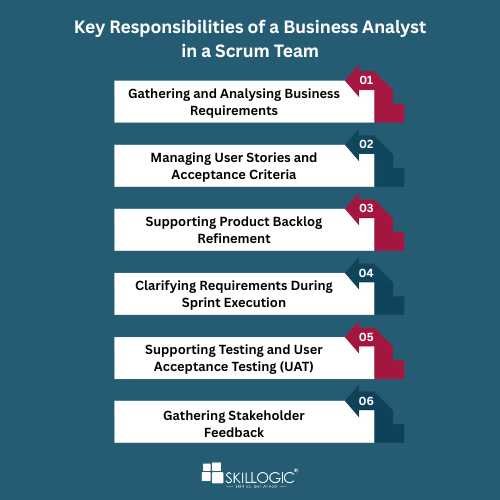
Gathering and Analysing Business Requirements
A Business Analyst gathers information from stakeholders, analyses business problems, and identifies functional requirements. They clarify business rules and ensure the team understands the expected outcomes.
For example, if customers frequently abandon an online shopping cart, the Business Analyst investigates possible issues in the checkout process and identifies areas for improvement.
According to Capgemini's World Quality Report 2025-26, 43% of organizations remain limited to narrow experimentation with automation in quality engineering due to challenges such as unclear business logic and unstructured test environments. Clearly defined requirements help establish the business logic needed for effective development and testing.
Managing User Stories and Acceptance Criteria
A Business Analyst helps clarify user stories and define acceptance criteria based on business requirements. They ensure that requirements communicate the intended functionality and expected results, giving Developers and testers a shared understanding of what needs to be delivered.
Supporting Product Backlog Refinement
A Business Analyst works with the Product Owner and Developers to review backlog items, clarify requirements, identify dependencies, and break down complex business needs into manageable tasks. This helps the team understand priorities and prepare work for upcoming Sprints.
Clarifying Requirements During Sprint Execution
During a Sprint, a Business Analyst answers requirement-related questions, resolves ambiguities, and consults stakeholders when further clarification is needed. This helps prevent misunderstandings and reduces unnecessary rework.
Supporting Testing and User Acceptance Testing (UAT)
A Business Analyst helps align test scenarios with business requirements, clarifies acceptance criteria, and supports business users during User Acceptance Testing. They also help assess feedback and determine whether the developed solution meets the intended business needs.
Gathering Stakeholder Feedback
A Business Analyst collects and analyses stakeholder feedback to identify gaps between expected and actual outcomes. They communicate relevant findings to the Product Owner and team, helping inform future product improvements and backlog updates.
Read More:
- How to become a Business Analyst in India
- Business Analytics Scope in India
- How to Become a Business Analytics Expert in India
How Does a Business Analyst Contribute to Scrum Events?
A Business Analyst supports Scrum events by clarifying requirements, providing business context, and helping the team communicate with stakeholders.
The following are the Scrum events where a Business Analyst can contribute:
Sprint Planning
During Sprint Planning, the Business Analyst explains the business context behind proposed backlog items and clarifies requirements, acceptance criteria, and dependencies. This helps Developers understand the work involved and identify missing information before planning the Sprint.
Daily Scrum
The Daily Scrum allows Developers to inspect progress toward the Sprint Goal and adapt their plan. A Business Analyst may provide clarification when requirement-related questions arise, helping resolve uncertainties that could affect progress.
Sprint Review
During the Sprint Review, the Scrum Team and stakeholders inspect the Sprint outcome and discuss future adjustments. The Business Analyst can explain how completed features address business needs, gather stakeholder feedback, and identify areas for improvement.
Sprint Retrospective
The Sprint Retrospective focuses on improving the team's effectiveness and working practices. A Business Analyst can contribute by identifying requirement-related challenges, communication gaps, and issues caused by unclear expectations, helping the team improve its approach in future Sprints.
How Does a Business Analyst Work With Other Scrum Team Members?
A Business Analyst collaborates with different Scrum Team members to clarify requirements, share information, and ensure that product development meets business expectations.
These are the ways a Business Analyst works with other Scrum Team members:
Business Analyst and Product Owner
The Business Analyst works with the Product Owner to understand business goals, analyse stakeholder needs, and clarify Product Backlog items. This collaboration helps keep requirements aligned with product goals and expected business value.
Business Analyst and Scrum Master
The Business Analyst works with the Scrum Master to improve communication and address collaboration challenges related to unclear requirements. They help ensure that the team has the information needed to work effectively.
Business Analyst and Developers
The Business Analyst explains business rules, requirements, and acceptance criteria to Developers. They answer questions during development and clarify expected behaviour to help ensure that features meet business needs.
Business Analyst and QA Testers
The Business Analyst works with QA testers to clarify requirements and acceptance criteria. This helps testers prepare relevant test scenarios and verify whether the developed features meet business expectations.
In short, the role of business analyst in scrum teams involves understanding business needs, clarifying requirements, supporting collaboration, and helping deliver useful product features. From requirement analysis and backlog refinement to testing and stakeholder feedback, a Business Analyst helps connect business expectations with product development.
Developing knowledge of Agile principles, business requirements, data analysis, and stakeholder communication can help aspiring professionals prepare for Business Analyst roles and understand how a business analyst in agile team contributes to project success.
Building a career in business analysis requires an understanding of business processes, stakeholder needs, and data-driven decision-making. Enrolling in a business analyst course in Chennai or Coimbatore, Ahmedabad, Pune, Mumbai, Nagpur, Bangalore, Hyderabad, or Delhi can help learners develop relevant knowledge and prepare for business analysis roles.
SKILLOGIC provides professional training designed to help learners gain practical, industry-relevant knowledge. SKILLOGIC’s Certified Business Analyst Course covers requirement analysis, business reporting, data analysis, process improvement, and stakeholder communication through practical exercises and real-world projects. The programme includes expert guidance and globally recognised IABAC certification. Learners can explore the business analyst course in Coimbatore or Chennai, along with training options in Ahmedabad, Pune, Mumbai, Nagpur, Bangalore, Hyderabad, and Delhi.