
Top SIEM Tools in Cybersecurity and How They Work
Explore the top SIEM tools in cybersecurity, how they work, and real-world use cases. Learn how SIEM helps detect threats, improve security, and protect modern businesses in 2026.
 Swagatam Sinha
Cyberattacks are no longer rare incidents. They are daily events. From phishing emails to ransomware attacks, businesses are constantly under threat. The real challenge is not just preventing attacks but detecting them before damage is done.
This is where SIEM tools come into the picture.
Security Information and Event Management (SIEM) tools act like a central nervous system for cybersecurity. They collect data, analyze it, and alert teams about suspicious activities in real time.
In 2026, organizations are no longer asking “Do we need SIEM?” Instead, they are asking “Which SIEM tool is best for us?”
What is SIEM in Cyber Security?
SIEM stands for Security Information and Event Management. It combines two major functions:
- Security Information Management (SIM) – log collection and storage
- Security Event Management (SEM) – real-time monitoring and alerting
Together, SIEM systems collect logs from multiple sources and convert them into actionable insights for security teams.
In simple terms, SIEM answers three critical questions:
- What is happening in the network?
- Is it normal or suspicious?
- What action should be taken?
Cyber threats are evolving rapidly.
A recent report shows that AI-driven cyberattacks increased by 89% in 2026, making traditional security methods less effective.
At the same time, the global cybersecurity market is expected to grow from $248.28 billion in 2026 to $699.39 billion by 2034, showing how critical security tools have become. (Source: Fortune Business Insights)
Refer to these articles:
- How Cybersecurity Works in Blockchain and Web3 Ecosystems
- What Is Malware? Types, Examples, and How It Works
- Top Programming Languages for Cybersecurity in 2026
How SIEM Tools Work: Step-by-Step Explanation
Understanding how Security Information and Event Management (SIEM) tools work is essential for organizations aiming to strengthen their cybersecurity posture. SIEM solutions provide real-time visibility, threat detection, and compliance management by collecting and analyzing security data from across the IT environment.
1. Data Collection
The first step in SIEM functionality is data collection. SIEM tools gather log and event data from multiple sources, including:
- Firewalls
- Servers
- Applications
- Cloud platforms
- User activity logs
This process creates a centralized repository of security data, enabling organizations to monitor their entire infrastructure from a single platform.
Example:
A financial institution collects login activity from mobile banking apps, ATMs, and internal systems into a centralized SIEM system. This unified view helps detect suspicious behavior quickly.
2. Data Normalization
Collected data often comes in different formats, structures, and timestamps. SIEM tools standardize (normalize) this raw data into a consistent format.
Normalization ensures:
- Efficient data processing
- Accurate analysis
- Improved correlation across systems
Without normalization, analyzing large volumes of diverse data would be complex and error-prone.
3. Correlation and Analysis
Correlation is the core strength of SIEM tools. The system analyzes normalized data to identify patterns, relationships, and anomalies.
SIEM platforms correlate events across multiple sources to detect potential threats.
Example:
- Multiple failed login attempts
- Followed by a successful login from a foreign location
This pattern may indicate a brute-force attack or compromised credentials.
4. Threat Detection
SIEM tools use advanced techniques to detect threats in real time, including:
- Rule-based detection (predefined security rules)
- Behavioral analytics (identifying deviations from normal behavior)
- Artificial Intelligence and Machine Learning models
These methods help identify both known and unknown threats, improving overall security resilience.
5. Alerting and Response
Once a threat is detected, SIEM systems generate alerts and notify security teams immediately.
Key actions include:
- Real-time alerts and notifications
- Incident prioritization
- Automated response (e.g., blocking IPs, disabling accounts)
This rapid response capability minimizes potential damage and reduces incident response time.
6. Reporting and Compliance
SIEM tools play a crucial role in compliance and auditing by generating detailed reports aligned with regulatory standards such as
- GDPR (General Data Protection Regulation)
- HIPAA (Health Insurance Portability and Accountability Act)
- PCI DSS (Payment Card Industry Data Security Standard)
These reports help organizations demonstrate compliance and maintain transparency during audits.
The global SIEM market is experiencing rapid growth due to increasing cyber threats and regulatory demands. It is projected to grow from $12.06 billion in 2026 to $20.78 billion by 2031, highlighting the rising adoption of SIEM solutions across industries. (Source: Mordor Intelligence)
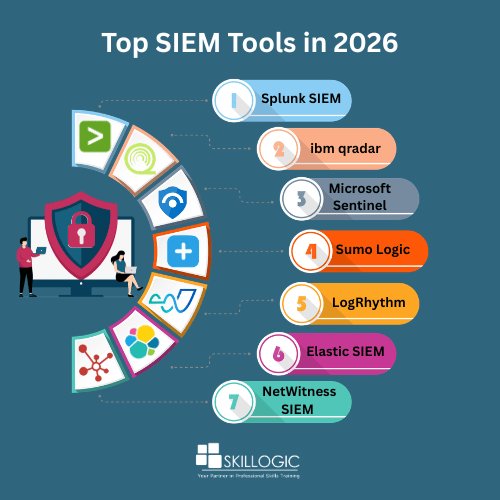
Top SIEM Tools in 2026
Security Information and Event Management (SIEM) tools have become essential for organizations aiming to detect, analyze, and respond to cyber threats in real time. In 2026, SIEM platforms are no longer just log management systems they are intelligent security hubs powered by AI, automation, and cloud-native capabilities.
Instead of simply listing tools, it is important to understand how each SIEM solution performs in real-world scenarios, what makes it unique, and where it fits best.
1. Splunk Enterprise Security
Overview:
Splunk remains one of the most widely adopted SIEM solutions due to its powerful data analytics engine and ability to scale across large environments.
Best For:
Large enterprises handling massive volumes of data
Key Strengths:
- Advanced search and correlation capabilities
- Real-time threat detection
- Highly scalable architecture
Real-World Use Case:
An e-commerce platform processes millions of transactions daily. Splunk analyzes logs in real time to identify suspicious purchase patterns and prevent fraud before it impacts customers.
2. IBM QRadar
Overview:
IBM QRadar is known for its strong threat intelligence integration and risk-based alert prioritization, helping security teams focus on critical threats.
Best For:
Organizations requiring deep visibility into network activity and user behavior
Key Strengths:
- AI-driven threat detection
- User behavior analytics (UBA)
- Integrated threat intelligence feeds
Real-World Use Case:
A telecom company uses QRadar to monitor employee activities and detect insider threats by identifying unusual access patterns and behavior anomalies.
3. Microsoft Sentinel
Overview:
Microsoft Sentinel is a cloud-native SIEM built on Azure, designed for modern, cloud-first environments.
Best For:
Organizations operating in cloud ecosystems, especially Microsoft Azure users
Key Strengths:
- Seamless integration with Microsoft services
- Scalable cloud infrastructure
- Built-in automation and orchestration
Real-World Use Case:
A startup running entirely on Azure uses Microsoft Sentinel to monitor login activities globally. It quickly flags suspicious login attempts from unusual locations and triggers automated responses.
4. Sumo Logic
Overview:
Sumo Logic is a cloud-based SIEM platform designed for modern DevOps and cloud-native teams.
Best For:
DevOps teams and cloud-centric organizations
Key Strengths:
- Real-time monitoring and analytics
- Machine learning-based anomaly detection
- Easy deployment and scalability
Real-World Use Case:
A SaaS company uses Sumo Logic to continuously monitor application logs. The system automatically detects anomalies in traffic patterns and alerts the team before performance or security issues escalate.
5. LogRhythm SIEM
Overview:
LogRhythm stands out for its focus on automation and integrated response capabilities, helping reduce manual intervention in security operations.
Best For:
Organizations aiming to automate their security workflows
Key Strengths:
- Built-in incident response automation
- Centralized visibility
- Reduced response time
Real-World Use Case:
A financial services firm uses LogRhythm to automatically respond to suspicious login attempts by triggering account lockdowns and alerting the security team instantly.
6. Elastic Security (Elastic SIEM)
Overview:
Elastic SIEM, part of the Elastic Stack, is an open-source solution that offers high flexibility and customization.
Best For:
Developers and technical teams seeking cost-effective SIEM solutions
Key Strengths:
- Open-source and customizable
- Powerful search and visualization tools
- Cost-efficient for scaling
Real-World Use Case:
A tech startup builds a customized SIEM solution using Elastic to monitor infrastructure logs and create tailored dashboards for threat detection.
7. RSA NetWitness Platform
Overview:
NetWitness SIEM focuses heavily on deep threat detection, investigation, and forensic analysis.
Best For:
Organizations dealing with advanced persistent threats (APTs)
Key Strengths:
- Deep packet inspection
- Advanced forensic capabilities
- Full visibility across networks and endpoints
Real-World Use Case:
A cybersecurity team uses NetWitness to investigate a sophisticated attack. The platform provides detailed context, helping analysts trace the attack path and identify the root cause.
Refer to these articles:
- How to Become a Cyber Security Analyst in 2026
- Autonomous SOC Explained: The Future of Intelligent Security Operations
- Top 10 Cybersecurity Tools for Small Businesses on a Budget
Top Benefits of SIEM Tools for Cybersecurity
Security Information and Event Management (SIEM) tools have become essential for modern organizations to protect their IT infrastructure. Leveraging SIEM tools offers several key benefits that enhance cybersecurity operations, streamline threat detection, and simplify compliance processes.
1. Centralized Visibility Across the Network
SIEM tools provide centralized visibility, collecting and consolidating security data from multiple sources, including servers, endpoints, applications, and network devices. This unified view allows security teams to monitor the entire IT environment efficiently, detect anomalies faster, and maintain a stronger security posture.
2. Faster Threat Detection and Response
With real-time monitoring and alerts, SIEM tools enable rapid identification of potential security threats. Security analysts can respond immediately to incidents, minimizing damage and reducing the risk of data breaches. The ability to detect threats quickly is crucial in today’s fast-evolving cyber threat landscape.
3. Enhanced Decision-Making with Context-Rich Insights
Modern SIEM solutions provide context-rich insights, allowing analysts to understand the severity and impact of security incidents. By correlating events and highlighting actionable intelligence, SIEM tools empower decision-makers to act decisively and prioritize critical threats over minor issues.
4. Simplified Compliance and Audit Support
Many industries require adherence to regulatory standards such as GDPR, HIPAA, or PCI DSS. SIEM tools simplify compliance by automatically generating detailed audit reports, tracking user activity, and maintaining logs. This reduces the time and effort needed to meet regulatory requirements.
5. Reduced Alert Fatigue and Noise
Traditional security systems often overwhelm analysts with excessive alerts. Modern SIEM tools focus on meaningful, high-priority alerts, filtering out unnecessary noise. This allows security teams to concentrate on genuine threats and respond more effectively, improving overall operational efficiency.
How to Choose the Right SIEM Tool for Your Organization
Selecting the right SIEM (Security Information and Event Management) tool is crucial for enhancing your organization’s cybersecurity posture. With multiple SIEM solutions available, making the right choice requires careful evaluation of your organization’s unique needs. Here’s a guide to help you choose the best SIEM tool.
1. Consider Your Organization Size
The size of your organization plays a key role in determining which SIEM solution is suitable. Small to medium-sized businesses may benefit from lightweight, easy-to-deploy SIEM tools, while large enterprises may require robust solutions with advanced analytics and scalable architecture.
2. Cloud vs On-Premise Infrastructure
Evaluate whether your IT infrastructure is primarily cloud-based, on-premise, or hybrid. Some SIEM tools are optimized for cloud environments, offering easier scalability and lower maintenance, while others are designed for on-premise deployments with more control over data storage.
3. Budget Considerations
SIEM solutions vary significantly in cost, depending on features, scalability, and licensing models. Define your budget early and compare options to ensure you get the best value for investment without compromising critical security features.
4. Integration Capabilities
Your SIEM tool should seamlessly integrate with your existing IT and security infrastructure, including firewalls, endpoints, cloud services, and applications. Strong integration capabilities enable real-time monitoring, automated alerts, and efficient incident response.
5. Ease of Use
A user-friendly SIEM interface with intuitive dashboards, reporting, and alert management can significantly improve operational efficiency. Consider tools that offer easy deployment, simplified configuration, and actionable insights for your security team.
Refer to these articles:
- Post-Quantum Cryptography (PQC) Explained: A Roadmap to Quantum-Safe Security
- Why Your Cloud Misconfigurations Are a Bigger Risk Than Any Hacker
- Cybersecurity and Geopolitics: Understanding the Global Digital Battlefield
SIEM tools have become the backbone of modern cybersecurity strategies. In 2026, they are no longer just log collectors; they are intelligent systems that help organizations detect, analyze, and respond to threats in real time.
With cyberattacks becoming faster and more sophisticated, investing in the right SIEM solution is not optional it is essential.
Organizations that adopt modern SIEM tools gain not just visibility, but control over their entire security landscape.
At SKILLOGIC Institute, we are committed to empowering professionals with the latest skills in cybersecurity. Our Cyber Security Course in Hyderabad is designed to provide hands-on training and industry-relevant knowledge, ensuring you stay ahead in today’s dynamic digital world.
With expert instructors and practical labs, SKILLOGIC helps you build a strong foundation in cybersecurity and prepares you for real-world challenges.



0
4