
Jaya Krishna’s Journey from Fresher to SOC Analyst
Explore Jaya Krishna’s inspiring journey from a fresher to a SOC Analyst at Necurity Solutions, highlighting his cyber security training, hands-on practice, interview experience, and practical advice for aspiring professionals.
 Aiswarya N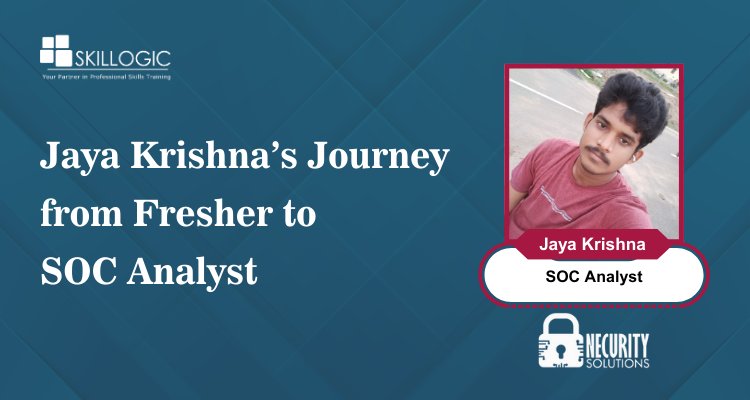
Jaya Krishna’s journey into cyber security stands as a strong example of clarity, consistency, and hands-on learning. Coming from an engineering background in Computer Science, he developed an early interest in cyber security during his academic years by exploring multiple technical domains, including networking, operating systems, and security fundamentals. His curiosity about red team and blue team concepts eventually led him to focus on SOC operations as a long-term career path.
To strengthen his skills, Jaya Krishna pursued structured cyber security training with SKILLOGIC in Chennai, where he combined classroom learning with extensive daily practice on real-world labs and security platforms. By consistently dedicating additional hours to hands-on practice, completing network scanning and security projects, and actively clarifying doubts with trainers, he built a solid technical foundation. With continuous mentorship and placement guidance, Jaya Krishna successfully transitioned from a fresher to securing his first role as a SOC Analyst at Necurity Solutions.
Here, he shares his learning experience, interview journey, and practical advice for aspiring cyber security professionals aiming to enter the SOC domain.
Refer these articles:
- Tarun’s Road to Becoming a Cyber Security Engineer
- Anurag's Journey: From Fresher to Cyber Security Engineer
- Vijay’s Journey: From Fresher to Technical Support Engineer
From Fresher to SOC Analyst: Jaya Krishna’s Cyber Security Journey
In this section, Jaya Krishna shares his educational background, cyber security training experience, hands-on practice, interview journey, and career transition into SOC operations.
His story highlights the importance of strong fundamentals, consistent practice, and mentorship in building a successful cyber security career from scratch.
Q1: Can you introduce yourself and your educational background?
My name is Jaya Krishna, and I am from Andhra Pradesh. I completed my B.Tech in Computer Science and Engineering from R&D Engineering College. During my graduation, I explored multiple technical domains, but I gradually developed a strong interest in cyber security, which later became my career focus.
Q2: When did your interest in cyber security begin?
My interest in cyber security started during my engineering days when I learned about red team and blue team concepts. Initially, I explored web technologies and networking, along with operating systems and Linux. As I strengthened my fundamentals, I realized that blue team roles, especially SOC operations, aligned well with my interests. That clarity helped me shift my focus toward becoming a SOC Analyst.
Q3: How did you come to know about SKILLOGIC and why did you choose it?
I came to know about SKILLOGIC through a friend who had already joined the institute. He shared his learning experience and explained how effectively the concepts were taught. Based on his feedback and progress, I decided to join SKILLOGIC as an offline student in Chennai to gain hands-on cyber security training.
Q4: How was your learning experience at SKILLOGIC?
When I joined SKILLOGIC, I did not have deep knowledge of cyber security tools or processes. However, the teaching methodology was very practical and structured. The trainers explained concepts clearly and focused strongly on fundamentals. Whenever I had doubts, I could approach the trainer without hesitation, and they patiently clarified concepts until I fully understood them.
Q5: How much time did you dedicate to practice outside class hours?
Apart from the daily two-hour classroom sessions, I consistently spent an additional two to three hours practicing. I worked on platforms like TryHackMe and Hack The Box to reinforce what was taught in class. This daily practice helped me build confidence and retain concepts effectively.
Q6: How did you handle doubts or difficulties during the course?
Whenever I faced any difficulty, I noted it down and asked the trainer the very next day. Even if I did not understand the explanation initially, I asked again. The trainers were very supportive and explained concepts repeatedly without any frustration, which helped me learn better.
Q7: Did you work on any projects or internships during your learning phase?
Yes, I worked on projects such as advanced network scanning, where I analyzed IP addresses, port numbers, and protocols using scanning tools. Additionally, during my college days, I completed multiple internships in web development, machine learning, data-related domains, and cyber safety. Out of these, cyber safety internships played a major role in shaping my interest in cyber security.
Q8: How was the support from the SKILLOGIC placement team?
The placement team provided clear guidance. They emphasized the importance of strong fundamentals and continuous practice. They advised me to focus on projects, daily revision, and hands-on learning rather than rushing toward placements. Their guidance helped me stay disciplined and job-ready.
Q9: Can you describe your SOC Analyst interview experience?
The interview process consisted of two rounds, lasting around 20 to 30 minutes in total. The interviewers appreciated my resume and mentioned that it made a strong first impression. Most questions were based on my interests, projects, and why I chose SOC operations. They also asked me to explain the projects I had worked on in detail.
Q10: What is your advice for creating a strong resume for cyber security roles?
A resume should only include skills and technologies that you genuinely know. Adding irrelevant or unfamiliar topics can backfire during interviews. Internships, certifications, and projects relevant to the target role should be clearly highlighted. A well-structured and honest resume creates a strong first impression.
Q11: How important is attending multiple interviews for freshers?
Attending multiple interviews is extremely important, especially for freshers. It helps reduce fear, improves communication skills, and builds confidence. With each interview, you understand the type of questions asked and learn how to present yourself better. This experience is valuable regardless of the domain.
Q12: What advice would you give to someone planning to enter cyber security?
The first step is to create a clear plan and choose a specific domain based on genuine interest. Cyber security is vast, and switching domains frequently can lead to confusion. Strong fundamentals in networking, operating systems, and Linux are essential. Consistent daily study of two to four hours is sufficient if done with discipline and interest.
Q13: Do you believe long study hours are necessary for success?
In my experience, studying eight to nine hours a day is not necessary. If you are genuinely interested in a domain, consistent daily effort of a few focused hours is enough to grow and succeed.
Q14: What are your future goals as a SOC Analyst?
This is just the beginning of my career. I plan to continue learning, improving my skills, and growing within the cyber security domain. Continuous learning and regular practice are essential to stay relevant and progress in this field.
Refer these articles:
- Cyber Security in India: What You Need to Know
- How to Become a Cyber Security Expert in India
- Cyber Security Scope in India
Key Takeaways from Jaya Krishna’s Cyber Security Journey
Jaya Krishna’s transition from a fresher to a SOC Analyst at Necurity Solutions demonstrates how clarity of goals, disciplined practice, and strong mentorship can accelerate a cyber security career. Below are the key insights drawn from his journey with SKILLOGIC and his interview experience.
- Strong Technical Foundation: Jaya Krishna built his interest in cyber security during his B.Tech in Computer Science, focusing early on networking, operating systems, Linux, and core security fundamentals.
- Clear Domain Selection: After exploring red team and blue team concepts, he consciously chose SOC operations, ensuring he did not lose focus by switching domains midway.
- Choosing the Right Training Institute: He joined SKILLOGIC based on a trusted referral and opted for offline training in Chennai to gain deeper hands-on exposure and classroom interaction.
- Consistent Hands-On Practice: Beyond daily classes, he dedicated two to three hours every day to practicing on platforms like TryHackMe and Hack The Box, reinforcing theoretical learning with real-world labs.
- Supportive Learning Environment: Regular doubt-clearing sessions and approachable trainers helped him strengthen weak areas without hesitation, contributing significantly to his confidence.
- Project and Internship Exposure: His experience with network scanning projects and multiple internships during college, especially in cyber safety, helped him understand practical security operations.
- Placement and Interview Readiness: Guidance from the SKILLOGIC placement team on fundamentals, projects, and interview preparation enabled him to perform confidently in interviews and secure his first SOC Analyst role.
- Practical Resume Strategy: Jaya Krishna emphasizes listing only genuine skills, relevant projects, and internships on the resume to create a strong and honest first impression.
In short, Jaya Krishna’s journey from a fresher to a SOC Analyst at Necurity Solutions shows that with focused learning, consistent hands-on practice, and the right mentorship, even those without prior industry experience can successfully enter the cyber security field.
His experience at SKILLOGIC, from practical training and real-world projects to placement guidance and interview preparation, highlights how discipline and structured support can turn career goals into reality.
Refer these articles:
- Why Cyber Security Career in Nashik
- How to Become a Cyber Security Expert in Nashik
- How to Launch Your Cyber Security Engineer Career in Nashik
The global cyber security market continues to expand rapidly, with research projecting that the industry’s value will grow from around USD 193.7 billion in 2024 to approximately USD 562.7 billion by 2032 as reported by Fortune Business Insights, supported by strong adoption of enterprise security solutions and rising digital threats worldwide.
Whether you are starting your journey in cyber security or planning to upgrade your skills for advanced career opportunities, enrolling in a best cyber security institute in Surat can be a smart and future-focused choice.
SKILLOGIC is recognized as one of the leading cyber security institutes in India, known for delivering industry-aligned and career-oriented training programs. Its cyber security courses are designed to bridge the gap between academic knowledge and real-world application through expert-led instruction, practical labs, and scenario-based learning. With training centers in major cities such as Bangalore, Hyderabad, Chennai, Pune, Delhi, Ahmedabad, Coimbatore, and Nagpur, SKILLOGIC maintains consistent training standards and learning quality across India.
The Cyber Security Professional Plus course from SKILLOGIC is accredited by NASSCOM FutureSkills and IIFIS and is delivered by experienced industry practitioners. The curriculum covers essential domains including ethical hacking, network security, penetration testing, and cyber risk management, ensuring learners gain comprehensive technical expertise. Participants also benefit from hands-on labs, globally recognized certifications, flexible learning options, and dedicated placement assistance.
With over one lakh professionals trained nationwide, SKILLOGIC continues to play a key role in developing future-ready cyber security talent. Among professional cyber security institutes in Nashik, SKILLOGIC stands out as a reliable choice, offering structured learning and strong industry exposure within the city’s expanding technology ecosystem.


0
71