
From HR Executive to Cyber Security Researcher: Indhu's Journey
Discover how Indhu transitioned from an HR Executive to a Cyber Security Researcher through practical training, real-world projects, and continuous learning.
 Nashid Hussain CN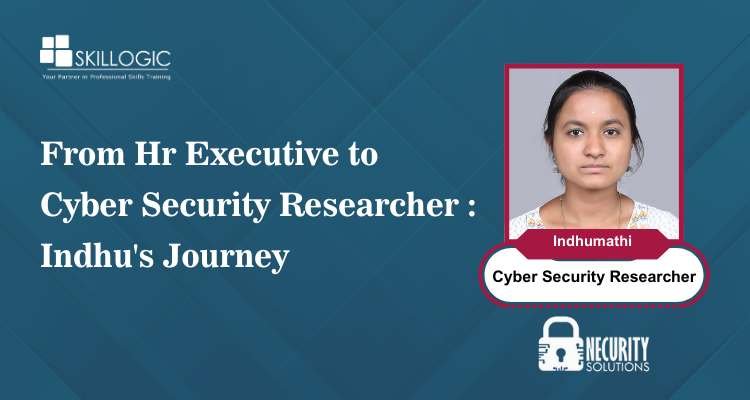
With the growing number of cyber threats and data breaches, cyber security has become a promising and future-ready career option. Many professionals from non-technical backgrounds are now successfully entering this field through the right training, practical exposure, and consistent learning.
This article highlights the journey of Indhu, who transitioned from an HR background into cyber security after completing professional training at SKILLOGIC. Today, she works as a Cyber Security Researcher at Necurity Solutions, contributing to real-world security challenges.
Let’s explore her career transition, learning experience, and key insights that led to her success in cyber security.
Indhu’s Transition from Cyber Security Training to Cyber Security Researcher
In this section, Indhu’s career journey shows how structured cyber security training at SKILLOGIC helped her successfully transition from a non-technical background into the cyber security industry. Through hands-on practice, real-time security labs, and continuous learning, she built strong skills in threat analysis and security fundamentals, which she now applies in her role as a Cyber Security Researcher at Necurity Solutions, confidently handling real-world cyber security challenges.
Refer these articles:
- From Fresher to SOC Analyst: Bhuvanesh’s Inspiring Journey
- Arasu’s Journey: From Fresher to SOC Analyst
- Tarun’s Road to Becoming a Cyber Security Engineer
Q1. Can you briefly introduce yourself and your background?
I completed my Bachelor’s degree from Madras University in a corporate-related field. After graduation, I worked as an HR Executive for 1.6 years in an organization. Alongside my job, I completed my MBA in HR through distance education. My academic and professional background was completely non-technical.
Q2. What made you choose cyber security despite being from an HR background?
My interest in cyber security started when I came across multiple news reports about data breaches and user information leaks happening globally. I became curious about how these attacks occur and how they can be prevented. This personal interest motivated me to explore cyber security seriously and build a career in this field.
Q3. Why did you choose SKILLOGIC for cyber security training?
I chose SKILLOGIC because of its strong reputation in cyber security training and its focus on hands-on learning. The course structure was beginner-friendly, especially for someone like me from a non-IT background.
Q4. Was your cyber security course online or offline? Which location?
I completed my training in offline classroom mode at the SKILLOGIC Chennai center. The classroom learning experience helped me interact directly with trainers and clear doubts instantly.
Q5. How was your learning experience as a non-technical learner?
Initially, it was challenging, but the trainers started with basic concepts and explained everything clearly. The teaching was a good mix of theory and practical sessions. Every day, we were given tasks and hands-on exercises, which made learning interesting and effective.
Q6. How much time did you spend practicing after classes?
Classes were around 2 hours daily, and I spent about 4 additional hours practicing after class. I also revised the topics again in the morning. This extra effort helped me understand technical concepts better.
Q7. Did the trainers support you when you faced difficulties?
Yes, absolutely. Whenever I had doubts or got stuck, the technical trainers were very supportive. They guided me step by step and helped me reach the right solution.
Q8. Did you work on any projects during the course?
Yes, SKILLOGIC provided a project. I worked on a basic Python-based malware scanner project. The idea was to analyze malicious files and help users detect malware, similar to how malware protection tools work.
Q9. Did you complete any internships after the course?
Yes. I completed an internship with Broad Infotech without wasting time after the course. By the end of that month, I also secured an opportunity in a security solutions company, which helped me gain real-world exposure.
Q10. How was the placement support from SKILLOGIC?
SKILLOGIC provided strong placement assistance. I shared my resume with them, attended interviews arranged by the placement team, and received guidance throughout the process.
Q11. Can you describe your interview experience?
The interview had two rounds:
- Technical round (around 20 minutes): Questions were mainly from basic cyber security concepts and my project work.
- HR round: Focused on background and career transition.
All questions were relevant to what was taught during the SKILLOGIC course, so no extra preparation was required.
Q12. What advice would you give to non-technical learners who want to enter cyber security?
If you are from a non-technical background, you need to put in extra effort, but it is completely possible. I spent more time practicing because I had more to learn compared to IT graduates. Consistency and daily practice are the keys. If you are willing to work harder, cyber security is achievable.
Refer these articles:
- Why SKILLOGIC for Cyber Security Courses in Bangalore
- How much is the Cyber Security Course Fees in Bangalore
- How to Become a Cyber Security Expert in Hyderabad
- How to Choose Best Institute for Cyber Security in Hyderabad
Key Insights from Indhu’s Cyber Security Career Journey
To help aspiring cyber security professionals learn from Indhu’s experience, here are the key takeaways that made her transition from an HR background to a Cyber Security Researcher successful.
- Background does not limit growth: Indhu’s non-technical and HR background did not stop her from building a strong career in cyber security with the right training.
- Personal interest drives learning: Her curiosity about data breaches and cyber threats motivated her to explore cyber security seriously.
- Right training makes the difference: Choosing SKILLOGIC helped her gain structured learning, expert guidance, and industry-relevant exposure.
- Hands-on practice is essential: Daily lab work, practical tasks, and real-time exercises helped her understand cyber security concepts clearly.
- Trainer support builds confidence: Continuous guidance from experienced trainers helped her overcome challenges and clear doubts easily.
- Projects improve practical skills: Working on a Python-based malware analysis project strengthened her technical understanding and interview readiness.
- Internships add real-world exposure: Completing internships helped her apply classroom knowledge to real security scenarios.
- Interview preparation matters: Placement support and interview guidance helped her perform confidently in technical and HR interview rounds.
- Consistency leads to success: Spending extra hours practicing after class played a major role in her learning progress.
- Career change is achievable: Indhu’s journey proves that with dedication, hands-on training, and guidance, even non-technical professionals can succeed in cyber security.
By following these insights, learners can confidently plan their cyber security career path and develop the practical skills needed to succeed in today’s evolving threat landscape.
In short, Indhu’s career journey clearly shows that a successful transition into cyber security is possible even from a non-technical background. With structured training at SKILLOGIC, hands-on practice, and continuous learning, she built the confidence and skills needed for a real-world role. Today, as a Cyber Security Researcher at Necurity Solutions, she applies her knowledge to tackle practical security challenges. Her story serves as strong motivation for aspiring learners to stay consistent, practice regularly, and choose the right training path in cyber security.
According to The Times of India, India recorded over 265 million cyberattacks in 2025, highlighting a rapidly growing threat landscape. This surge in cyber threats has created immense demand for skilled professionals in the field. Indhu’s success story exemplifies this, as her training at a leading cyber security institute in India equipped her with the hands-on skills needed to excel as a SOC analyst. Her journey shows how the right guidance and practical experience can transform rising cyber risks into rewarding career opportunities.
If you are planning to enter the cyber security field, enrolling in the right cyber security courses in India and focusing on practical skills, real-world projects, and consistent practice will prepare you for a successful career in this fast-growing industry.
SKILLOGIC offers comprehensive Cyber Security Training, including the ethical hacking course in Bangalore, covering topics like SOC operations, network security, ethical hacking, threat detection, and vulnerability management. The 4-month program provides over 200 hours of learning, hands-on labs, real-time projects, and prepares students for global certifications such as NASSCOM FutureSkills and IIFIS. This practical approach equips learners with the skills and confidence needed to enter the cyber security industry.
The training program also includes key areas such as penetration testing, malware analysis, SIEM tools, IDS/IPS management, and compliance standards. With ethical hacking training in Hyderabad and branches across India including Pune, Mumbai, Coimbatore, Kochi, Ahmedabad, and Chennai SKILLOGIC provides expert guidance and practical exposure to help learners succeed. After completing the course, learners are ready for roles such as SOC Analyst, Security Consultant, Penetration Tester, or Cyber Security Engineer, with strong placement support to launch a thriving career in cyber security.

0
55