
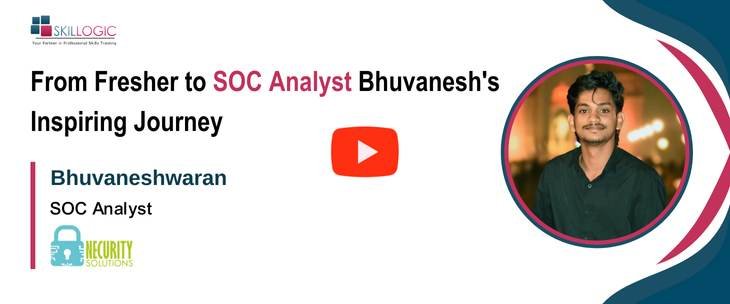
From Fresher to SOC Analyst: Bhuvanesh’s Inspiring Journey
Discover Bhuvanesh’s inspiring journey from a Computer Science fresher to a SOC Analyst. Learn how structured training, hands-on projects, and interview preparation helped him launch a successful career in cyber security.
 Aiswarya N
Bhuvanesh’s journey into cyber security is an inspiring example of how focus, guidance, and consistent effort can help a fresher successfully enter a highly competitive domain. Coming from a Computer Science background, he developed an early interest in cyber security through exposure within his family, which motivated him to explore the field in depth and build a career around it.
After completing his formal education, Bhuvanesh strengthened his technical foundation through structured cyber security training, hands-on practice, and real-time project work. With continuous mentor support and dedicated self-learning, he gained confidence in core security concepts and tools. With the right training and placement assistance from SKILLOGIC, Bhuvanesh successfully cleared interviews and secured his first role as a SOC Analyst at Necurity Solutions.
In this journey, he shares his experience, lessons learned, and practical insights for freshers aspiring to break into the cyber security industry.
Refer these articles:
- Tarun’s Road to Becoming a Cyber Security Engineer
- Anurag's Journey: From Fresher to Cyber Security Engineer
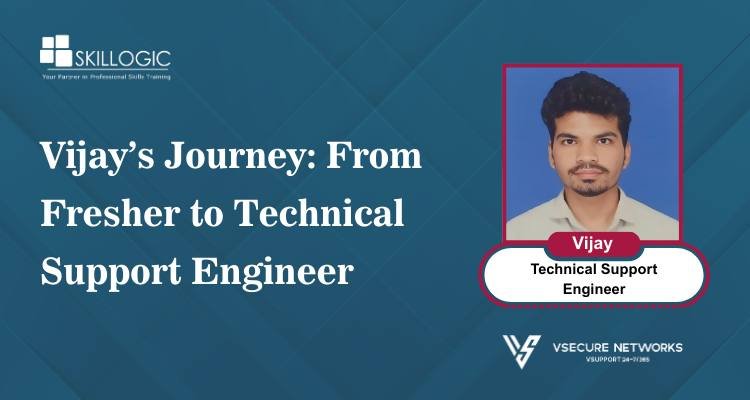
- Vijay’s Journey: From Fresher to Technical Support Engineer
Bhuvanesh’s Journey from Fresher to SOC Analyst
Here’s a brief look at Bhuvanesh’s journey into cyber security, highlighting how his education, training at SKILLOGIC, practical projects, and interview experience helped him secure his first role as a SOC Analyst:
Q1. Can you introduce yourself and share your educational background?
My name is Bhuvanesh, and I am from Dallur. I recently completed my Bachelor’s degree in Computer Science from Hindu College in 2025. As a fresher, I was keen to build a career in a technology-driven domain, which led me toward cyber security.
Q2. What motivated you to choose cyber security as a career path?
My interest in cyber security was influenced by my brother, who is already working in this field. Through him, I became aware of the importance of monitoring, threat analysis, and protecting systems from cyber attacks. This exposure helped me understand that cyber security is a critical and growing domain.
Q3. Where did you pursue your cyber security training and in which mode?
I completed my cyber security training through SKILLOGIC Institute. I belonged to the June batch and attended offline classes at the institute. The structured learning environment helped me stay focused and consistent.
Q4. How was your learning experience during the cyber security course?
The learning experience was very good. The mentors explained concepts clearly, starting from cyber security fundamentals and gradually moving to practical tools. Each session combined theory with hands-on practice, which helped me understand how tools work in real-world scenarios.
Q5. How much time did you dedicate to practice outside of class hours?
Apart from the regular classes, I spent one to two extra hours every day revising concepts and practicing the cyber security tools that were taught during the sessions. This additional practice helped me strengthen my understanding.
Q6. How supportive were the mentors when you faced doubts or challenges?
The mentors were very supportive. They encouraged us to ask questions at any time, and whenever I had doubts, they were clarified immediately. This continuous support played a key role in my learning journey.
Q7. Can you describe your internship experience and project work?
During my internship, I worked on a cipher encryption and decryption project along with a steganography project. In the encryption project, I focused on converting human-readable text into non-readable formats using symmetric key concepts. The internship allowed me to apply theoretical knowledge practically.
Q8. Did you receive guidance while working on your projects?
Yes, I received full support from the team while working on my projects. The mentors guided me whenever I faced difficulties and ensured I stayed on the right track throughout the project phase.
Q9. How was the placement support provided by the institute?
The placement team provided regular updates about job openings and application status. They stayed in touch consistently and guided me through the placement process, which helped reduce uncertainty during job applications.
Q9. What was your interview experience like for your current role?
The interview was face-to-face and lasted around 15 to 25 minutes. The interviewer asked me to introduce myself and questioned me on basic concepts such as the difference between Nmap and Zenmap, VPN, IP addresses, and other networking fundamentals. The questions were mostly focused on core concepts.
Q10. How many interviews did you attend before getting selected?
I attended three interviews in total. While I did not get selected in the first two, each interview helped me understand where I needed improvement, especially in communication skills and English speaking.
Q11. What were your key learnings from attending multiple interviews?
The biggest learning was the importance of communication skills along with technical knowledge. Each interview experience helped me become more confident and prepared for the next opportunity.
Q12. How do you feel about starting your career as a SOC Analyst?
I am very happy and confident about starting my career in cyber security. This is my first job, and I am grateful for the support from my trainers, mentors, and placement team. I am motivated to continue learning and growing in this field.
Q13. What advice would you give to freshers entering cyber security?
Freshers should stay consistent with learning, practice regularly, and focus on improving both technical and communication skills. With the right guidance and dedication, it is possible to build a successful career in cyber security.
Refer these articles:
- Why Cyber Security Career in Trivandrum
- How to Build a Career as a Cyber Security Engineer in Trivandrum
Key Highlights from Bhuvanesh’s Cyber Security Journey
Bhuvanesh’s journey demonstrates how a fresher can successfully enter the cyber security field with the right mix of education, training, and persistence. His experience with SKILLOGIC reflects several important factors that contributed to his early career success.
- Strong academic foundation: Coming from a Computer Science background, Bhuvanesh already had exposure to core technical concepts, which made it easier for him to understand networking and cyber security fundamentals.
- Structured training: The well-organized curriculum helped him progress from basic cyber security concepts to practical tools, ensuring a clear and logical learning path.
- Balanced theory and hands-on learning: Each session combined conceptual explanations with real-time tool usage, enabling him to understand how cyber security works in real-world scenarios.
- Consistent self-practice: By spending one to two extra hours daily revising concepts and practicing tools, Bhuvanesh strengthened his technical confidence and retention.
- Strong mentor support: Continuous guidance from mentors, along with immediate doubt resolution, played a crucial role in overcoming learning challenges.
- Practical internship projects: Working on cipher encryption, decryption, and steganography projects allowed him to apply theoretical knowledge and gain hands-on experience.
- Placement assistance and follow-ups: Regular communication from the placement team regarding job openings and application status helped him stay focused and prepared during the job search.
- Interview learning and improvement: Attending multiple interviews helped him recognize the importance of communication skills alongside technical knowledge, leading to improved performance.
- Successful career start: With structured training, practical exposure, and consistent effort, Bhuvanesh secured his first role as a SOC Analyst, marking a strong beginning to his cyber security career.
Bhuvanesh’s journey highlights how a fresher can successfully build a career in cyber security through structured learning, hands-on practice, and continuous self-improvement. With strong mentor support, practical project exposure, and dedicated preparation, he transformed his academic foundation into a professional role as a SOC Analyst.
His story highlights the importance of choosing cyber security out of genuine interest, maintaining consistency in learning, and effectively utilizing mentorship and placement support.
Refer these articles:
- Cyber Security in India: What You Need to Know
- How to Become a Cyber Security Expert in India
- Cyber Security Scope in India
For individuals planning to transition into the cyber security field, Bhuvanesh’s journey shows that success is attainable with the right attitude, focused learning, and structured training. According to Grand View Research, the global cyber security market is projected to reach USD 500.7 billion by 2030, making it one of the fastest-growing technology domains. Enrolling in a cyber security institute provides a strong foundation to enter this expanding industry through industry-relevant academic programs and hands-on certification courses aligned with evolving market needs.
Whether you are beginning your career in cyber security or looking to upskill for better opportunities, enrolling in the best cyber security institutes in Thane is a practical and strategic decision. As a rapidly growing IT and business hub within the Mumbai Metropolitan Region, Thane hosts numerous IT companies, financial institutions, startups, and digital enterprises that are driving demand for skilled cyber security professionals. With access to quality training, industry exposure, and real-world project experience, Thane offers an ideal environment to build hands-on expertise and accelerate career growth in cyber security.
SKILLOGIC is one of the best cyber security institutes in India, renowned for providing practical, career-oriented programs tailored to current industry requirements. Its cyber security course is structured to equip learners with real-world skills through expert-led training, hands-on labs, and scenario-based simulations. With training centers across major cities including Bangalore, Hyderabad, Chennai, Pune, Delhi, Ahmedabad, Coimbatore and Nagpur, SKILLOGIC ensures consistent and high-quality learning experiences nationwide.
The Cyber Security Professional Plus course from SKILLOGIC, accredited by NASSCOM FutureSkills and IIFIS, is taught by more than 100 seasoned industry experts and covers key domains including ethical hacking, network security, penetration testing, and cyber risk management. Learners benefit from practical labs, globally recognized certifications, flexible learning formats, and comprehensive placement support.
Having trained over one lakh professionals across India, SKILLOGIC continues to equip learners with future-ready cyber security skills. Among the professional cyber security institutes in Trivandrum, SKILLOGIC stands out within the city’s growing technology ecosystem as a trusted destination for building a strong and sustainable career in cyber security.
0
106